


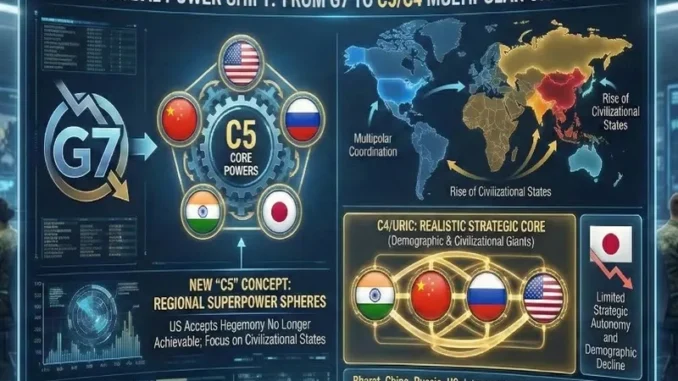
ENB Pub Note: This article from the Andrew Korybko Substack parallels what Stu Turley has been talking about on the Energy News Beat podcast: the realignment of global trading blocs. We are seeing a shift from the United States supporting the EU and the UK unconditionally to the United States doing business with other nations that are focused on financial growth and realistic energy policies. The realignment of Net Zero and deindustrialization nations, or those that follow more of the all of the above energy policies without subsidies and fiscal responsibility. Japan has endured 40 years of horrific fiscal policies, and now, with an estimated debt-to-GDP ratio of 230%, it is the weak link in the group. The new trading blocs that Stu Turley has discussed have been India, Russia, Saudi Arabia, Japan, and the United States. We recommend following and subscribing to Andrew’s Substack.
Regular consultations between the US, China, Russia, India, and Japan on the emerging world order would help jointly manage issues as they arise and therefore reduce the chances of uncontrollable systemic instability during this sensitive moment when one wrong move could unleash global chaos.
Defense One was the first to report on the supposed existence of a “Core 5” (C5) proposal in the allegedly classified version of the US’ new National Security Strategy. It would comprise the US, China, Russia, India, and Japan, who’d regularly meet to discuss issues of global significance. The EU would conspicuously be excluded, presumably because the US finally realized that it’s now an ideologically driven organization that revels in grandstanding and rarely gets anything of importance done nowadays.
Russian philosopher Alexander Dugin assessed that India would balance between the C5’s de facto Sino-Russo and US-Japanese factions for facilitating tangible progress on the issues that they’d address. About them, Defense One reported that the first point on their agenda would be “Middle East security—specifically, normalizing relations between Israel and Saudi Arabia.” Economic, financial, and other geopolitical issues would likely end up on the table of this Asian-centric unofficial UNSC too with time.
This segues into the purpose of the C5 proposal, namely to reform Global Governance in a practical way keeping in mind Asia’s rising role therein and the UNSC’s limitations brought about by its permanent members’ veto power. Expanding the number of permanent members would simply extend the UNSC’s working sessions to give everyone the chance to speak while exacerbating the group’s dysfunction if new permanent members also receive veto power (whether right away or after some time).
Moreover, Russia won’t agree to World War II’s German and Japanese losers joining as permanent members while China won’t agree to its historical Japanese enemy nor long-time Indian rival joining either, so the C5’s inclusion of Japan and India is a way to informally involve them in Global Governance. Excluding Germany and the rest of Europe is meant to signal that the US is serious about getting things done as well as massage the Asian members’ egos by reinforcing the notion of an Asian Century.
Given the C5’s intended function as an Asian-centric unofficial UNSC, its responsibilities wouldn’t conflict with BRICS’, the G7’s, or the G20’s but complement them by setting their respective agendas. To get to the point where this reported proposal becomes politically viable, however, the US must first and foremost enter into a “New Détente” with Russia upon the end of the Ukrainian Conflict, the path to which readers can learn more about from this six-part series here, here, here, here, here, and here.
Other obstacles include US and Japanese sanctions on Russia, the lack of a peace treaty between Russia and Japan for ending their dimension of World War II, new Sino-Japanese tensions over Taiwan, and difficult ties between China, India, and the US. The C5 could only take shape if these are resolved or set aside in the interests of the greater good and only in the event of a Russian-US “New Détente”. If all that happens, which is far from guaranteed and would take time in any case, then Russia stands to benefit.
Politically, Russia would be part of an exclusive club for setting all other international groups’ agendas; economically, it could more easily leverage its resource wealth to receive high technology from the other members, including AI in exchange for letting them set up data centers that would be powered and cooled by its nearly limitless hydroelectric potential; and strategically, Russia would jointly shape the emerging world order. The Alt-Media Community therefore shouldn’t rule out Russia’s participation.
Want to get your story in front of our massive audience? Get a media Kit Here. Please help us help you grow your business in Energy.





Be the first to comment