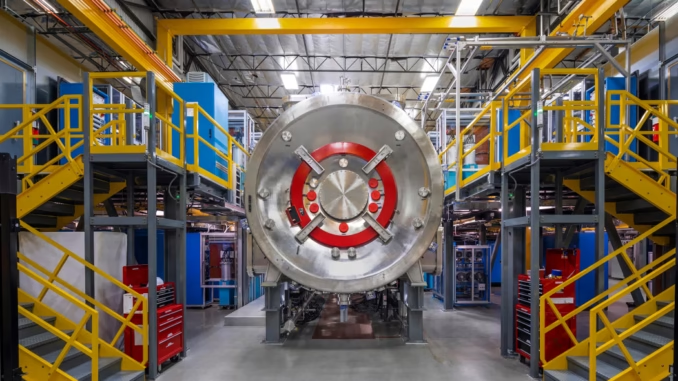
In the quest for sustainable, limitless power, nuclear fusion stands out as the ultimate prize—a technology that mimics the processes powering the sun and stars. Often dubbed the “holy grail” of energy, fusion promises to deliver vast amounts of clean electricity without the environmental pitfalls of fossil fuels or the waste issues plaguing traditional nuclear fission.
By merging light atomic nuclei, such as hydrogen isotopes, fusion releases enormous energy while producing minimal carbon emissions and no long-lived radioactive waste.
Its fuel sources, like deuterium extracted from seawater, are abundant and virtually inexhaustible, offering a path to energy independence and security.
Unlike fission, which splits heavy atoms and risks meltdowns, fusion reactions are inherently safe: if containment fails, the process simply stops.
The energy density is staggering—millions of times greater than chemical reactions in coal or oil—making it ideal for powering everything from cities to spacecraft.
Yet, fusion’s allure comes with formidable challenges. For decades, scientists have struggled to achieve “net energy gain,” where the power output exceeds the input required to sustain the ultra-hot plasma (hundreds of millions of degrees) in magnetic confinement devices.
Recent breakthroughs, such as those at the U.S. National Ignition Facility, have demonstrated net gain on a small scale, but scaling to commercial viability remains elusive.
Trump just acquired “crown jewel” Tri-Alpha Energy.
Why is this important? TAE doesn’t settle for hot fusion, they do cool fusion.
They don’t need Helium 3 from the moon, they use Boron 11 which is common.
Aneutronic fusion means no neutrons aka no heat/radiation. No steam… pic.twitter.com/vueTH3hopq
— Ashton Forbes (@AshtonForbes) December 18, 2025
Energy, Power and Suppression
Every civilisation, without exception, is built on energy. Not ideology, nor money, it’s actually ENERGY that marks the difference between thriving or merely surviving.
Who controls it, who distributes it, who decides its price, and who is allowed… pic.twitter.com/08678lRsRL
— Laura Aboli Official (@LauraAboli_X) December 19, 2025
High costs, complex engineering, and the need for advanced materials to withstand extreme conditions have kept fusion “always 30 years away.” Despite this, optimism is surging, fueled by private investments exceeding $6 billion globally and innovations from startups aiming for commercialization by the 2030s.
Enter President Donald Trump’s media empire, Trump Media & Technology Group (TMTG), which operates Truth Social and trades under the ticker DJT. In a bold pivot announced on December 18, 2025, TMTG revealed a $6 billion all-stock merger with TAE Technologies, a leading nuclear fusion startup.

While we don’t give investment advice, I did buy some options!
This deal positions TMTG as a key player in the fusion race, betting big on TAE’s aneutronic fusion technology. This cleaner variant uses proton-boron reactions to generate electricity directly, without neutrons or significant waste.
TAE, founded in 1998, has raised over $1.3 billion from investors like Google and Chevron, and its approach employs a “field-reversed configuration” with high-beta plasma containment, allowing for compact reactors potentially the size of a large truck.
Why is this a great investment? Fusion’s potential payoff is astronomical. A breakthrough could unlock unlimited, carbon-free energy, slashing global reliance on oil and gas while meeting the skyrocketing demands of AI data centers and electric grids.
TMTG’s shares surged over 30% in premarket trading following the announcement, recovering from a 70% yearly decline and signaling market excitement.
The merger infuses TAE with up to $300 million in cash ($200 million upfront and $100 million later), accelerating its path to a 50 MWe utility-scale fusion plant by mid-2026, pending approvals.
For TMTG, led by CEO Devin Nunes, this diversifies beyond media into high-growth sectors like energy and AI, potentially transforming it into a Berkshire Hathaway-style holding company with subsidiaries in fintech, streaming, and now fusion.
While high-risk—fusion faces scientific hurdles and regulatory scrutiny—the rewards could be transformative, positioning TMTG at the forefront of an “America First” energy revolution.
The technology highlighted in recent discussions, such as a post by researcher Ashton Forbes on X, draws parallels between TAE’s reactors and earlier designs like Lockheed Martin’s Compact Fusion Reactor (CFR). Both utilize high-beta configurations for efficient plasma containment, enabling smaller, more deployable systems. A video shared in the post depicts scientists explaining how such tech could power “next-generation airplanes” with unlimited range and endurance, eliminating fuel needs entirely. This aneutronic approach promises safe, emission-free operation that’s proliferation-resistant, allowing global deployment without nuclear weapon risks.
What could this deal mean for transportation markets?
If TAE achieves commercialization, compact fusion reactors could redefine mobility. Imagine electric vehicles, ships, and trains with indefinite range, free from battery limitations or refueling stops.
Next generation of plasma drones that don’t rely on fuel and can stay aloft indefinitely.
That’s what aneutronic fusion can do.
Now you understand why DJT just merged with TAE. https://t.co/v63TrZU8hY pic.twitter.com/aHuOVsexU3
— Ashton Forbes (@AshtonForbes) December 19, 2025
Aviation stands to gain most dramatically: aircraft powered by fusion could fly nonstop across the globe, slashing costs and emissions while enabling new designs like hypersonic jets or perpetually airborne drones for surveillance and delivery.
The post’s mention of “plasma drones” that “stay aloft indefinitely” underscores military and commercial applications, from logistics to disaster response. Overall, fusion could disrupt oil-dependent transport, reducing geopolitical tensions over energy resources and accelerating the shift to electrified, sustainable fleets. However, success hinges on overcoming technical barriers, with timelines potentially stretching years.
As President Trump champions domestic innovation, this merger exemplifies a high-stakes wager on fusion’s promise. If it pays off, it won’t just power the grid—it could propel humanity into a new era of abundance.
Sources: WSJ.com, Axios.com, perchenergy.com, tae.com