


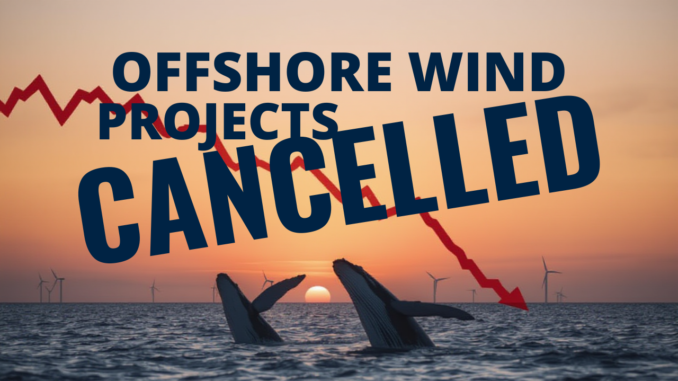
In a significant blow to the U.S. renewable energy sector, the Department of the Interior has announced the immediate suspension of all large-scale offshore wind projects currently under construction. This decision follows a critical report from the Department of War (commonly referred to as the Department of Defense in modern contexts) that highlights national security risks associated with these developments. Secretary of the Interior Doug Burgum stated that the pause will allow federal agencies to assess and mitigate potential threats in collaboration with leaseholders and state partners. The move affects five major projects along the East Coast, imperiling billions in investments and raising questions about the future of offshore wind in America.
We will be following up on this story and covering it on Wednesday’s Energy News Beat’s Stand-Up. Stu will also break out the stock prices for each company this week.
“Oil saved the whales the first time, and natural gas could replace all 5 projects with one pipeline saving the whales the second time” – Stu Turley
The Five Suspended Offshore Wind Projects
The suspension targets the following five projects, all in various stages of construction off the U.S. East Coast:
Vineyard Wind 1 – Located off the coast of Massachusetts, this 800-megawatt project was one of the first large-scale offshore wind farms in the U.S. It features turbines supplied by GE Vernova and was expected to power over 400,000 homes.
Revolution Wind – Situated off Rhode Island and Connecticut, this 704-megawatt farm is designed to provide clean energy to approximately 350,000 homes. Construction was reportedly 80% complete before a prior partial halt in August 2025, now fully suspended.
Sunrise Wind – Off the coast of New York, this 924-megawatt project aims to serve around 600,000 homes and includes an onshore transmission system connecting to the state’s grid.
Coastal Virginia Offshore Wind (CVOW) – Commercial – Positioned off Virginia’s coast, this massive 2,600-megawatt initiative is the largest offshore wind project in the U.S., capable of powering up to 660,000 homes upon completion.
Empire Wind 1 – Also off New York, this 816-megawatt farm is part of a broader development plan and was set to contribute significantly to the region’s renewable energy goals, powering over 500,000 homes.
These projects collectively represent a combined capacity of over 5,000 megawatts, enough to supply electricity to millions of households and support thousands of jobs in manufacturing, installation, and maintenance.
Department of War’s Reasons for Suspension
The Department of War’s report, which prompted the Interior Department’s action, cites radar interference as the primary national security concern. Specifically, the rotating turbine blades and highly reflective tower structures disrupt military radar systems, potentially compromising detection capabilities for incoming threats.
The report emphasizes the risks posed by these installations’ proximity to densely populated East Coast areas, where evolving adversary technologies could exploit such vulnerabilities. Secretary Burgum highlighted that the DoD’s findings were “conclusive,” noting that these projects create a “genuine risk” to U.S. defense operations.
This isn’t the first time such issues have arisen; earlier assessments and memorandums between the DoD and Interior have long acknowledged the need for compatibility between renewable energy and military readiness.
While the administration frames this as a necessary step for national security, critics argue it aligns with President Trump’s longstanding opposition to offshore wind, which he has described as “ugly, costly, and inefficient.”
🚨BREAKING: Sec. @DougBurgum announces he will PAUSE leases for ALL large-scale offshore Wind projects immediately.
“Today we’re sending notifications to the five large offshore wind projects that are under construction, that their leases are being suspended due to national… pic.twitter.com/lFPyMscALr
— The Patriot Oasis™ (@ThePatriotOasis) December 22, 2025
Companies Involved
The affected projects are led by a mix of U.S. and international energy firms:
GE Vernova Inc.:Developer of Vineyard Wind 1, a U.S.-based company specializing in renewable energy technologies.
Ørsted A/S: A Danish renewable energy giant overseeing Revolution Wind and Sunrise Wind. The company has significant investments in U.S. offshore wind.
Dominion Energy Inc.: A Virginia-based utility company behind the Coastal Virginia Offshore Wind project, with a focus on integrating renewables into its portfolio.
Equinor ASA: A Norwegian energy firm developing Empire Wind 1, known for its global offshore wind expertise.
These companies have already poured billions into site preparation, turbine manufacturing, and grid connections, with partnerships involving state governments and local utilities.
Impacts on Investors and Consumers
The suspension has immediate ripple effects on investors. Shares of Ørsted, for instance, dropped sharply in European markets following the announcement, reflecting market jitters over the uncertainty.
Overall, the decision jeopardizes tens of billions in private and public investments, potentially leading to legal challenges and financial losses for shareholders. Analysts warn that prolonged delays could deter future foreign investment in U.S. renewables, as regulatory uncertainty undermines confidence.
For consumers, the halt could mean delayed access to clean, affordable energy. Or after all of these horribly expensive projects get canceled and real energy policies are implemented, consumers will get lower energy prices. There is a reason the Democrat-run states have higher energy prices, and offshore wind is one of the most significant cost increases buried in subsidies. These projects were poised to reduce reliance on fossil fuels, potentially lowering long-term electricity costs through diversified supply. However, Secretary Burgum countered this by noting that a single natural gas pipeline could match the output of all five projects combined, suggesting a pivot toward more “secure” energy sources.
In the short term, consumers in affected states like Massachusetts, New York, Virginia, Rhode Island, and Connecticut may face higher energy prices if alternative supplies are needed to fill the gap. Job losses in the wind sector—estimated in the thousands—could also strain local economies. This development underscores the tension between advancing renewable energy goals and safeguarding national defense. As the Interior Department reviews mitigation options, the fate of these projects remains uncertain, with potential for resumption if risks can be addressed. Energy News Beat will continue monitoring this story for updates.
Sources: X, reuters.com, zerohedge.com, nytimes.com, nytimes.com



Be the first to comment