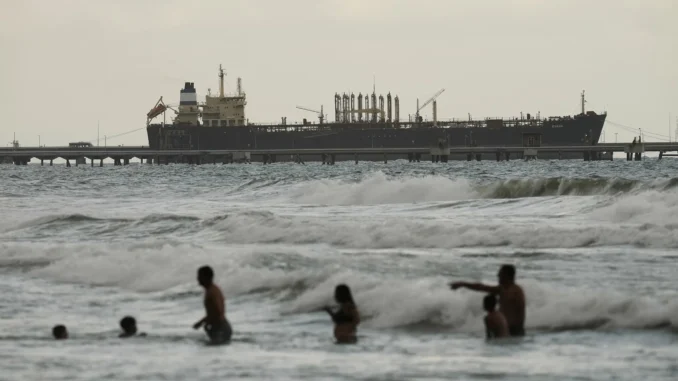
In a bold defiance of escalating US pressure, sanctioned tankers continue to load Venezuelan oil off the country’s coast, even as the Trump administration ramps up its naval blockade to cut off revenue streams for President Nicolás Maduro’s regime. Despite recent high-profile interceptions and pursuits by US forces, oil loadings have persisted at a near-normal pace, highlighting the challenges of enforcing sanctions against Venezuela’s shadow fleet. This ongoing activity comes amid a broader global oil market fraught with apparent surpluses and logistical disruptions, raising questions about potential impacts on prices if US enforcement intensifies.
Recent Loadings and the Shadow Fleet’s Resilience
According to maritime intelligence data, since December 11, approximately 14 vessels have loaded Venezuelan oil, with at least six of them operating under US sanctions.
These loadings have primarily occurred at key ports like Bajo Grande and Puerto Jose, maintaining an average of about 890,000 barrels per day—slightly above the typical 800,000 barrels per day.
Venezuela’s overall exports hover around 900,000 barrels per day, with roughly 30% relying on this elusive shadow fleet of vessels that often employ tactics like switching off automated identification systems (AIS) to evade detection.
Currently, around 35 sanctioned oil tankers are clustered near Venezuela’s coast, a figure consistent with recent months.
Most of these vessels transport crude that ultimately finds its way to buyers in Asia, particularly China, which remains a primary destination for sanctioned Venezuelan oil.
This flow persists despite the US deploying a significant naval presence, including an aircraft carrier, 20 F-35 jets, and 11 warships, to enforce the blockade announced by President Trump.
Notably, some loadings involve licensed operations, such as those for Chevron Corp., which holds US approval to export Venezuelan crude and insists its activities comply with sanctions.
The resilience of these operations underscores the adaptability of the shadow fleet, which includes vessels rerouting, rebranding cargoes, or conducting ship-to-ship transfers to skirt restrictions.
While US actions have caused some vessels to linger in Venezuelan waters, exports have not ground to a halt, with sanctioned oil often moved by non-designated ships.
The Three US-Boarded Tankers: Escalating Enforcement
The US has intensified its efforts with direct interventions, boarding or attempting to board three tankers in recent weeks as part of the blockade. These actions signal a broadening scope, targeting not just sanctioned vessels but also those carrying prohibited cargoes.
Skipper (December 10): The first interception involved the stateless vessel Skipper, a large oil tanker sanctioned for its ties to Iranian oil networks and participation in illicit shipping supporting terrorist organizations.
US forces detained it off Venezuela’s coast, with its cargo destined for Asia.
This marked the initial seizure under the blockade, aimed at disrupting Maduro’s revenue.
Centuries (December 20): In a pre-dawn operation supported by the Defense Department, the US Coast Guard intercepted and boarded the Panama-flagged Centuries supertanker in international waters east of Barbados.
Laden with 1.8 to 2 million barrels of Venezuelan Merey crude (loaded under a false name at the Jose Oil Terminal), the ship was en route to China.
Although the vessel itself was not previously sanctioned, its cargo from state-owned PDVSA was, prompting the seizure. Venezuela condemned the action as “piracy,” vowing to complain to the UN.
President Trump has indicated that oil from such seized ships could be sold or added to US strategic reserves.
🚨 BEST MOMENT from Trump’s Mar-a-Lago Presser Today:
Reporter: What about the 1.9M barrels of seized Venezuelan oil?
Trump: “We’re KEEPING it! Maybe sell it, maybe stock the reserves… And we’re keeping the SHIPS too!”
Maduro played stupid games now he’s Finding Out 🇺🇸 pic.twitter.com/dnCDCGSLpG
— Alec Lace (@AlecLace) December 22, 2025
Bella 1 (December 21): The US Coast Guard, with Navy assistance, pursued and attempted to board the sanctioned Bella 1 in international waters as it headed toward Venezuela to load oil.
Linked to Iranian oil networks and flying a false flag, the empty vessel (in ballast) evaded boarding and continued its course, with AIS data falsely signaling for Curaçao.
This incident highlights the cat-and-mouse tactics employed by shadow fleet operators.
These interceptions represent a shift, with the US now targeting non-sanctioned ships carrying illicit cargoes, potentially deterring future trade.
However, they have sparked diplomatic tensions, including with China, given the destinations involved.
Potential Price Impacts from Further US Enforcement or Seizures
While these actions have so far minimally affected global oil prices, West Texas Intermediate futures have dipped about 1% since the first seizure amid plentiful supplies. Further enforcement could introduce new market dynamics.
Venezuela’s crude accounts for less than 1% of global supplies, but intensified seizures or a tighter blockade could reduce exports by up to 500,000 barrels per day, delivering a more financial blow to Maduro than a major supply shock in a 100-million-barrel-per-day market.
Analysts view the current market jitters—Brent futures below $59, the lowest since early 2021—as stemming from market dysfunction rather than a true glut, driven by sanctions on Russian and Iranian oil that have led to 1.3 billion barrels lingering at sea (up 30% since August).
Additional US actions against Venezuelan tankers could exacerbate these distortions, forcing more rerouting, blending, or ship-to-ship transfers in the shadow fleet, potentially spooking traders and adding volatility.
However, strong underlying demand growth (projected at 680,000-1.4 million barrels per day in 2025-2026) and OPEC+’s ability to manage supply—aiming for Brent at $75-$80—could mitigate upward price pressure.
In essence, while seizures might tighten niche markets for discounted sanctioned crude, the overall impact on global prices is likely limited unless broader geopolitical shifts, like sanction rollbacks on Russia, occur.
As the US continues its pressure campaign, the interplay among enforcement, shadow-fleet adaptability, and global market forces will be critical to watch. For now, Venezuelan oil keeps flowing, sanctioned or not.
Sources: bloomberg.com, energynewsbeat.co, aljazeera.com