


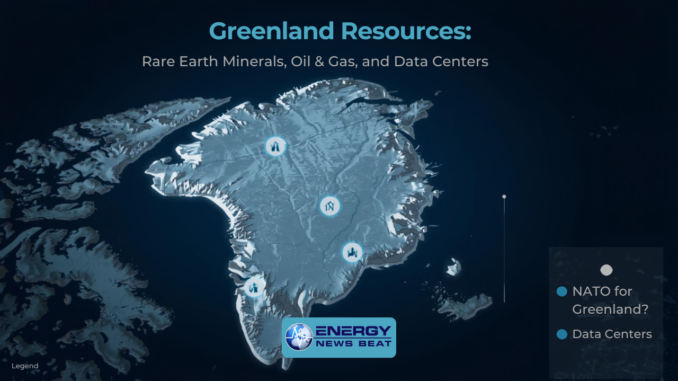
In a bold geopolitical maneuver, President Donald Trump has once again floated the idea of acquiring Greenland from Denmark, this time potentially tying it to U.S. participation in NATO. This hypothetical scenario raises intriguing questions about transatlantic alliances, defense spending, and the strategic value of the world’s largest island. As the host of the Energy News Beat podcast, I’ve long tracked how energy resources and global security intersect. Here, we explore what a U.S. withdrawal from NATO might mean for Europe’s defense, the staggering costs involved in such a “deal,” and the energy and resource bonanza Greenland could offer if it became America’s 51st state.
Europe’s Defense Dilemma: Life Without Uncle Sam
If Trump leveraged NATO membership to push for Greenland’s acquisition, a U.S. pullout could force Europe to dramatically ramp up its military capabilities. NATO has long relied on American might, with the U.S. providing key assets like intelligence, missiles, and troop deployments. Without this backbone, the European Union would need to fill massive gaps to deter threats, particularly from Russia.
Recent analyses paint a picture of the scale required. The Bruegel think tank estimates Europe might need 300,000 additional troops and at least €250 billion ($272 billion) more annually in defense spending in the short term to maintain deterrence.
The International Institute for Strategic Studies (IISS) goes further, calculating that replacing core U.S. contributions could cost around $1 trillion, including one-off procurements and a 25-year lifecycle.
This aligns with NATO’s evolving targets: at the 2025 Hague Summit, members committed to 3.5% of GDP on defense plus 1.5% on security-related spending by 2035, up from the current 2% average.
The EU’s ReArm Europe Plan, launched in 2025, aims to mobilize €800 billion ($870 billion) in defense investments through 2030, including €150 billion in loans.
This could involve activating fiscal flexibility under the EU’s Stability and Growth Pact, allowing up to 1.5% extra GDP spending on defense—potentially unlocking €650 billion more from national budgets.
Goldman Sachs notes that if EU states had met the 2% target consistently since 2006, it would have added €1.1 trillion in spending.
In essence, Europe’s defense budget could balloon from the current ~$360 billion (about 2% of the EU’s $18 trillion GDP) to $900 billion or more annually at 5% GDP. This shift would strain economies already grappling with climate and demographic pressures, but it could foster greater strategic autonomy.
As one Reddit commenter quipped, a U.S. exit might “force [Europe] to toughen up,” though it would likely increase overall global military spending rather than reduce it.
The Price Tag: Estimating Greenland’s “Sale” Value
Denmark has repeatedly insisted Greenland isn’t for sale, but let’s indulge the “what if.” Valuations vary wildly, reflecting the island’s economic, strategic, and resource potential. Historical precedents offer a starting point: the U.S. bought Alaska for $7.2 million in 1867 (about $125 million today) and the Virgin Islands from Denmark for $25 million in 1917 (~$500 million adjusted).
Scaling these for GDP growth yields estimates of $12.5 billion to $77 billion.
More expansive views factor in resources and location. The American Action Forum pegs Greenland’s mineral reserves at $186 billion (economically extractable portion of $4.4 trillion total), while its North Atlantic strategic value—using Iceland’s real estate as a proxy—could reach $2.76 trillion.
Trump administration discussions reportedly included $10,000–$100,000 per Greenlander (~57,000 people), totaling up to $5.7 billion, but this would be nominal alongside payments to Denmark.
Britannica’s inflation-adjusted figure for similar deals lands at $90 billion.
A realistic “purchase” might fall between $500 billion and $1 trillion, covering subsidies (Denmark provides ~$800 million annually), infrastructure, and strategic premiums. Yet, as one analyst noted, “something in the trillions looks about right” for full value.
Greenland’s Bounty: Rare Earths, Oil, Gas, and Beyond
If Greenland joined the U.S., its resources could supercharge American energy independence and tech dominance. The island ranks eighth globally in rare earth reserves with 1.5 million metric tons.
Key deposits like Kvanefjeld hold 11 million tons of rare earth oxides (1.43% ore grade), including 370,000 tons of heavy rare earths, while Tanbreez boasts 28.2 million tons (0.38% grade, 27% heavies).
Greenland could supply 18% of global reserves for critical elements like neodymium and dysprosium, meeting over 25% of future demand—vital for EVs, wind turbines, and defense tech.
The EU lists 25 critical raw materials present here, including lithium and zirconium.
Oil and gas reserves are equally tantalizing. The U.S. Geological Survey estimates 31–50 billion barrels of oil equivalent in northeast Greenland, akin to U.S. proven reserves.
Offshore basins like North and South Danmarkshavn could hold the bulk, though a 2021 moratorium halted exploration due to climate concerns.
Warming trends might ease access, but environmental risks loom large.Finally, Greenland’s Arctic chill makes it a data center paradise. Cooling consumes 40% of data center energy, but subzero temps enable “free cooling” with air or seawater, slashing costs and emissions.
Abundant hydropower and wind could power green facilities, positioning Greenland as a low-carbon hub for AI and cloud computing.
Challenges like sparse infrastructure and population exist, but as one expert noted, it’s “literally the best place in the world for data centers.”
Conclusion: A High-Stakes Gamble
Trump’s NATO-Greenland gambit could reshape global alliances, forcing Europe to spend trillions on defense while unlocking Greenland’s $1 trillion+ resource potential for the U.S. From rare earths powering the green transition to oil reserves rivaling Alaska’s, the energy implications are profound. Yet, this overlooks Greenlanders’ sovereignty and climate realities. As energy watchers, we’ll monitor if this “what if” becomes reality—stay tuned to Energy News Beat for updates.
Oil, Gold, Silver all going up. Copper is in the waiting room expecting to be next.



Be the first to comment