


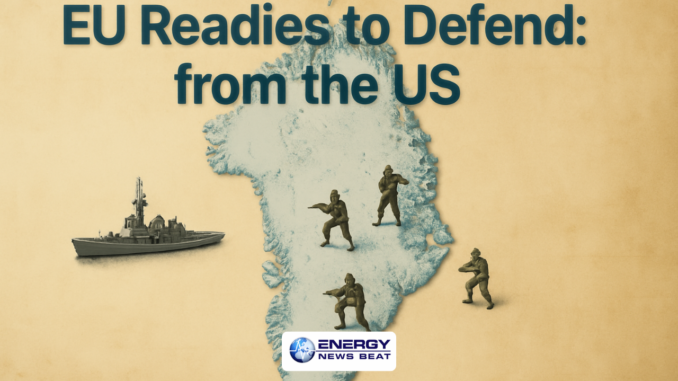
In a rapidly escalating transatlantic standoff, the European Union is preparing a robust counterpunch to U.S. President Donald Trump’s aggressive push to acquire Greenland. EU officials have signaled readiness to impose retaliatory tariffs worth approximately €93 billion ($108 billion) on American goods, a move that could ignite a full-blown trade war with profound implications for global energy markets, supply chains, and alliances like NATO. This response comes amid Trump’s threats to slap escalating tariffs on eight European nations unless Denmark agrees to sell the mineral-rich Arctic island, highlighting tensions over strategic resources in a warming world.
The dispute, which has roots in Trump’s longstanding interest in Greenland’s vast untapped reserves of oil, gas, and rare earth minerals essential for renewable energy technologies, underscores the intersection of geopolitics and energy security. As climate change opens new Arctic shipping routes and resource opportunities, control of Greenland could reshape global energy dynamics, pitting the U.S. against its traditional allies while benefiting competitors like Russia and China.
The Trigger: White House Communications and Greenland Ambitions
The latest flare-up was sparked by a series of provocative statements from the White House and Trump himself. On January 17, 2026, Trump announced via social media that the U.S. would impose a 10% tariff on all goods from Denmark, Norway, Sweden, France, Germany, the United Kingdom, the Netherlands, and Finland starting February 1, escalating to 25% by June 1, unless a deal is reached for the “complete and total purchase” of Greenland. Trump framed the move as a national security imperative, claiming that without U.S. control, adversaries like China and Russia could seize the island’s resources.
This threat followed earlier White House assertions that acquiring Greenland is a priority to “deter adversaries in the Arctic region.” A January 6 statement confirmed Trump was exploring options, including military ones, to secure the territory.
Trump further tied his Greenland pursuit to a perceived snub for the Nobel Peace Prize, messaging Norway’s prime minister that he no longer felt bound to “think purely of Peace” after failing to win the award, despite claiming to have stopped multiple wars.
These communications came amid diplomatic talks, including a January 14 White House meeting with Danish and Greenlandic representatives, where interpretations diverged: the U.S. claimed progress toward acquisition discussions, while Denmark emphasized addressing security concerns without a sale.
Europe’s “Fearsome Force”: A Symbolic Defense of Greenland
In a show of solidarity, Denmark—Greenland’s sovereign overseer—has bolstered its military presence on the island, leading a multinational exercise dubbed “Operation Arctic Endurance.” As of mid-January 2026, a symbolic contingent of 37 troops from several NATO countries, including France, Germany, Norway, Sweden, the Netherlands, and Finland, has arrived for joint drills focused on infrastructure protection, reconnaissance, and Arctic operations.
Denmark has deployed over 200 additional soldiers, with plans for a long-term presence potentially lasting one to two years. French President Emmanuel Macron confirmed the dispatch of 15 mountain infantry troops, emphasizing Europe’s commitment to upholding sovereignty. This “fearsome force” of 37 allied personnel, while modest, symbolizes a united front against what European leaders call U.S. “blackmail” and “coercion.”
Danish Defense Minister Troels Lund Poulsen described it as a step toward permanent enhanced security in cooperation with allies.
Background on the WEF, Greenland, and the EU from the Promethean Action Group.
I found out today that the WEF was set up by Kissinger and the CIA in conjunction with the UK to gain control of the U.S.
🚨 Europe just deployed troops to Greenland to stop Trump’s acquisition.
Meanwhile, Trump rolls into Davos with 300 delegates—not to negotiate, but to deliver the globalists’ terms of surrender.
The old order is dying. Watch what happens next. 👇 pic.twitter.com/VHrgTrwPFs
— Promethean Action (@PrometheanActn) January 19, 2026
Planned Tariffs: What the EU and UK Are Preparing
The EU’s retaliatory package targets €93 billion in U.S. imports, reviving duties suspended under a July 2025 trade deal. Potential hits include American aircraft (e.g., Boeing), agricultural products like soybeans and whiskey, chemicals, and tech goods. This “trade bazooka”—formally the anti-coercion instrument—could also involve export controls or market access restrictions, marking its first-ever use.
EU leaders, convening for an emergency summit on January 22, aim to de-escalate while preparing countermeasures. French Finance Minister Roland Lescure called the threats “unacceptable,” and European Council President Antonio Costa stressed unity in defending Denmark.
The UK, facing its own tariff threat, has adopted a more conciliatory tone. Prime Minister Keir Starmer ruled out immediate retaliation, emphasizing “calm discussion” and that tariffs “should not be used against allies.” However, Starmer vowed to use “the full strength of government” to avert them, warning a trade war benefits no one.
Impacts on the United States
These European threats could significantly disrupt U.S. markets. Retaliatory tariffs might raise costs for American consumers on imported goods, exacerbate inflation, and hurt exporters in sectors like aerospace, agriculture, and energy. The U.S. energy sector, reliant on European chemicals and refined products, could face supply chain snarls, potentially increasing fuel prices amid ongoing global volatility.
Broader fallout includes strained alliances. Trump’s tactics have drawn Republican criticism, with figures like Sen. Marco Rubio warning of risks to U.S. global standing.
Equity markets have already reacted negatively, with European stocks underperforming amid fears of a prolonged dispute.
Repercussions for NATO, the EU, and UK if U.S. Tariffs Escalate
If the U.S. follows through, NATO could fracture irreparably. Denmark has warned that any attack on Greenland would “end NATO,” eroding the alliance’s foundational mutual defense principle.
The EU, already facing internal strains, might see deepened divisions, with economic hits amplifying populist pressures. The UK’s post-Brexit economy, heavily tied to both the U.S. and EU, risks a double blow, potentially slowing growth and complicating trade deals.
A trade war could create a “dangerous downward spiral” in transatlantic relations, as warned by European leaders, benefiting adversaries like Russia, which has expressed understanding for Trump’s Greenland ambitions.
For energy, disrupted trade might accelerate Europe’s pivot to alternative suppliers, weakening U.S. influence in global LNG markets.
Can the U.S. Get By Without Imports from Europe?
Short answer: Yes, but not without pain. The U.S. imported about $600 billion in goods from the EU in 2024, including vehicles (e.g., German cars), pharmaceuticals, machinery, and chemicals critical for energy production. Diversification to Asia, Mexico, or domestic sources is feasible—the U.S. is a net energy exporter thanks to shale oil and gas—but would involve higher costs, supply disruptions, and time lags.
In energy terms, Europe provides refined products and technologies for renewables, but the U.S. could ramp up domestic output or source from Canada and Latin America. Long-term, a trade rift might spur U.S. innovation but at the expense of economic efficiency and alliance stability.
We will know a lot more after this week, and the group from the Promethean Action folks is spot on. We recomend subscribing to their newsletters. As the team from the Promethean Action mentioned, the financial systems are changing, and the EU and the UK are in panic mode.
As EU leaders convene and diplomacy intensifies, the world watches whether this Greenland gambit leads to de-escalation or deeper division. For energy stakeholders, the stakes are high: control of Arctic resources could define the next era of global power.
How Did President Trump Change the Oil Markets?



Be the first to comment