


ENB Pub Note: This article was first run on America Outloud News, and Ronald Stein has some outstanding points. We will cover this and other articles on the next Energy News Beat Stand-Up.
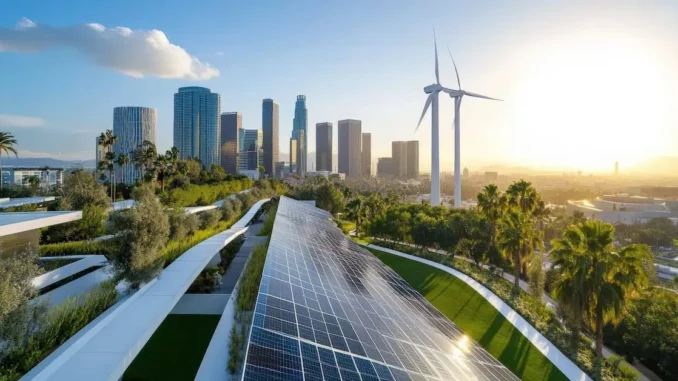
The Net Zero emission goals of California government leaders, including Governor Gavin Newsom, cannot ignore the fundamental reality that wind turbines and solar panels ONLY generate electricity.
Beyond chemistry, hydrocarbons underpin physical mobility.
- Diesel powers heavy logistics: trucks, mining equipment, construction machinery, rail, and agricultural systems.
- Aviation depends almost entirely on jet fuel.
- Global trade relies on bunker fuel for ships.
- Military mobility, tanks, aircraft, naval fleets, and supply chains remain inseparable from liquid hydrocarbons due to their unmatched energy density, storability, and reliability.
Electrification has yet to demonstrate credible substitutes for these domains, especially under conditions of conflict, disruption, or extreme demand. We must have an “all of the above” energy solution.
Renewable electricity, by contrast, is structurally narrow. Wind and solar generate electricity, and only electricity, intermittently. They do not produce molecules, fuels, or industrial feedstocks. They depend on weather, geography, and extensive material inputs, many of which are themselves derived from fossil fuels and geopolitically concentrated supply chains. Storage solutions remain costly, scale-limited, and technologically immature relative to the scope of modern energy systems. It doesn’t mean they are not important; they are, but they have limitations.
Will it always be like this? Probably not, but it’s the current reality.
Hospitals and the entire medical industry, transportation mobility, national security, and the health and well-being of millions in California and billions on this planet, will suffer from the transition to wind turbines and solar panels as those so-called renewables only generate electricity, but CANNOT support that supply chain of the thousands of products demanded by doctors and hospitals, i.e., the more than 6,000 products and transportation fuels that are made with petrochemicals manufactured from crude oil, coal, or natural gas.
Current CA mandates for transitioning from internal combustion engine (ICE) vehicles to electric vehicles (EV’s) would only eliminate gasoline used in ICE vehicles, which is only one of the more than 6,000 products made from fossil fuels. EVs, the ICE vehicle, continues to be 100% made from those oil products, inclusive of tires, computers, wiring, and insulation, and all the electronics of what are termed “zero emissions” vehicles.
Shockingly, no one can explain how wind turbines and solar panels can make any of the other 5,999 products that are now made from oil that we see in operating hospitals, airports, offices, shopping centers, data centers, etc. In addition, our government leaders CANNOT explain how those renewables will support the merchant ships, cruise ships, commercial aircraft, and military aircraft on this planet, that did not exist 200 years ago?
Raw crude oil is virtually useless until it’s refined into usable derivatives and fuels. Policies cannot be focused only on the “supply” side of the equation and continue to force California, the 4th largest economy in the world, to be the only state in contiguous America that imports most of its crude oil demands from foreign countries. California crude oil production is in terminal decline, driven by the lack of drilling permits, despite ample reserves. That dependence on foreign imports has increased imported crude oil from foreign countries from 5 percent in 1992 to more than 70 percent today of total consumption demand.
In 2025, significant refinery outages were driven by planned maintenance, unplanned incidents like fires, and permanent closures, particularly in California. reducing capacity. Permanent refinery closures are impacting the State in perpetuity with the closure of the Phillips 66 Los Angeles Refinery, a 139,000-barrel-per-day refinery that was closed in the fourth quarter of 2025.
The immediate future is not looking much better with the Valero Benicia Refinery, a 145,000-barrel-a-day refinery slated for closure in early 2026.
With no pipelines over the Sierra Mountains, California is an energy island separated from the crude oil supply and the infrastructure of oil refineries within the other 49 States. Thus, California transportation fuel demands for ships, airports, cars, and trucks have staggering numbers FROM in-state refineries:
- Fuel for the ships in three of the busiest Ports in America, located in California.
- Port of Los Angeles had more than 1,800 vessel arrivals in 2024, which includes cruise and merchant ships.
- Port of Long Beach handled over 9.6 million container units in 2024, indicating a very high volume of ship activity, plus cruise ships.
- Port of Oakland, which also handles significant cargo volumes, contributes to the total number of cruise and merchant ships needing fuel.
- Jet fuel: With all its 145 airports, including 9 international airports and 41 military airports, the demand is 13 million gallons of aviation fuel daily. Several of those airports have direct pipelines to local refineries. In 2019, California consumed 16.7% of the national total of jet fuel, making it the largest consumer of jet fuel in America.
- Gasoline: For its 30 million vehicles, California is the second-largest consumer of motor gasoline among the 50 states, consuming 42 million gallons a day of gasoline, just behind Texas.
- Diesel: Diesel fuel is the second largest transportation fuel used in California, consuming 10 million gallons a day of diesel to support the state’s trucking of products from 3 of the busiest shipping ports in America.
Over the last several decades, California’s passion to transition away from fossil fuels, lacks a significant backup plan to support the supply chain of products and fuels, has overregulated and overly burdened just the SUPPLY of oil production and refining but has not reduced the increasing materialistic DEMANDS of the State for the more than 6,000 products and transportation fuels made from those fossil fuels to support the demands for ships, airports, cars, and trucks
Since wind and solar ONLY generate electricity occasionally, the greatest threat to humanity is running out of crude oil, before we have an alternative to meet the supply chain of all the products and transportation fuels that are derived from oil that are supporting the 8 billion on this planet.
This is a year of awakening, as many remain unaware that electricity came AFTER oil, as ALL electrical generation methods from hydro, coal, natural gas, nuclear, wind, and solar are ALL built with the products, components, and equipment that are made from the oil derivatives manufactured from crude oil. Without Crude Oil, there can be no Electricity, and without crude oil California will be unable to support the fuel demands for three of the busiest Ports in America, 13 million gallons of aviation fuel daily for its 145 airports, 42 million gallons a day of gasoline for cars, and 10 million gallons a day of diesel to support the state’s trucking infrastructure.
The perspective of the California Energy Infrastructure Future remains very fragile, with no one able to clearly verbalize to the voters their plan for what the replacement will be for that black tar commonly referred to as crude oil, to maintain the supply chain of products demanded by our materialistic society.
California policymakers seem to be unaware that China is savoring the future with their many refineries coming online by 2030 to meet the supply chain of products and transportation fuel DEMANDS of California.
We need to work together with clarity and wisdom to balance the state’s economic and environmental needs and find the best possible solutions to ensure affordable, reliable energy for all Californians and the West. California has the opportunity to lead the state and help address a national security risk for all Americans.
Please share this information with teachers, students, and friends to encourage Energy Literacy conversations at the family dinner table.
Click this Link to Sign up for Energy Literacy from Ronald Stein.




Be the first to comment