


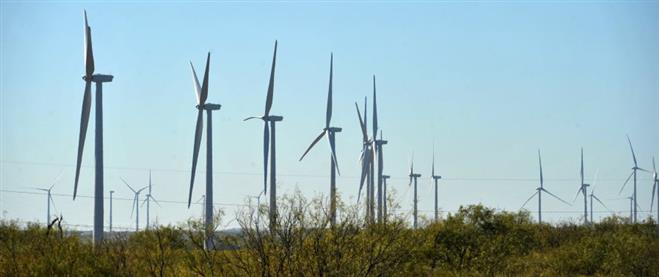
In a development that underscores the mounting vulnerabilities in America’s renewable energy sector, Shannon Wind, LLC—a 204 MW wind farm operating in Clay County, Texas—has filed for Chapter 11 bankruptcy protection. The filing, made on January 25, 2026, in the U.S. Bankruptcy Court for the Southern District of Texas, aims to facilitate a sale of the facility amid crippling financial disputes stemming from Winter Storm Uri in 2021.
This event not only highlights operational and financial risks in wind energy but also raises serious questions about land reclamation obligations, potentially leaving local landowners and taxpayers on the hook for cleanup costs. As Stu Turley, host of the Energy News Beat podcast, has repeatedly warned, this could be the tip of a systemic iceberg, with an estimated $89 billion in decommissioning liabilities poised to unfold across the United States.
The Bankruptcy Filing: A Storm’s Long Shadow
Shannon Wind, owned by Dallas-based Lotus Infrastructure Partners, consists of 119 turbines spread across Clay County, a region prized for its strong wind resources.
The farm, which began commercial operations in 2015, has been entangled in a $108 million secured hedge obligation dispute with Citigroup, exacerbated by the extreme weather event of Winter Storm Uri. According to court documents, the company reported $5.1 million in funded debt while owing approximately $103 million in hedge-related liabilities.
On January 28, 2026, a Texas bankruptcy judge approved the use of cash collateral, allowing the company to maintain operations during the sale process.
Chief Restructuring Officer John Shepherd, from Accordion Partners, LLC, emphasized in his declaration that the site’s prime location in one of the U.S.’s strongest wind regions makes it an attractive asset for potential buyers.
However, the bankruptcy has sparked local concerns in Clay County, a rural area where wind farms have historically faced opposition from residents worried about environmental and aesthetic impacts.
The video from MSN, dated February 21, 2026, titled “Wind Farm Bankruptcy in Clay County,” appears to cover this story, though detailed transcripts were unavailable. Similar local reports, such as from TexomasHomepage, echo the bankruptcy’s implications for the community, including potential job losses and economic ripple effects.
We have a $89 billion land Reclamation Problem, and here is the summary. 🤣When the subsidies start winding down, people are going to see some real truths being dropped, much like the dog in the video. pic.twitter.com/4G8slwo5J1
— STUART TURLEY – Energy Podcast Host (@STUARTTURLEY16) February 22, 2026
Land Reclamation Bonds: Filed, But Fully Funded?
A critical aspect of this bankruptcy is the uncertainty surrounding land reclamation— the process of decommissioning turbines, removing infrastructure, and restoring the land to its pre-development state. In Texas, unlike some states or federal lands managed by the Bureau of Land Management (BLM), there are no statewide regulations mandating decommissioning bonds for wind farms.
Instead, obligations typically stem from private lease agreements between developers and landowners, which promise site restoration but often lack enforceable financial backing.
Specific to Shannon Wind, public records and court filings do not explicitly confirm the existence of dedicated reclamation bonds or their funding status. The company’s bankruptcy petition focuses on asset sales and debt resolution, with no mention of set-aside funds for decommissioning.
This aligns with broader industry patterns: many U.S. wind farms rely on vague contractual promises rather than fully funded bonds, rendering them ineffective if the operator goes bankrupt.
In Shannon Wind’s case, if bonds exist, they are likely tied to the lease terms, but without state oversight, their adequacy is questionable.
This gap is particularly alarming given Texas’s history with wind waste. Just weeks ago, Texas Attorney General Ken Paxton sued Global Fiberglass Solutions for abandoning over 3,000 turbine blades in Sweetwater, creating a “wind turbine graveyard” without proper permits or recycling.
The lawsuit seeks over $1 million in penalties and demands full site cleanup, highlighting how underfunded or nonexistent reclamation plans can lead to environmental hazards and financial burdens on states.
A Systemic Crisis Brewing: The $89 Billion Decommissioning Time Bomb
Stu Turley has long highlighted on the Energy News Beat podcast that wind farm bankruptcies like Shannon Wind’s signal a nationwide crisis. With thousands of turbines approaching the end of their 20-30 year lifespans, decommissioning costs are skyrocketing. A recent study from the Finnish Environment Institute estimates per-turbine costs at €929,500 to €1,509,000—far exceeding industry claims of €100,000-€200,000—due to factors like foundation removal, hazardous material handling, and site-specific challenges.
In the U.S., these costs could accumulate to $89 billion as a starting point for onshore wind alone, with global estimates reaching $70-150 billion.
By 2050, cumulative decommissioning material may hit 133 million tons, including 3,000-9,000 blades annually entering landfills or illegal dumps.
Offshore wind adds even more complexity and expense, with no uniform federal framework to ensure funding.
Texas exemplifies the problem: while wind projects generate billions in tax revenue (estimated $12.3 billion lifetime for current fleet), inadequate bonding leaves landowners vulnerable. If companies like Shannon Wind default, restoration falls to private parties or governments, potentially straining rural economies already reliant on these installations.
Looking Ahead: Calls for Reform
The Shannon Wind bankruptcy serves as a wake-up call. Policymakers must mandate fully funded reclamation bonds nationwide, similar to BLM requirements for federal projects. Wind and Solar farms need to have storage and land reclamation fully funded as part of their original projects. The wind farms don’t last 20 to 30 years, as they have been “upgrading” nameplate capacity and scamming the subsidies, and we have seen ratepayers or consumers get hit with rate increases within 5 to 8 years of wind or solar being put on the grid.
The entire grid pricing matrix is out of whack. The natural gas turbines are forced to spin up and turn off, adding more wear and tear and costing ratepayers millions every year in additional maintenance just to let wind and solar on the grid. Wind and Solar need to be charged for grid resilience as a condition of being allowed on the grid. Land reclamation and toxic waste are only part of the problems surfacing as subsidies wind down. We are about to see the real cost of “Renewable” wind and solar.
Without action, the green energy transition risks creating environmental liabilities that undermine its sustainability claims. As Turley notes, this isn’t just a local issue—it’s a national reckoning with the true costs of wind power.
For more insights, tune into the Energy News Beat podcast, where Stu Turley breaks down these developments and their implications for America’s energy future.
Sources: energynewsbeat.co, dailyyonder.com, forbes.com, texomashomepage.com, msn.co,
Get your CEO on the #1 Energy Podcast in the United States: https://sandstoneassetmgmt.com/media/
Is oil and gas right for your portfolio? https://sandstoneassetmgmt.com/invest-in-oil-and-gas/



Be the first to comment