


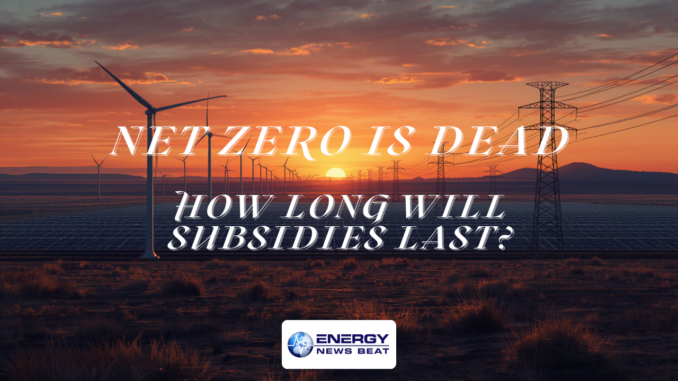
Just yesterday, Bloomberg Opinion columnist Javier Blas dropped a bombshell: “Net Zero Is Dead. Long Live Renewable Energy.”
In his February 24 piece, Blas chronicles the quiet burial of the 2050 net-zero fantasy at the latest IEA ministerial meeting in Paris. Mentions of “net zero” in official communiqués cratered from 13 in 2022 and 15 in 2024 to exactly one in 2026 — and that lone reference simply noted the lack of universal support.
U.S. Energy Secretary Chris Wright put it bluntly: the probability of hitting net zero by 2050 is “zero point zero.” Fatih Birol, the IEA’s longtime net-zero cheerleader, pivoted hard — “energy security” eight times, “affordability” four times, “climate” twice, and net zero zero times.
Denmark, once a green poster child, is now eyeing extensions for North Sea oil and gas drilling to 2050. Reality has won. Global oil demand is running near 105 million barrels a day and climbing. Emissions hover above 35,000 million metric tons annually and aren’t plunging off a cliff.
Yet here’s the rub: while the ideological net-zero crusade is dead, the subsidy machine for wind and solar keeps humming. Tax credits, mandates, feed-in tariffs, and renewable portfolio standards didn’t vanish overnight.
The question Energy News Beat asks today is simple:
How long will wind and solar get a free pass on the real costs they impose?
The LCOE Mirage — What Renewables Don’t Pay ForBloombergNEF, Lazard, IRENA, and others trumpet wind and solar LCOE at $30–$43/MWh. Great numbers — if you ignore everything that makes the grid actually work.
Storage? Variable output demands it.
BloombergNEF’s own February 2026 Levelized Cost of Electricity report shows four-hour battery storage LCOE hit a record low of $78/MWh in 2025, but that’s still an add-on cost renewables push onto the system. When will developers internalize pairing every solar farm with 4–8 hours of storage as part of their bid? Not yet. Ratepayers and gas plants still eat the balancing bill.
Land reclamation and recycling?
Almost never baked into project economics. Wind turbine decommissioning runs $50,000–$150,000 per MW onshore (higher offshore). Finnish researchers peg full removal and site restoration at €929,500 to €1.5 million per turbine.
By 2050, the U.S. alone could face 200,000–370,000 tons of blade waste annually. Most still heads to landfills.
Solar panel waste? One million tons in the U.S. by 2030, 10 million by 2050. Only ~10% recycled today. Valuable silver and silicon get trashed while taxpayers foot cleanup if bonds prove inadequate (see Vineyard Wind’s $191 million federal waiver drama).
These are not trivial. Yet most LCOE models treat decommissioning as someone else’s problem decades from now.
Grid resiliency?
Renewables get a total pass. Intermittent sources don’t provide inertia, frequency control, or black-start capability. That burden falls on dispatchable plants — mostly natural gas.
The Silent Tax on Gas Turbines Nobody Talks About
This is the dirty secret almost no mainstream outlet covers. Rapid renewable ramp-ups force combined-cycle gas turbines (CCGTs) — designed for steady baseload — into frantic cycling: hundreds of starts, deep load-following, and prolonged low-load idling.
Consequences, per Energy News Beat reporting and industry studies: Thermal mechanical fatigue cracking accelerates.
Maintenance intervals shorten dramatically.
Equivalent forced outage rates rise.
Efficiency drops 20–30% versus steady operation, burning more fuel and ironically raising emissions per MWh delivered.
Dollar impact?
Studies estimate renewables-driven wear and tear adds $35 million to $157 million annually in extra O&M costs for fossil generation across just the Western Interconnection. In ERCOT alone, wind/solar variability added $2.3 billion in 2023 via higher energy and ancillary prices. Nationwide, the hidden cycling tax is in the hundreds of millions — perhaps billions — every year, yet LCOE spreadsheets pretend gas plants are static assets unaffected by policy choices.
No one forces wind and solar developers to pay a “cycling surcharge” to the gas fleet that keeps the lights on when the wind dies or the sun sets. That cost flows straight to ratepayers.
Time for Full-Cost LCOE — Or the Subsidies End
The world has shifted. Energy security and affordability now trump ideology. Policymakers from Washington to Brussels to Copenhagen are waking up. Yet the subsidy architecture built for the net-zero era remains largely intact — even as some U.S. tax credits face phase-outs or restrictions under recent legislation.
Renewables have a bright future if they compete on real economics: Internalize storage pairing.
Post robust decommissioning bonds that actually cover full reclamation and recycling.
Compensate the dispatchable fleet for the wear and tear they impose.
Until then, the question remains: How long will taxpayers and ratepayers keep writing blank checks for an industry that externalizes its toughest costs?
Net Zero is dead. The era of honest, full-cost energy accounting should be born. The longer we delay it, the higher the bill when the music finally stops.
Stuart Turley and the Energy News Beat team will continue tracking these hidden costs. Follow the podcast for unfiltered analysis on what actually keeps the grid running.
Get your CEO on the #1 Energy Podcast in the United States: https://sandstoneassetmgmt.com/media/
Is oil and gas right for your portfolio? https://sandstoneassetmgmt.com/invest-in-oil-and-gas/


Be the first to comment