


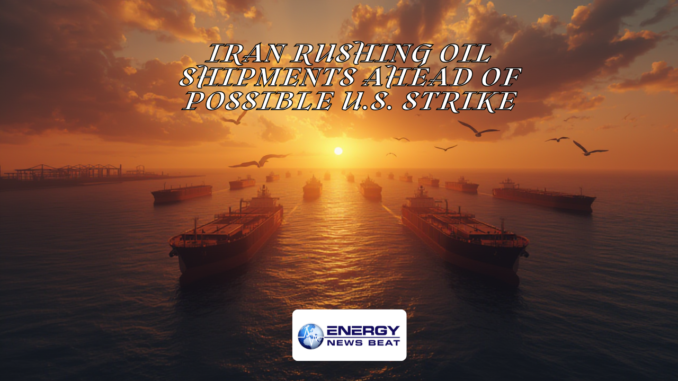
Amid escalating U.S.-Iran tensions and a massive American military buildup in the Middle East, Iran has dramatically accelerated crude loadings at its primary export terminal on Kharg Island. Vessel-tracking and satellite data show Tehran is rushing to move as much oil as possible out of the Persian Gulf before any potential U.S. strikes disrupt operations.
According to Kpler data cited by Bloomberg and OilPrice.com, Iran loaded 20.1 million barrels of crude onto tankers from Kharg Island between February 15 and 20 — nearly triple the volume loaded during the same period in January. That equates to more than 3 million barrels per day (bpd) over the six-day window, more than double Iran’s typical recent export rate of 1.5–1.6 million bpd.
Kharg Island handles approximately 90% of Iran’s total oil exports. Satellite imagery analyzed by Bloomberg confirms the surge: the number of tankers observed in waters southeast of the terminal more than doubled, from 8 to 18 during that period, while onshore storage tanks visibly emptied.
This is not the first time Iran has employed the tactic. Similar rushes occurred ahead of heightened risks in October 2024 and June 2025, when U.S. and Israeli strikes targeted Iranian facilities. Analysts say the current spike signals Tehran is bracing for possible escalation, including strikes on its oil infrastructure or enforcement actions against its export fleet.
Where Is the Oil Going?
Iran’s oil exports remain heavily concentrated. China accounts for 80–90% of Iran’s shipped crude and condensate, according to Kpler, Vortexa, and EIA data. In February 2026, China discharged roughly 1.03–1.14 million bpd of Iranian barrels — down slightly from January but still the overwhelming majority of Tehran’s sales.
Chinese independent “teapot” refiners in Shandong province are the primary buyers, attracted by steep discounts on sanctioned Iranian crude. Smaller volumes occasionally reach Syria or move via ship-to-ship transfers and relabeling through third countries, but China dominates the flow.
Dark Fleet Enforcement and Venezuela-Style Tactics: On the Table for Trump 2.0?
Iran relies heavily on its “shadow” or “dark fleet” — aging tankers that frequently change flags, names, and use ship-to-ship transfers to evade sanctions. Industry estimates suggest the majority of Iranian oil moves on vessels already under U.S. sanctions.
The Trump administration is aggressively targeting this network, mirroring tactics used against Venezuela earlier this year. On January 3, 2026, U.S. forces removed Nicolás Maduro; the U.S. subsequently seized multiple Venezuelan-linked tankers (including Iranian shadow-fleet vessels such as the Bertha, Veronica III, and others tracked across oceans) and began marketing Venezuelan crude through U.S.-controlled channels. Proceeds flow into accounts benefiting the U.S. and Venezuelan people, with American companies like Chevron gaining expanded access.
For Iran, the playbook looks similar but intensified:
On February 25–26, the U.S. Treasury’s OFAC sanctioned 12 additional tankers and associated entities in Iran’s shadow fleet, plus 30 total designations covering missile, drone, and oil networks.
U.S. forces have boarded and interdicted shadow-fleet vessels in the Indian Ocean, demonstrating long-range enforcement capability.
President Trump has publicly committed to driving Iranian oil exports “to zero,” especially flows to China, including via tariffs on Iran’s trading partners and maximum-pressure sanctions.
Administration officials and analysts note that physical interdiction of tankers (as in Venezuela) combined with financial isolation could starve the regime of revenue — its primary funding source for proxies, missiles, and the nuclear program — without requiring long-term U.S. ground presence.
Energy analysts at TankerTrackers.com and others estimate Iran’s February exports will still average 1.5–1.6 million bpd thanks to the mid-month surge, but sustained enforcement could slash that sharply. Saudi Arabia is already ramping exports to near three-year highs as a contingency, underscoring market expectations of potential disruption.
Whether the Trump administration opts for limited strikes, expanded dark-fleet seizures, or a combination remains fluid as indirect nuclear talks continue in Geneva. One thing is clear from the data: Iran is betting on getting its barrels to sea fast, while Washington is signaling it can choke the flow — financially and physically — far from shore.
Energy News Beat will continue monitoring tanker movements, OFAC actions, and Strait of Hormuz developments. Oil markets remain on edge, with Brent and WTI pricing in both supply-risk premiums and potential diplomatic breakthroughs.
Get your CEO on the #1 Energy Podcast in the United States: https://sandstoneassetmgmt.com/media/
Is oil and gas right for your portfolio? https://sandstoneassetmgmt.com/invest-in-oil-and-gas/



Be the first to comment