


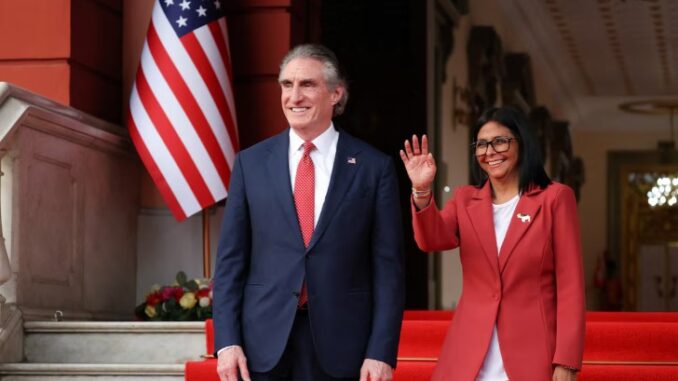
In a significant step toward strengthening U.S.-Venezuela energy and resource ties, U.S. Interior Secretary Doug Burgum arrived in Caracas today for a two-day visit aimed at forging new partnerships in critical minerals and oil production. As chairman of President Donald Trump’s National Energy Dominance Council, Burgum’s trip underscores the Trump administration’s push to revive Venezuela’s vast natural resources following the capture of former President Nicolás Maduro earlier this year. The visit comes on the heels of Energy Secretary Chris Wright’s February trip, which focused on oil, and signals a broader effort to integrate Venezuela’s mineral wealth into secure global supply chains while undercutting reliance on adversaries like China.
High-Level Meeting with Acting President Delcy RodríguezSecretary Burgum met with Venezuela’s acting President Delcy Rodríguez at the Miraflores presidential palace in Caracas.
The encounter, briefly captured by media outlets, highlighted mutual enthusiasm for collaboration. In joint remarks, Rodríguez expressed gratitude to President Trump for his support, while Burgum emphasized the “unlimited opportunities” for partnership between the two nations. He stressed the need to “cut red tape” to facilitate capital inflows, noting Venezuela’s abundance in both oil and critical minerals.
Burgum was accompanied by U.S. Chargé d’Affaires Laura Dogu and other officials. The discussions covered metallic and non-metallic minerals, strategic resources, and energy topics slated for further exploration tomorrow. President Trump publicly praised Rodríguez during the visit, calling her efforts “a great job” and noting that Venezuelan oil is already flowing to U.S. markets.
U.S. Companies Involved in the PushBurgum traveled with more than two dozen executives from U.S. mining and commodities firms, representing potential billions in investments and thousands of high-paying jobs for Venezuelans.
Key companies include:
Peabody Energy Corp.: A major coal producer eyeing opportunities in Venezuela’s mineral sector.
Hartree Partners: Involved in commodities trading and energy investments.
Trafigura: A global commodities firm with expertise in mining and metals.
Other participants from mining and metals trading sectors, focusing on rare earths, gold, and diamonds.
In the oil realm, discussions have involved major players like Chevron, ExxonMobil, and ConocoPhillips, which have been in talks for general licenses to operate independently in Venezuela.
These companies are keen on revitalizing production, with U.S. shale oil playing a role in diluting Venezuela’s heavy crude for export.
The gathering took place on the 17th floor of a downtown Caracas hotel, where Burgum told executives, “You all understand how rich the resources are,” emphasizing the U.S. commitment to unlocking Venezuela’s potential.
Deals and Announcements: Oil Deal Unveiled, Mining Reforms on the Horizon
During the visit, Burgum unveiled a new oil deal, building on the administration’s efforts to boost Venezuelan crude exports to the U.S.
Since January, the U.S. has received over 80 million barrels of Venezuelan oil, with Trump highlighting this partnership in his State of the Union address.
The deal aims to ease global oil prices and create jobs by leveraging U.S. refining capabilities.
On the minerals front, no specific deals were announced today, but acting President Rodríguez revealed that a reform to Venezuela’s main mining law—dating back to 1999—will be submitted to the legislature in the coming days for swift passage.
The reform will allow foreign companies to exploit gold, diamonds, and rare earths, addressing past nationalizations that left Venezuela owing billions to firms like Crystallex, Gold Reserve, and Rusoro Mining.
Burgum’s agenda includes meetings with oil and gas companies tomorrow to discuss expansion, signaling more announcements could follow.
Price Controls and Sustainable Financial Support: Mirroring Oil and Gas Models?
A key question surrounding the mineral partnerships is whether they will adopt similar frameworks to those in the oil and gas sectors, including price controls and sustainable financial support. In oil, the Trump administration has implemented controlled sales mechanisms to stabilize the market, granting general licenses for private operations and fostering collaboration to rebuild the industry.
This includes U.S. assistance in diluting heavy crude with lighter shale products, which has displaced Russian oil from the market and supported lower gas prices.
For minerals, the upcoming mining law reform is explicitly designed to “reflect successful models from the hydrocarbons law,” which has recently been amended to attract investment by reducing bureaucratic hurdles and encouraging foreign participation.
While specific price controls haven’t been detailed, the emphasis on “legitimate mining sectors” and “safe critical mineral supply chains” suggests a structured approach to ensure stability and sustainability, similar to oil. This could include U.S.-backed financial mechanisms, such as investment guarantees or joint ventures, to mitigate risks in high-risk environments.
Burgum has noted that U.S. companies experienced in “zones of high risk and destabilized” areas are ready to engage, implying robust support structures akin to those in energy.
Experts view this as a “win for the hemisphere,” with potential to spread wealth and foster pride in U.S.-Venezuelan collaboration.
However, challenges remain, including unconfirmed rare earth reserves and historical debts, which the reforms aim to address.
This visit marks a pivotal moment in U.S.-Venezuela relations, positioning the South American nation as a key partner in America’s energy dominance strategy. Stay tuned to Energy News Beat for updates on tomorrow’s developments.
Sources: reuters.com, facebook.com, @RapidResponse47
Get your CEO on the #1 Energy Podcast in the United States: https://sandstoneassetmgmt.com/media/
Is oil and gas right for your portfolio? https://energynewsbeat.co/invest/

Be the first to comment