In a sharp escalation of the ongoing regional conflict, Iran has placed the United Arab Emirates’ strategic Fujairah oil export terminal squarely in its sights. Once hailed as a masterstroke of energy security engineering, the Fujairah terminal and its connected pipeline have become a focal point of vulnerability as Tehran retaliates against perceived U.S.-linked operations in the Gulf.
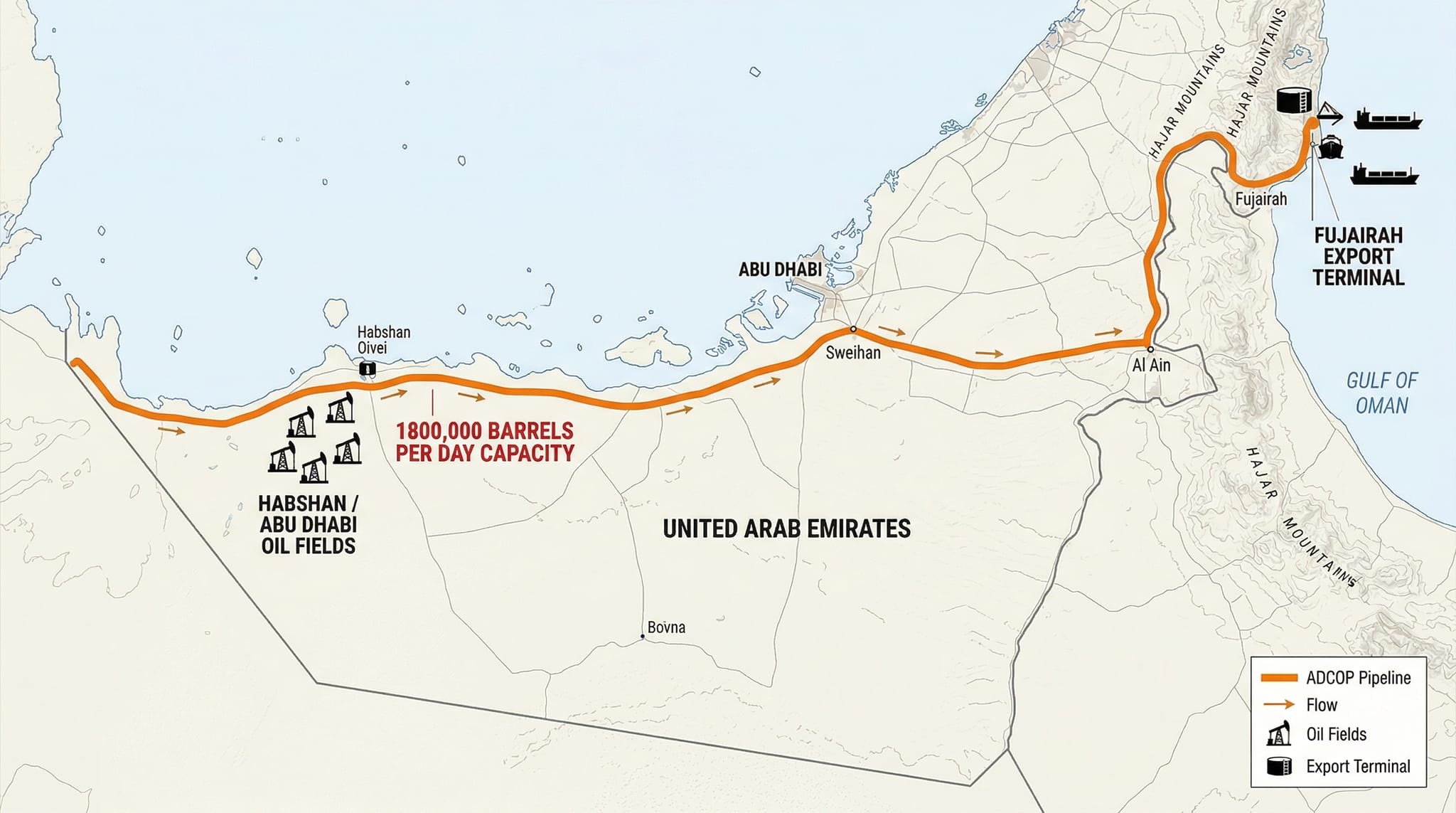
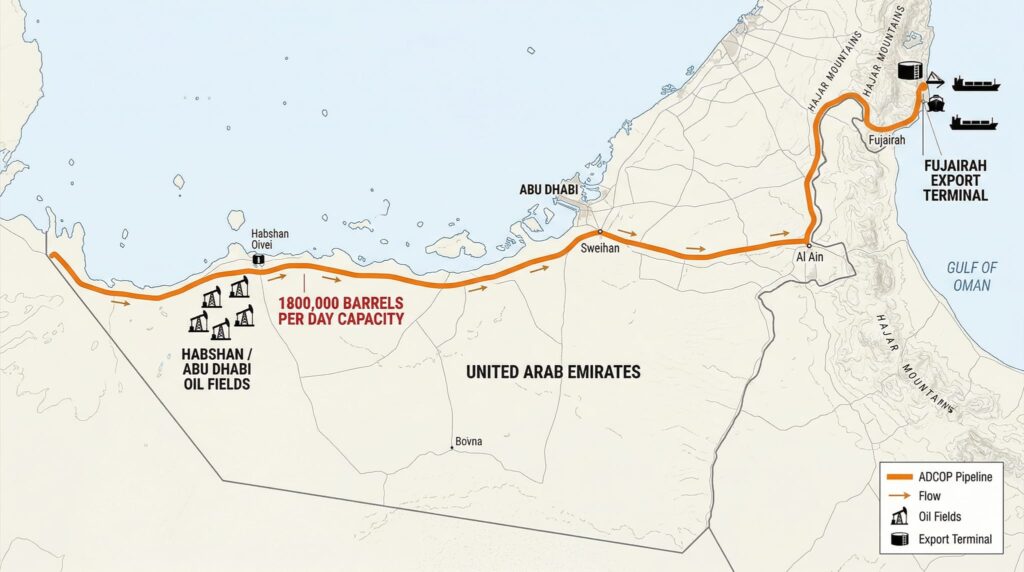
For years, the UAE invested heavily to reduce its dependence on the narrow Strait of Hormuz, through which roughly one-fifth of global oil flows. The centerpiece of that strategy is the Habshan–Fujairah pipeline, also known as the Abu Dhabi Crude Oil Pipeline (ADCOP). Built at a cost of approximately $4.2 billion and operational since 2012, this 360–380 km (220–235 mile) 48-inch pipeline runs overland from the major Habshan oil fields in inland Abu Dhabi directly eastward to the port of Fujairah on the Gulf of Oman.
By skirting the Strait of Hormuz entirely—avoiding the congested Persian Gulf shipping lanes and the choke point at the narrow strait—the pipeline allows tankers to load Murban crude (UAE’s flagship light sour grade) in open waters of the Gulf of Oman and head straight toward Asian markets without ever entering the high-risk Hormuz corridor. A short offshore section completes the route, delivering crude to the Fujairah Oil Tanker Terminals (FOTT) for export.
Volumes and Global Reach
Under normal conditions, the pipeline operates at roughly 1.1 million barrels per day (bpd) of Murban crude, representing a significant portion of the UAE’s total exports. The line’s nameplate capacity is 1.5 million bpd, with surge capability reported up to 1.7–1.8 million bpd.
Fujairah as a whole handles more than 1.7 million bpd of crude oil and refined products on average, plus massive storage (over 70 million barrels) and bunkering operations that rank it among the world’s top fuel supply hubs.
The vast majority of this oil heads to Asia. India has emerged as a leading buyer, with recent large cargoes of Murban crude shipped directly from Fujairah. Other key Asian destinations include China, Japan, South Korea, and the Philippines, where refiners prize Murban’s quality for blending and processing.
ADNOC’s international partners—among them CNPC (China), Inpex (Japan), and GS Energy (South Korea)—hold equity stakes that further channel volumes into these markets.Now in the Cross HairsThe pipeline’s success in bypassing Hormuz ironically made Fujairah a prime target once the strait itself became a war zone. In March 2026, as the U.S.-Iran conflict intensified following strikes on Iran’s Kharg Island terminal, Tehran labeled UAE ports—including Fujairah—“legitimate targets,” claiming they housed U.S. assets used in attacks on Iranian infrastructure.
Multiple Iranian drone strikes followed. Debris from intercepted drones sparked fires at oil storage facilities and terminals in the Fujairah industrial zone. Loading operations were suspended temporarily, with smoke plumes visible over the port and at least two single-point mooring buoys affected.
Although some operations have resumed, the incidents underscore Fujairah’s newfound exposure: even a Hormuz bypass is not immune when the conflict spills onto land and coastal infrastructure.
With Hormuz largely closed, the UAE had ramped pipeline flows to near-maximum capacity (1.62–1.8 million bpd in recent weeks), making any disruption at Fujairah immediately painful for both ADNOC and global supply chains.
What Options Does the UAE Have?
Short-term relief is limited. The pipeline already runs close to capacity, and Fujairah’s port infrastructure constrains further surges. ADNOC maintains robust air defenses, and several drones have been intercepted, but repeated attacks highlight the challenge of protecting sprawling storage tanks and loading berths.
Longer-term options include:
Pipeline expansion: ADNOC is advancing plans for a second 1.5 million bpd line linking offshore fields at Jebel Dhanna (via Habshan) to Fujairah, targeted for 2027. This would nearly double bypass capacity.
Strategic storage: The world’s largest underground crude storage cavern—42 million barrels—is being completed at Fujairah, providing a buffer against short-term outages.
Diversification: Greater use of Oman’s Duqm port or enhanced Red Sea routing (via Saudi partnerships) could be explored, though both require major new investment.
Diplomatic and military posture: Strengthened alliances with the U.S. and GCC partners, plus continued investment in advanced missile defense, remain critical.
The UAE’s $4.2 billion bet on the Habshan–Fujairah pipeline once seemed like an ironclad insurance policy against Hormuz risk.
Today, it stands as both a lifeline and a lightning rod. As the conflict drags on, the world is watching whether Fujairah’s strategic bypass can withstand sustained pressure—or whether the UAE must accelerate even bolder infrastructure moves to keep its oil flowing freely to Asia and beyond.
Energy News Beat will continue monitoring developments at Fujairah and their impact on global oil markets.
- Habshan–Fujairah oil pipeline (Wikipedia) – Length: 360 km (220 mi), 48-inch diameter, commissioned 2012, capacity 1.5 million bpd.
https://en.wikipedia.org/wiki/Habshan%E2%80%93Fujairah_oil_pipeline - Habshan–Fujairah Oil Pipeline (Global Energy Monitor) – Construction cost $4.2 billion, bypass rationale, full specs.
https://www.gem.wiki/Habshan%E2%80%93Fujairah_Oil_Pipeline - Abu Dhabi Crude Oil Pipeline Project (UAE Embassy, 2012) – Early operational data and strategic purpose.
https://www.uae-embassy.org/news/abu-dhabi-crude-oil-pipeline-project
2. Export Volumes, Throughput & Fujairah Operations (2025–March 2026)
- UAE boosts Fujairah oil exports as Hormuz disruption redirects crude flows (World Oil / Bloomberg, 27 Mar 2026) – Post-attack loadings averaged 1.9 million bpd in late March; surge from 2025 baseline.
https://worldoil.com/news/2026/3/27/uae-boosts-fujairah-oil-exports-as-hormuz-disruption-redirects-crude-flows - UAE’s Fujairah resumes oil loadings after attack (Reuters, 15 Mar 2026) – Fujairah handled >1.7 million bpd of crude + refined products in 2025.
https://www.reuters.com/business/energy/oil-loading-operations-uaes-fujairah-have-restarted-industry-source-says-2026-03-15 - Why does the port of Fujairah matter to the oil market? (Reuters / Korea Times, 15–16 Mar 2026) – Storage capacity, bunkering ranking, and Murban export role.
https://www.reuters.com/business/energy/why-does-port-fujairah-matter-oil-market-2026-03-14
3. Main Customers & Market Destinations
- The strategic importance of Fujairah to global oil markets (Modern Diplomacy, 14 Mar 2026) – Murban crude sold mostly to Asia (China, India, Japan, South Korea).
https://moderndiplomacy.eu/2026/03/14/the-strategic-importance-of-fujairah-to-global-oil-markets - South Korea Secures UAE Oil Supply Amid Middle East Crisis (StratNews Global, 18 Mar 2026) – Confirmed large Murban cargoes to South Korea; broader Asian priority.
https://stratnewsglobal.com/asia/south-korea/south-korea-secures-uae-oil-supply-amid-middle-east-crisis - Strait of Hormuz – About (IEA) – Asian destinations (China, India, Japan, South Korea) account for the vast majority of Gulf crude via Fujairah bypass.
https://www.iea.org/about/oil-security-and-emergency-response/strait-of-hormuz
4. Iranian Targeting & March 2026 Drone Strikes on Fujairah
- 2026 Iranian strikes on the United Arab Emirates (Wikipedia, updated 31 Mar 2026) – Timeline of drone attacks on Fujairah Oil Industry Zone, fires, and loading suspensions.
https://en.wikipedia.org/wiki/2026_Iranian_strikes_on_the_United_Arab_Emirates - UAE’s Fujairah hit, causing a large fire at the key oil trading hub (CNBC, 16 Mar 2026) – Drone strikes, fires, and temporary suspension of operations.
https://www.cnbc.com/2026/03/16/uae-fujairah-oil-hub-drone-fire-iran-war-us-israel-middle-east.html - Photos show aftermath from Iran’s waves of retaliatory strikes (Reuters Pictures, 30 Mar 2026) – Visual documentation of fires and debris at Fujairah oil zone.
https://www.reuters.com/pictures/photos-show-aftermath-irans-waves-retaliatory-strikes-2026-03-30/3TF46NOUKVOGTINFU5D5VMQTPU - Oil loading suspended at UAE’s Fujairah port after drone attack (Iran International, 16 Mar 2026) – Direct impact on loading berths and single-point moorings.
https://www.iranintl.com/en/202603168823
5. Future Options – Expansion, Storage & Diversification
- Adnoc’s New Strategic Fujairah Crude Pipeline to Double Flows (Energy Intelligence, 11 Oct 2024; still active 2026) – Plans for a second 1.5 million bpd pipeline to Fujairah (target ~2027).
https://www.energyintel.com/00000192-7afe-d9e0-a5df-7ffe73070000 - ADNOC’s Fujairah crude oil storage caverns (S&P Global / earlier ADNOC announcements) – 42 million barrel underground cavern project (phased completion).
https://www.spglobal.com/energy/en/news-research/latest-news/crude-oil/052522-adnocs-fujairah-crude-oil-storage-caverns-set-to-open-in-2023-sources - Two pipelines helping Saudi Arabia, UAE bypass the Strait of Hormuz (CNBC, 12 Mar 2026) – Current utilization, spare capacity, and surge potential to 1.8 million bpd.
https://www.cnbc.com/2026/03/12/strait-of-hormuz-oil-pipelines-iran-war-saudi-arabia-uae.html
Additional Context & Real-Time Monitoring
Energy News Beat will continue tracking developments using tanker-tracking data from Kpler/Vortexa, official ADNOC statements, and IEA updates. All links above were active and verified as of April 1, 2026.
What do you feel about this post?

Like

Love

Happy

Haha

Sad