


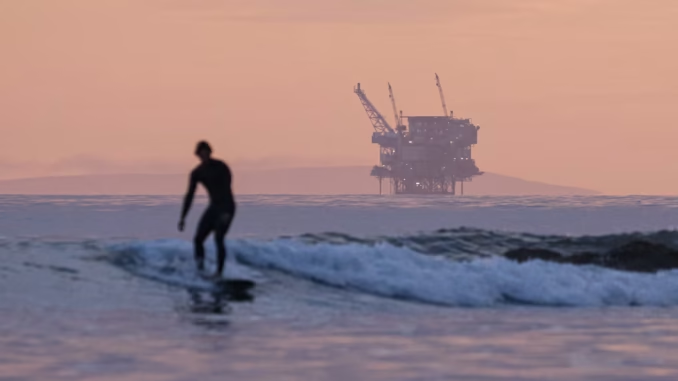
Oil is flowing again off the Santa Barbara coast for the first time in over a decade. On Monday, Sable Offshore Corp. restarted the Santa Ynez Pipeline System, sending “black gold” from its Dos Cuadras Field platforms through the onshore network that ends at Pentland Station in Kern County. The move follows President Donald Trump’s executive order last Friday, invoking the Defense Production Act (DPA) for national security reasons — a direct override of California state blocks that had kept the system idle since the 2015 Refugio oil spill.
Sable has 540,000 barrels of processed crude already in storage and plans to begin sales by April 1 at roughly 50,000 barrels per day. Full production across its three offshore platforms is expected by June, delivering what Sable Chairman and CEO Jim Flores called a roughly 17% boost in domestic crude supply for California consumers. “We look forward to working closely with the Department of Energy … to deliver the energy necessary for the security and defense of the country,” Flores said.
Gavin Newsom’s administration immediately threw up roadblocks.
Governor Newsom labeled the federal order “illegal,” claiming the pipeline’s operators face criminal charges and are barred by multiple court orders. He vowed to fight in court, while environmental groups like the Center for Biological Diversity warned of another “oil disaster.” State Attorney General Rob Bonta and the California State Fire Marshal have already sued the Trump administration over federal preemption of state oversight. Santa Barbara County prosecutors have filed criminal charges against Sable for alleged water-protection violations.
This is classic California obstructionism — the same regulatory overreach that has already driven the state’s refining industry to the brink of collapse. California once had more than 40 refineries. Today, it has just seven operational facilities. Recent closures include Phillips 66’s Wilmington/Carson complex (shuttered December 2025) and Valero’s Benicia refinery (idling April 2026), slashing roughly 18-20% of the state’s refining capacity. Multiple others have warned they are evaluating exit or conversion amid CARB’s proposed “cap-and-invest” rules, low-carbon fuel standard mandates, and relentless permitting delays. Industry leaders, including Chevron, have explicitly told Newsom these policies are a “death knell” for the remaining plants.
Without federal action on the entire downstream market — refining, storage, and distribution — Sable’s offshore win will be meaningless.
Federalizing the Santa Ynez project is a strong first step, but crude has to be turned into gasoline, diesel, and jet fuel somewhere. If California’s last refineries shut down, the state will be 100% dependent on imported finished products — already a growing and dangerous trend.
Here are the latest import realities (2025 data through Q1-Q2, per California Energy Commission, EIA, and Kpler tracking):
• Gasoline (including blending components): West Coast imports (primarily California) averaged a record 119,000 barrels per day year-to-date 2025 — up 36% year-over-year and the highest since at least 2004. Total imports for the first quarter alone hit 10.6 million barrels. Major sources: Bahamas (≈40% of ship-borne volumes), India, South Korea, and rerouted Gulf Coast barrels. These imports now fill the gap left by the shrinking of in-state refining.
• Diesel (distillate fuel oil): Foreign imports average 20,000–25,000 bpd, representing roughly 20% of California’s total diesel supply. Primary origins: India and South Korea. Ironically, California often remains a net diesel exporter (9.3 million barrels exported in Q1 2025 alone), but that balance is fragile as refinery capacity erodes.
• Jet fuel (kerosene-type): California is the nation’s largest jet-fuel consumer. Roughly 20% of supply is now imported, primarily from India and other Asian refiners (South Korea). Imports have surged alongside refinery closures, with total petroleum product imports hitting a four-year high of 279,000 bpd in May 2025 — 70% from Asia.
These foreign barrels take weeks to arrive by tanker, cost more, and are vulnerable to global disruptions — exactly what national-security experts warned about. Chevron’s upstream president recently highlighted the risk to “more than 30 military defense installations” in California and the Pacific theater if domestic refining vanishes. Military readiness, commercial aviation, and emergency response all depend on a reliable West Coast fuel supply that imported cargoes simply cannot guarantee during a crisis.
Trump’s DPA action on Sable proves Washington can cut through Sacramento’s red tape when national security is on the line. The same urgency must now be applied to the downstream sector. Federal preemption or emergency permitting relief for remaining California refineries is not optional — it is essential. Without it, the “black gold” flowing from federal waters today will simply sit in storage or be shipped elsewhere while Californians pay record prices at the pump and the Pentagon worries about fuel for Pacific operations.
But is this the point of no return without Federal help in the downstream sector?
The message to the Trump administration is clear: Finish the job. Federalize the full supply chain or watch California become America’s largest energy-security liability. The offshore restart is a victory — but only the first chapter. The refining chapter must be written in Washington before Gavin Newsom and CARB close the book for good. Energy News Beat will continue tracking every barrel, every lawsuit, and every policy move. Stay tuned.
Sources: chevron.com, energynewsbeat.co, gov.ca.gov ,
Get your CEO on the #1 Energy Podcast in the United States: https://sandstoneassetmgmt.com/media/
Is oil and gas right for your portfolio? https://energynewsbeat.co/invest/





Be the first to comment