ENB Pub Note: This article is from David Blackmon’s Substack, and we highly recommend subscribing and being a paid member. This is a perfect example of the realignment of trading blocs that Stu Turley has been talking about last year. We are in the middle of a total global realignment, and this is a huge story. The new Donroe Doctrine from the White House will be entertaining to watch after the trip back from Davos. This is totally a setup against the Trump Administration, and he will react.
In case you missed it, Canadian PM Mark Carney – a noted acolyte of the World Economic Forum like his peers in the UK, France, Germany, and Australia – traveled to Beijing this week and struck a trade deal which plants America’s neighbor to the north firmly in the China orbit of what Carney says is a developing “new…world…order.”
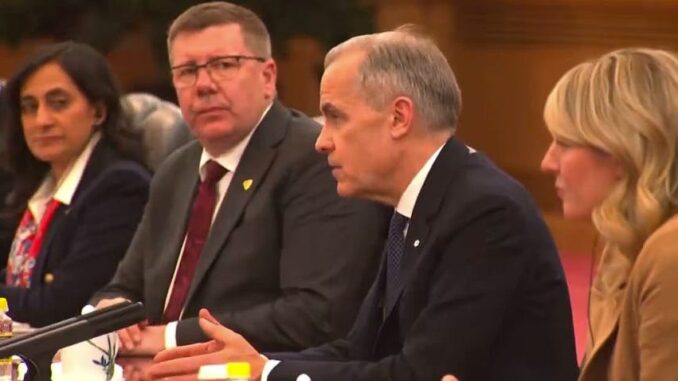
Take a look at Carney’s body language as he makes that statement during his bilateral meeting with ChiCom officials:
As I mentioned earlier China is going to buy Canadian OIL
JUST IN: 🇨🇦🇨🇳 Prime Minister Carney says Canada’s partnership with China “sets us up well for the new world order.”#oott https://t.co/Cv5EBHw2M5 pic.twitter.com/BBYN0WSg22
— Jack Prandelli (@jackprandelli) January 16, 2026
“Mine is the first visit of a Canadian prime minister to China in nearly a decade. The world has changed much since that last visit. And I believe the progress we have made and the partnership sets us up well for the new…world…order.’
Does this seem like someone who is proud of what he is saying? He has a hard time maintaining eye contact with his Chinese hosts when muttering his scripted words. Note also how he pauses between each word of “new…world…order” to put emphasis on the phrase to ensure no one misses it and its implications.
Here are the key bullet-point highlights of the deal:
- Tariff reductions on Chinese electric vehicles (EVs): Canada will allow up to 49,000 Chinese EVs into its market at a preferential most-favored-nation tariff rate of 6.1% (down dramatically from the 100% tariff imposed in 2024, in alignment with prior U.S. policy). This targets lower-cost EVs (many under $35,000), expanding affordable options for Canadian consumers and signaling potential future Chinese investment in Canada’s auto sector.
- Relief for Canadian agri-food exports: China agreed to slash tariffs on key products, including lowering duties on canola seed to around 15% from 84% by March 1, 2026, and removing discriminatory tariffs on canola meal, lobsters, crabs, peas, and related items (at least through year-end). This is expected to unlock nearly $3 billion in export orders for Canadian farmers, fishers, and processors, revitalizing access to China’s massive market.
- Broader strategic collaboration: The partnership emphasizes joint efforts in clean energy, climate competitiveness, and technology. Discussions included opportunities for Chinese investment in Canada’s expanding energy grid (e.g., offshore wind), LNG exports to Asia (targeting 50 million tonnes annually by 2030), and other sectors like forestry and pet food. It builds on earlier agreements during the visit addressing long-standing trade irritants.
- Geopolitical context and goals: Carney described the accord as adapting to “the world as it is, not as we wish it to be,” positioning Canada for greater strategic autonomy amid U.S. tariff pressures. Both sides hailed a “turnaround” in relations, with ambitions to boost two-way investment and increase Canadian exports to China by 50% by 2030.
The deal has sparked domestic debate in Canada—praised by some for economic pragmatism but criticized by others (including opposition leaders) for security risks and shifts from prior stances on China. On the latter point, it is well known that Chinese EVs are filled with surveillance tech designed to gather gigabytes of data about the space they occupy and the people who drive them and transmit it all back to Beijing.
Basically, Carney just inked a deal to import 49,000 high-tech spying platforms into Canada at a discounted price, thus mortgaging every Canadian citizen’s future to the ChiComs. Amazing.
Consider the context of this all being done amid rising tensions on trade and tariffs between Carney and Donald Trump, and we see Canada sliding perhaps irreversibly into the China orbit in this emerging “new world order” to which Carney refers.
So, what does Carney mean when he uses that term? He tries to explain it when asked by a reporter in the following clip (a transcript follows):
Reporter: What did you mean by the new world order?
Carney: The architecture, the multilateral system is being eroded—undercut. The question is what gets built in its place… pic.twitter.com/UM6cvvKGgL
— Clash Report (@clashreport) January 16, 2026
Transcript:
Reporter: Prime Minister, Brian Platt with Bloomberg News. Yesterday when you met with Premier Lee, one of the things you said in the public remarks was this partnership Canada and China, this new partnership, sets us up well for the new world order. What did you mean by that? What is the New World Order?
Carney: Well, it’s a great question, Brian, because I think the world is still determining what that order is going to be. And let’s be clear what we’re talking about first and foremost, which is what is going to govern global trade? What is the role of the WTO going to be? How important are bilateral deals such as the one we’re developing, plural lateral deal so I can use that term, Trans-Pacific Partnership. Potential linkages between Trans-Pacific Partnership and the EU. Where is financial regulation, payment system regulation going to fit into that?
All of these aspects, the architecture, the multilateral system that has been developing these is being eroded, to use a polite term, undercut, use another term.
So the question is What gets built in that place? How much of a patchwork is it? How much is it just on a bilateral basis? Or where do like-minded countries in certain areas?
So, like-mind countries, just to be clear, doesn’t mean you agree on everything. So aspects, for example, on digital trade or agricultural trade. Climate finance as another area. To move into… Areas of geostrategy, geosecurity, you will have different coalitions that are formed.
What this partnership does is in areas, for example, of clean energy, conventional energy, agriculture, as we were just talking about, and financial services, which we’ve talked less about, but the evolution of the global financial system, the role of the renminbi over time, the evolution across border payments.
I know it all sounds very dry, except for your organization, which I think takes an interest in it. These are important. Elements of how the system is going to work, and look, the expectation is that rather than these being developed necessarily through the IMF, WTO, and other multilateral organizations, it is going be coalitions that develop them, not for the world, but for subsectors of…
[End]
A more direct-to-the-point explanation would have looked like this:
- The liberal world order established immediately following the end of World War II in a series of binding international agreements is ending – President Trump is speeding up that process.
- The era in which the United States spent hundreds of billions of dollars every year propping up western democracies – most of which, like Canada, barely even qualify as such anymore – and “protecting” them from real and imaginary aggressors is rapidly disappearing.
- A new era is dawning, one in which global trading blocks and the multi-national security arrangements will be completely reorganized.
- Five years from now, economic and trade partnerships like the G7 and G20, as well NATO and other security alliances will no longer exist. They will be supplanted by alliances which are only now beginning to take form.
- This accelerating global reorganization is being driven by a competition between the two major global powers: The United States and China.
- It is incumbent now on every national government to begin the process of picking sides – of deciding whether to align its country and its people among the US orbit or China’s orbit.
The agreement Carney just struck with China sends a clear signal of which way his government plans to jump. If that process of realignment continues, America will soon be faced with the reality of having a China puppet nation perched on its northern border.
What a time to be alive.
That is all.