


ENB Pub Note: This is a huge story from the Cowboy State Daily, and we recommend subscribing and following them.
An Albany County conservation group is accusing federal agencies of concealing eagle deaths caused by wind farms in Carbon County.
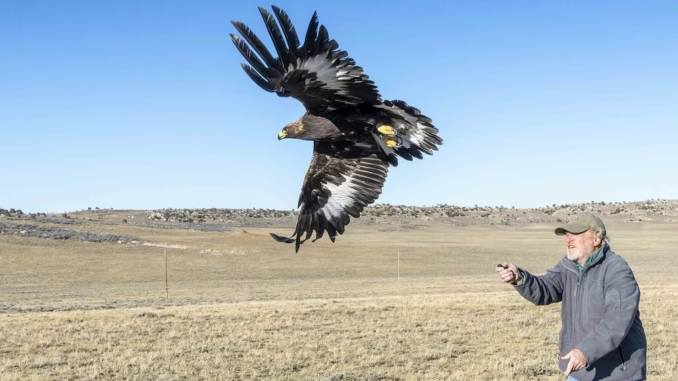
Meanwhile a retired Wyoming Game and Fish biologist says the number of golden eagles — a protected species — are plummeting in Carbon County. His data suggests wind farms are to blame for nearly half of all human-caused eagle deaths.
The Albany County Conservancy has filed a lawsuit in the District of Columbia to force the U.S. Department of the Interior and U.S. Fish and Wildlife Service to release all 1,166 pages of the incident reports about bald and golden eagle deaths and injuries related to the Seven Mile Hill, Ekola Flats, and Dunlap wind farms.
The Conservancy had first sought these records through a Freedom of Information Act (FOIA) filing submitted late last year to U.S. Fish and Wildlife, after learning from retired U.S. Fish and Wildlife Service biologist Mike Lockhart about concerning levels of eagle deaths.
In March, the federal agency acknowledged having 1,166 pages of responsive material but would only release 256 redacted pages.
The agency cited an exemption that’s meant to protect trade secrets and competitive commercial material, according to the Conservancy’s court filing.
“Defendants’ obfuscation and the lack of any coherent justification for withholding this information strongly suggests that defendants have something to hide,” Albany County Conservancy attorney William Eubanks wrote in the lawsuit. “It may well be that eagle mortality stemming from these projects is far outpacing predictions, or FWS may be asleep at the switch.
“Either way, under FOIA (Freedom of Information Act), the public has a right to know,” Eubanks continued. “This is especially true where there may be recurring violations of federal law.”
Little Data On Known Eagle Deaths
The limited data that the federal agency did release didn’t include known instances of eagle deaths reported by Lockhart, Albany County Conservancy’s Executive Director Anne Brand told Cowboy State Daily.
That’s a big red flag, she added, for anyone who cares about continuing to see eagles in Wyoming.
“Golden eagles, I mean, there’s nothing above them,” she said. “They have a 7-foot wingspan, and they’ve been coming to Wyoming forever. We’re talking about millions of years. (They) are an apex predator, so they indicate the health of an entire ecosystem. When golden eagles aren’t doing well, it means our entire ecosystem is out of whack, and that’s why our membership is very honed into this.”
Because golden eagles are a protected species, wind farms are required to maintain a dead eagle database.
“We have this bald and golden eagle preservation act, which says you can’t kill an eagle,” Brand said. “If you do, it’s punishable by a really huge fine or even being put in prison. But back in the day, they decided they would allow an eagle take permit for wind developers.”
The permit requires wind farm companies to track eagle deaths and injuries.
Brand’s group sought these records after hearing from Lockhart that large numbers of golden eagles were being particularly affected by newer wind farms in Carbon County.
“This information is public,” Brand said. “They are required by their own legal definitions to collect this information. This is something that the public has a right to have access to, and I have asked appropriately.”
One Majestic Bird’s Miserable Death
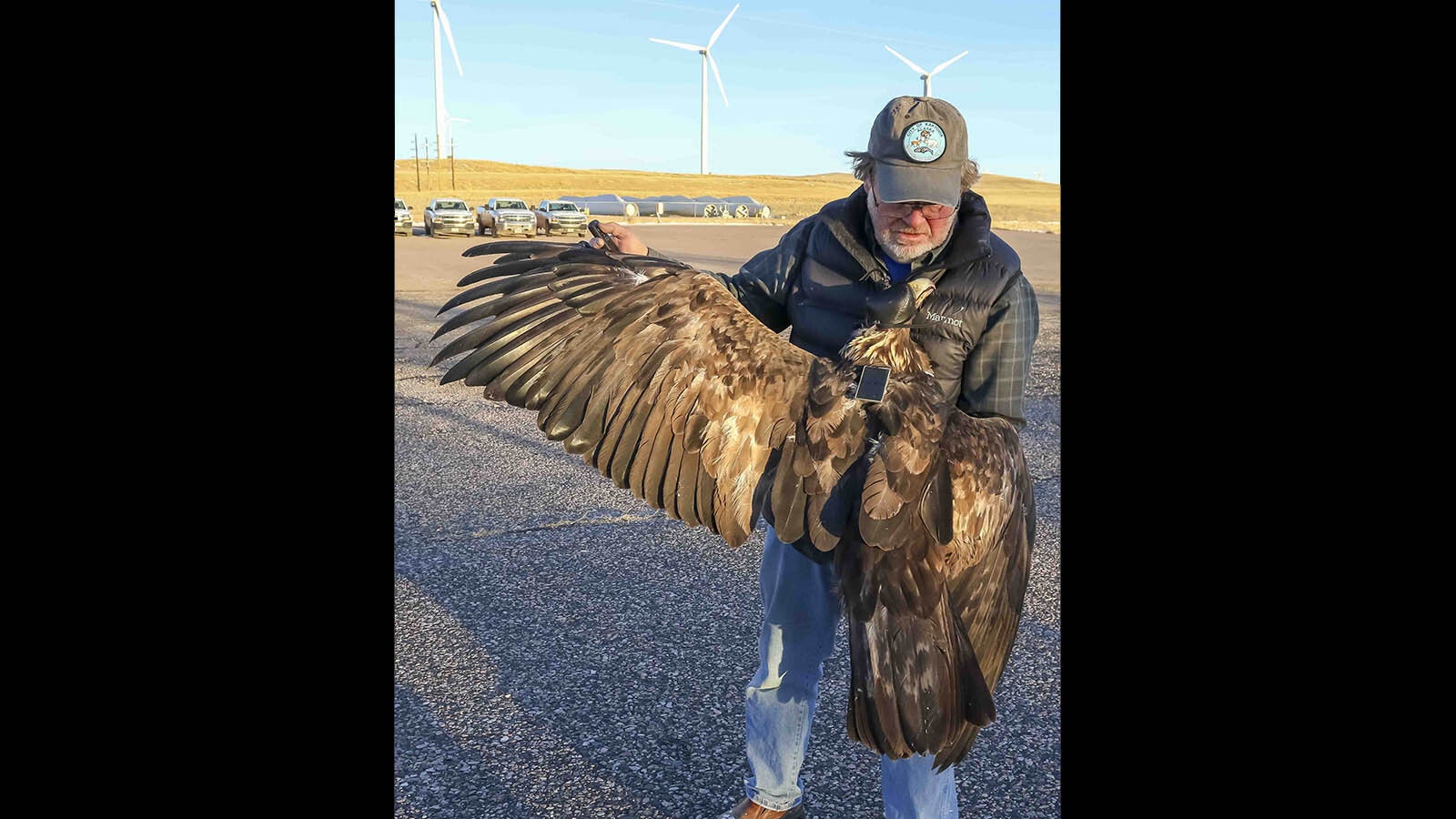
Lockhart told Cowboy State Daily he just recently helped a biologist who worked for Fish and Wildlife Services recover a tagged bird north of Rock River.
“When we found that tag, it was still attached to the bird,” he said. “And when the biologist got back and started looking at the data, he found out he got hit by a wind turbine on Oct. 15. It had walked over 4 miles and eventually succumbed to starvation and stress. So, a miserable death.”
While a miserable death for the bird, it was, in some ways, lucky for the wildlife researchers trying to track eagle deaths.
“The only reason that eagle was recovered was because that transmitter was still working, so we could find it,” Lockhart said. “I know that when some of the birds are struck the transmitters are destroyed. They become instantly useless.”
Another of the birds Lockhart found had a wing completely sheared off, which was thrown out of the radius of the turbine. Thanks to that, Lockhart was able to confirm that death as well.
Tracking Bird Deaths Is Difficult
Some of the reports in the U.S. Fish and Wildlife record should have been Lockhart’s.
But Lockhart is not able to track all eagles. He’d like a look at the larger subset to better understand what’s happening on the ground.
Lockhart has been tagging eagles in wind farm country since 2017 for two national nonprofit conservation groups. Before that, he worked with eagles off and on throughout a 33-year career with Fish and Wildlife. He has been observing eagles for a long time in the Cowboy State.
Of the 161 eagles he’s tagged in Wyoming for the studies he’s doing, he’s been able to confirm a cause of death in 29 cases, about half of which he has been able to confirm were due to wind farms.
But he knows his figures are not capturing the total picture. For one he’s only tracking healthy eagles that he’s been able to catch and tag. Any that appear to be struggling, he releases without a tag.
He also only counts deaths where he can find the bird’s body and confirm both the death and its cause.
So far, he has 46 birds whose fates are completely unknown.
“They could be radio tag failures, they could be shed tags in places where they fell off and I’d have no signal,” he said. “I also have 21 birds that pulled the tags off where I was able to recover the tag. And some, I know were absolute tag failures, because you can check the battery level as it goes down, and right before I lost them, the battery had failed.”
The 46 unknowns do include eight birds that Lockhart strongly believes were killed by wind farms, based on tracking data and other details.
“Going back in, looking at the tracks of those birds, they had very good batteries and they were flying normally,” he said. “Then they just, all of a sudden, disappeared in proximity to wind turbines. So, I suspect, and I can only say it that way, that those birds were killed by wind turbines.”
Not Seeing As Many Birds
Beyond the data set Lockhart has been collecting, however, there’s another, more anecdotal data set in his head.
He’s been in Wyoming working with wildlife since 1996, and he sees a lot fewer golden eagles today than he used to see.
“I used to drive south of Laramie, and I could see 14, 15 golden eagles in an area that I used to go to,” he said. “I don’t see that anymore.”
That’s something he feels that public agencies are not being totally forthright about with the public.
“That needs to be exposed,” he said.
Knowing what he knows now, Lockhart wishes he’d kept better records on his observations of eagle prevalence in the field.
“I am going back to look at my data retrospectively, in terms of trapping days and numbers of eagles encountered during trapping days,” he said. “But I know that the population has just, I mean, it’s just collapsed compared to what it used to be. I just don’t have any specific figures to cite in saying that.”
Renée Jean can be reached at renee@cowboystatedaily.com.
Want to get your story in front of our massive audience? Get a media Kit Here. Please help us help you grow your business in Energy.




