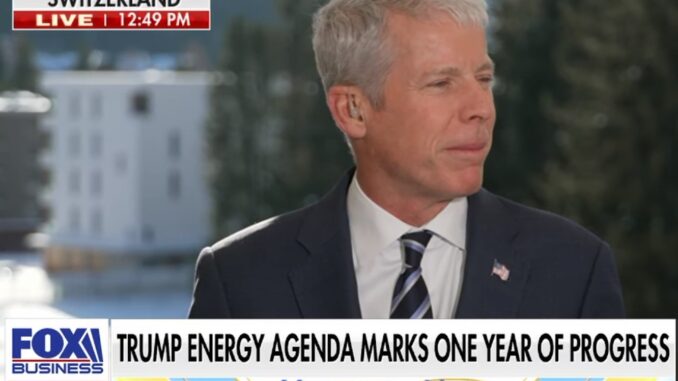
Secretary Chris Wright has some key points, and the fact that Venezuela may bring in $5 billion this year is huge, and that could be a huge win for the Venezuelan people if handled correctly. Secretary Wright’s handling of the Venezuela oil situation has been critical for both Venezuela and the United States.
The main topics discussed in this interview are:
1. Declining energy prices:
– Secretary Chris Wright mentions that average gasoline prices are now well below $3 per gallon, and this may be the first year they average below $3 in quite some time.
– He attributes this to continued growth in oil supply and oil prices trending downward.
2. Efforts to increase domestic energy production:
– The Secretary discusses the administration’s efforts to make it easier to refine oil in the United States, which helps lower the cost chain.
– He expresses confidence in the ability of the U.S. oil and gas sector to thrive, even as prices fluctuate.
3. Utilization of Venezuelan oil:
– The discussion covers the first sale of sanctioned Venezuelan oil, which generated $500 million initially and is expected to bring in over $5 billion this year.
– The Secretary explains how this oil was previously sold at a steep discount, benefiting adversaries like China, but is now being marketed by the U.S. government to reduce energy prices and displace criminal activity.
4. Importance of energy for innovation and competitiveness:
– The transcript touches on the connection between energy availability and the ability to drive innovation, particularly in areas like AI and semiconductors.
– The Secretary emphasizes the need to expand electricity production capacity to support the growth of these critical technologies.
5. Challenges with European energy policy:
– The discussion references the European reliance on Russian energy sources, which the Secretary says they are now working to end.
– He suggests that Europe needs to take a more realistic approach to energy policy to maintain its economic and military strength.
After watching President Trump’s speech and Secretary Chris Wright’s interview, we can see that the EU is set for major failures if it does not pivot.
Blue states like California shut down coal plants and poured billions into unreliable wind and solar infrastructure, resulting in high energy prices and an unstable grid.
In just one year, President Trump and @SecretaryWright have already saved 17GW of coal capacity from going… pic.twitter.com/A6RQOpeaML
— U.S. Department of Energy (@ENERGY) January 22, 2026
Secretary Wright’s key quotes:
Here are some of the most interesting and impactful quotes from the transcript:
1. “We’re also making it easier to refine oil in the United States. We’re trying to lower that part of the cost chain as well.” – Secretary Chris Wright
This quote highlights the administration’s efforts to improve domestic oil refining capabilities, which can help drive down energy prices.
2. “U.S. American oil and gas companies have just been tremendous innovators. With the shale revolution, they’ve just changed the global energy situation.” – Secretary Chris Wright
This quote emphasizes the innovative capabilities of the U.S. oil and gas industry and its significant impact on the global energy landscape.
3. “We’re growing their revenues of their government, and we have significant influence over them to start to end the criminality, displace our adversaries, and bring a better society in Venezuela.” – Secretary Chris Wright
This quote discusses the strategic benefits of utilizing Venezuelan oil, including reducing the influence of adversaries and promoting positive change in the country.
4. “The biggest constraint right now in the speed of innovation of A.I. In the United States is the speed we can grow our electricity production.” – Secretary Chris Wright
This quote underscores the critical importance of expanding electricity production capacity to support the growth of emerging technologies like AI.
5. “Building new capacity and expanding the demand for electricity is very helpful in keeping prices down. It’s states like California that have invested huge amounts of money in closing plants, building wind farms and solar panels, and they’ve actually produced less electricity today than they did five or ten years ago. That’s the road to high prices.” – Secretary Chris Wright
This quote provides a clear contrast between the administration’s approach to expanding electricity production and the approach taken by some states, highlighting the potential impact on energy prices.