


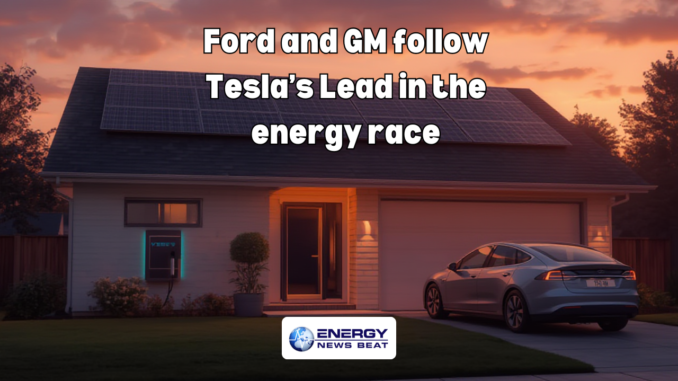
In the rapidly evolving landscape of energy and automotive innovation, traditional automakers Ford and General Motors (GM) are pivoting toward energy storage solutions, mirroring Tesla’s established dominance in the sector. This strategic shift comes as electric vehicle (EV) adoption slows in the U.S., partly due to reduced government incentives under the Trump administration, prompting these companies to diversify their portfolios and cut EV manufacturing costs. Much like how oil giants ExxonMobil and Chevron are following Liberty Energy’s footsteps into powering hyperscale data centers with natural gas, Ford and GM are leveraging their battery expertise to enter the energy storage market—aiming to own a slice of the value chain that supports EVs, grid stability, and renewable integration.
The global battery energy storage system market is booming, projected to reach $14.5 billion by 2027 with a compound annual growth rate (CAGR) of 25.2% from 2021 to 2027.
This growth is fueled by surging demand for utility-scale storage to bolster renewable energy adoption and enhance grid reliability, alongside needs from data centers and backup power during blackouts. For Ford and GM, this represents an opportunity to offset sluggish EV sales while capitalizing on their investments in battery technology.
Ford’s Strategic Shift to Energy Storage
Ford is aggressively repurposing its facilities to produce batteries for energy storage. The company is converting its Kentucky battery plant specifically for this purpose and allocating part of its Marshall, Michigan, factory to manufacture residential storage cells alongside EV truck batteries.
Ford has already invested $10 billion in EV-related initiatives, with an additional $2 billion planned, but it’s now emphasizing hybrids, trucks, commercial vehicles, and energy storage for better returns. This pivot follows a massive $19.5 billion write-down on its EV investments, reflecting a pragmatic response to market realities.
GM’s Push Through GM Energy
GM, on the other hand, launched its GM Energy division several years ago and is partnering with Redwood Materials to repurpose EV batteries for storage applications.
The company offers the PowerBank home storage product in 10.6 kWh and 17.7 kWh variants, allowing EV owners to store and transfer solar energy. Sales of these products have surged fivefold from January to October last year.
GM is also selling charging adapters, positioning itself to empower customers with greater control over energy usage, outage mitigation, and renewable integration.Tesla’s Unrivaled LeadTesla remains the frontrunner, with its global giga-factories enabling massive scale. The company deployed over 3 GWh in 2020 alone, primarily through its Megapack systems for grid stabilization.
In the 12 months ending October 2024, Tesla’s deployed capacity grew 84% year-over-year to 43.5 GWh, generating $3.41 billion in revenues against $2.32 billion in costs.
This dominance underscores Tesla’s integrated approach, from vehicle production to energy storage, which Ford and GM are now emulating to drive EV adoption by addressing infrastructure challenges.
Parallels to Oil Majors in the Hyperscaler Space
This automotive pivot echoes developments in the energy sector, where ExxonMobil and Chevron are trailing Liberty Energy into supplying power for data centers.
Liberty Energy, a leader in innovative energy services, has partnered with Vantage Data Centers to develop and operate up to 1 GW of power solutions for next-generation facilities.
Chevron is rolling out its first data center power project in West Texas, supplying natural gas-fired power directly to an unnamed hyperscaler, with operations expected by late 2027.
ExxonMobil is in advanced talks to power data centers with natural gas plants equipped with carbon capture technology, aiming to capture 90% of emissions.
Just as these oil majors are leveraging natural gas abundance to meet AI-driven energy demands without straining public grids, Ford and GM are using their battery know-how to carve out roles in storage, potentially stabilizing EV ecosystems and creating new revenue streams.
Comparing Q4 2025 Earnings: Investor Returns in Focus
To gauge the financial health and investor appeal of these companies amid their pivots, let’s examine their latest Q4 2025 earnings. Ford faced significant headwinds, including a massive net loss driven by EV write-downs, while GM showed resilience with beats on adjusted EPS and strong cash flow for shareholder returns. Tesla, despite its lead in energy storage, reported its first annual revenue decline, highlighting competitive pressures.
|
Metric
|
Ford
|
GM
|
Tesla
|
|---|---|---|---|
|
Q4 Revenue
|
$45.9 billion (down 5% YoY)
|
$45.3 billion (down 5.1% YoY)
|
$24.9 billion (down 3% YoY)
|
|
FY Revenue
|
$187.3 billion (up 1% YoY)
|
$185.02 billion (down 1.3% YoY)
|
$94.8 billion (down from $97.7 billion)
|
|
Q4 Net Income/Loss
|
Loss of $11.1 billion
|
Loss of $3.3 billion
|
$840 million (down 61% YoY)
|
|
FY Net Income/Loss
|
Loss of $8.2 billion
|
$2.7 billion (down 55% YoY)
|
$3.8 billion
|
|
Q4 Adjusted EPS
|
$0.13 (missed $0.19 estimate)
|
$2.51 (beat $2.20 estimate)
|
$0.50 (beat $0.45 estimate)
|
|
FY Adjusted EPS
|
N/A
|
$10.60
|
N/A (Non-GAAP net income: FY $5.9 billion)
|
|
Adjusted EBIT (FY)
|
$6.8 billion
|
$12.7 billion (down 15% YoY)
|
N/A
|
|
Key Investor Returns
|
Stock rose 0.52% post-earnings; 13.2% U.S. market share (best in 6 years)
|
54% total shareholder return in 2025; 20% dividend increase to $0.18/share; $6B buyback authorization
|
Highest gross margin in two years; stock up 0.22% post-earnings
|
Sources: Ford data from official earnings release and analyst summaries. GM from investor relations and CNBC. Tesla from quarterly update and CNBC.
Ford’s losses reflect heavy restructuring costs, but its focus on profitable segments like trucks could yield better returns long-term. GM stands out with robust cash generation ($10.6 billion adjusted automotive free cash flow), enabling significant shareholder payouts—making it attractive for income-focused investors.
Tesla’s beat on EPS and growth in energy storage (despite overall revenue dips) signal potential upside as it scales AI and autonomy, though its high valuation demands sustained execution.
Looking Ahead: Driving EVs Through Storage Dominance
As Ford and GM chase Tesla in energy storage, they face challenges like uncertain EV demand and the need for alternative revenues. However, opportunities abound in a market hungry for reliable, scalable solutions. By owning more of the energy ecosystem, these automakers could accelerate EV adoption, much like Exxon and Chevron aim to fuel the AI boom. For investors, GM’s strong returns and Tesla’s innovation edge make them compelling, while Ford’s recovery potential offers value. This race isn’t just about batteries—it’s about reshaping the future of energy and mobility.
As Stu Turley discusses Energy Security Starting At Home on the Energy News Beat Channel, it makes sense that car companies watch Tesla’s success and follow its lead. How well they implement is yet to be seen. Michael Tanner and Stu Turley will cover the stock charts, and discuss this on the Energy News Beat Stand Up later today.
Get your CEO on the podcast: https://sandstoneassetmgmt.com/media/
Is oil and gas right for your portfolio? https://sandstoneassetmgmt.com/invest-in-oil-and-gas/




Be the first to comment