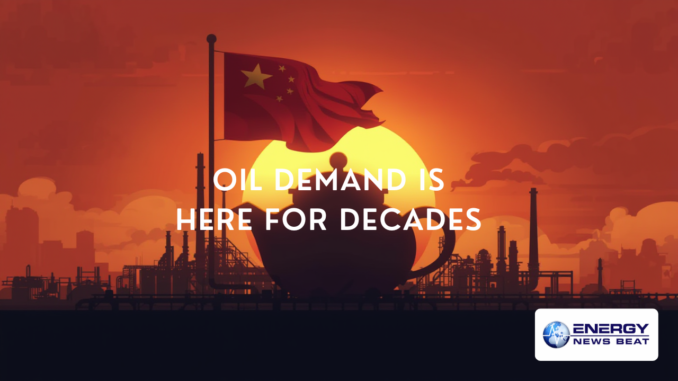
In a world increasingly focused on energy transitions and geopolitical tensions, recent projections paint a picture of sustained growth in global oil demand. According to a report from the CNPC Economics and Technology Research Institute, global oil demand is expected to continue rising until peaking in 2040 at 4.8 billion tons, marking a significant upward revision from previous estimates.
This forecast, driven by stronger-than-expected consumption and heightened emphasis on energy security, suggests that oil will remain a cornerstone of the global energy mix for at least another 15 years. But what underpins this growth, and how are key players like India and China influencing the market? More importantly, what are the implications for consumers and investors navigating this landscape?
Projections for Sustained Oil Demand Growth
The CNPC report highlights a 5.2% increase in the peak demand estimate compared to last year, with global energy demand projected to rise 15% from 2025 to 2035, reaching 17.6 billion tons of oil equivalent.
China’s oil demand is anticipated to stabilize between 2025 and 2030, while its total energy consumption peaks around 2035 at 5 billion tons of oil equivalent, with oil and gas retaining over 25% market share.
Natural gas demand is also revised upward by 11%, peaking between 2040 and 2045 at 5 trillion cubic meters.
This optimism contrasts with slowing demand in developed regions like the UK and EU, where energy transitions toward renewables and efficiency measures are curbing consumption. However, non-OECD countries, particularly China and India, are driving about 60% of global oil demand growth through petrochemicals and industrial expansion.
This shift underscores a divided world: while Western nations pursue net-zero goals, leading to deindustrialization and economic challenges, developing giants like India and China prioritize growth, effectively compensating for declines elsewhere.
India’s Defiant Push for Russian Oil Amid SanctionsIndia’s role in bolstering global demand is particularly noteworthy. Despite U.S. tariff pressures—including a 25% tariff imposed in August 2025 and threats from President Trump—India has deepened its ties with Russian oil suppliers.
Imports of Russian crude hit a five-month high of 1.855 million barrels per day (bpd) in November 2025, up from 1.48 million bpd in October, now accounting for about 50% of India’s total oil imports compared to just 2.5% in 2021.
This surge is fueled by discounted prices, enabling India to stockpile and refine ahead of 2026 EU restrictions on non-Russian oil products.
Geopolitically, this partnership remains resilient. At the December 2025 Russia-India summit, Prime Minister Modi and President Putin reaffirmed their energy cooperation, aiming to double bilateral trade to $100 billion by 2030.
Russia has redirected supplies from sanctioned European markets to Asia, sustaining its revenues while providing India with affordable energy to support its booming economy.
Such moves not only prop up global demand but also highlight how sanctions can inadvertently strengthen alternative supply chains.
Underinvestment in Oil Supply: A Looming Shortage
Compounding the demand story is a critical shortage of investment in new oil exploration and drilling. Global upstream oil investment is set to drop 6% to around $420 billion in 2025, with total upstream spending under $570 billion—levels insufficient to offset natural decline rates.
This underinvestment, driven by volatile prices, energy transition pressures, and regulatory hurdles, has created a void in new discoveries and production capacity.
Analysts warn of a looming supply deficit, with oil and gas rigs lingering near three-year lows.
OPEC+ actions further illustrate supply constraints. The group, which has cut output by about 5.3 million bpd (5% of global demand) since 2022 to stabilize prices, is now unwinding these reductions faster than planned, adding over 1.37 million bpd since April 2025.
While this aims to reclaim market share from U.S. shale, it risks oversupply in the short term—but persistent underinvestment could lead to volatility and higher prices in the medium to long term.
As one expert notes, trillions of dollars are needed just to maintain current output levels against decline curves.
Implications for Consumers
For everyday consumers, rising global oil demand coupled with supply shortages spells higher energy costs. As India and China absorb more oil to fuel their growth—offsetting flat or declining demand in the OECD—prices are poised to climb, potentially averaging $65-70 per barrel for Brent in 2025 before surging due to deficits.
This translates to elevated gasoline and heating oil prices, exacerbating inflation in transportation and utilities. In regions like the UK and EU, where demand is waning but import dependencies persist, consumers may face amplified volatility from geopolitical risks, such as ongoing sanctions on Russia. Low-income households in developing nations could benefit short-term from discounted imports but risk long-term exposure if global shortages materialize.
What This Means for Investors
Investors stand to gain from this bullish outlook on oil, but with caveats. The combination of sustained demand from Asia and underinvestment in supply creates opportunities in upstream producers, exploration firms, and integrated majors poised to capitalize on higher prices.
Companies with exposure to Russian-Indian trade routes or resilient shale operations could see revenue boosts, especially as OPEC+ maneuvers suppress short-term competition but pave the way for a super-cycle.
Diversifying into commodities like oil futures or ETFs tracking Brent/WTI could hedge against inflation. However, risks abound: trade tensions, including U.S. tariffs, could dampen global growth and demand by 200,000-500,000 bpd.
Energy transition policies in the West may accelerate, pressuring fossil fuel investments, while oversupply from OPEC+ unwinds could keep prices range-bound near $60-70 in the near term.
Savvy investors should monitor geopolitical developments, such as India-Russia summits, and focus on firms with low breakeven costs to weather volatility. Overall, the next 15 years favor a contrarian bet on oil’s endurance, rewarding those who anticipate supply crunches over green hype.
Sources: energynewsbeat.co, caixinglobal.com, oilprice.com