ENB Pub Note: Stu Turley is getting Robert Bryce scheduled to talk about this important article and the impact of the grid in Venezuela. There are many moving parts around the world, and Venezuela has become the cornerstone of the Monroe Doctrine, being enforced. The enforcement of the Dark Fleet tankers may be the tipping point for the ending of the Ukraine War, as well as the global enforcement of sanctions. Secretary Chris Wright and President Trump talked about stabilizing the grid, oil production, and the country. This will be a wild right getting rid of the corrupt system that is still in place.
When US military forces swept into Caracas early Saturday morning to capture Nicolás Maduro, among the first targets hit were, predictably, electricity targets. The fastest way to sow confusion in a society is to shut down or destroy its electric grid. And as I noted in an article last year, the US military has been using that tactic in nearly every conflict since the Korean War.
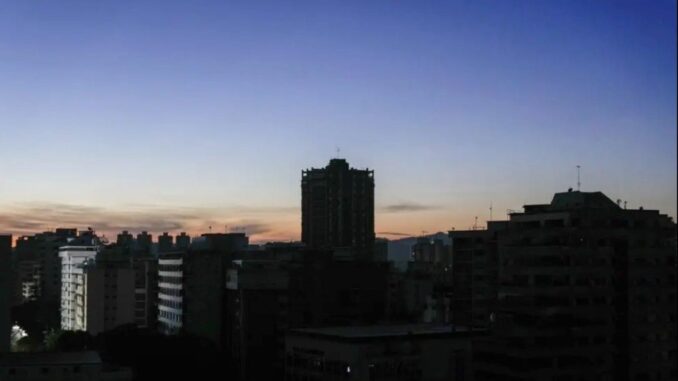
While the extent of the damage to Venezuela’s grid is still being assessed, early evidence suggests that it was extensive. Yesterday, the energy minister, Jorge Marquez, told Xinhua that the US inflicted significant damage to transmission infrastructure near Caracas and workers at the National Electric Corporation (Corpoelec) were trying to restore power. Also yesterday, a journalist with Sky News reported that Caracas residents are living in a “total blackout.” With no electricity or Internet, the reporter, Rosali Hernandez, said that citizens are unable to get any news or information about what will happen next or when the power might return.
Electric grids are a near-perfect reflection of the societies they power. In countries where corruption is rampant, electricity systems don’t work because the leaders, and citizens alike, are stealing too much. The theft includes cash intended for grid investment, equipment needed to deliver power, and the juice itself. Put another way, theft is the enemy of light. And under Maduro’s kleptocratic regime, Venezuela’s electricity production has plummeted.
Since Saturday, geopolitical analysts have primarily focused on Venezuela’s enormous heavy oil resources and how quickly that oil might enter global markets. Resuscitating the country’s oil production, and reforming its state-controlled company, PdVSA, will take years. But the most immediate challenge — and it will require spending billions of dollars — is stabilizing and rebuilding Venezuela’s tattered electric grid.
And remember, the stakes here go far beyond Venezuela’s grid. By snatching Maduro, the Trump administration is also cranking up the heat on the kleptocrats in Havana.
Let’s take a look.

Before going further, let me be clear: the US went after Maduro because of Venezuela’s oil wealth.
Secretary of State Marco Rubio himself said that yesterday during an appearance on Meet The Press. “We don’t need Venezuela’s oil,” he said. “What we’re not going to allow is for the oil industry in Venezuela to be controlled by adversaries of the United States.” Rubio was, of course, talking about China and Russia.
With an estimated 300 billion barrels of proved reserves, Venezuela is the Saudi Arabia of Latin America. Furthermore, the heavy crude that Venezuela produces is the type that refineries on the US Gulf Coast have been built to handle. Those refiners make their biggest profits — known as the crack spread — by buying lower-cost heavy sour crude and converting it into refined products. Venezuela’s heavy crude is ideal for producing diesel fuel and jet fuel. The light sweet crude produced by US shale oil formations, is not.
Given those facts, it’s not surprising that some US oil companies are seeing a bounce in their stock prices. Chevron, the Texas-based supermajor, has been operating in Venezuela since 1923, and it stayed in the country during the Chávez and Maduro regimes. Chevron’s stock is up 6% today. The stock price of San Antonio-based Valero, one of America’s biggest refiners, was up nearly 10% at midday.
While Venezuela’s vast oil wealth is tantalizing, getting the oil out of the ground and to refineries will require years of investment. It will also require vast amounts of electricity. Bringing back Venezuela’s grid will likely cost tens of billions of dollars, and it will be just as crucial as reviving its oil sector. In fact, the two efforts will have to go hand in hand.
Blackouts and electricity shortages have become common under Maduro. In 2019, the country endured a nationwide blackout that lasted for a week. As Marc Oestreich reported, the blackout shuttered hospitals, water systems, and telecom networks. At least 21 people died due to the outage or its aftermath, “a grim testament.” Oestreich notes, “to how intertwined electricity is with basic survival.” Since then, the country has been plagued by ongoing power shortages. In 2024, a blackout hit all 24 Venezuelan states, an outage that Maduro blamed on “electrical sabotage.”
Venezuela’s grid relies heavily on the Guri Dam, a huge (10,000-megawatt) hydroelectric project on the Caroni River that was built in the late 1960s. But reduced rainfall, along with insufficient investments in maintenance, has cut the dam’s output, perhaps by as much as half. Further, the Venezuelan grid has been hamstrung by a lack of spending on new generation, and, as the Associated Press noted in 2024, “a drain of engineering talent.” The AP estimates that some 8 million Venezuelans have fled the country over the past few years.

Bringing Venezuela’s top engineers back home won’t happen quickly. And it’s clear that many of them fled because of the immiseration that occurred under Maduro. As seen above, electricity production in Venezuela grew steadily under Maduro’s predecessor, the charismatic and bombastic Hugo Chávez. Generation peaked in 2013, the year that Maduro took power, and it has been declining ever since. Between 2013 and 2024, Venezuela’s electricity production dropped by 37%. A country’s electricity use always provides a good proxy for economic activity. And as Venezuela’s grid has collapsed, so has its economy. According to data from the International Monetary Fund, Venezuela’s GDP peaked at about $372 billion in 2012. By 2024, its GDP had fallen to just $120 billion.
Stabilizing the country’s power grid could be done in the short term with a battalion of portable diesel generators producing a few megawatts each. But the key questions are obvious: Who will pay for those generators? Who will operate and maintain them? Who will collect the electricity bills? Hours after snatching Maduro, President Donald Trump claimed the US will “run” Venezuela. He didn’t bother to explain how that would happen — or rather, how it could happen without putting thousands of US troops on the ground.
Furthermore, given the years of corruption under Maduro, it’s readily apparent that corruption will likely plague any government that takes his place. We can see that by looking at what happened in Iraq. During the First Iraq War and the Second Iraq War, the US bombed the Iraqi power grid. Today, Iraq’s grid still hasn’t fully recovered, and untold billions of dollars that were earmarked for infrastructure and improvements to the country’s electricity network have been lost to corruption.
Finally, it’s essential to consider what might happen next in Cuba. Without support from Maduro, the Cuban regime will be even more vulnerable. And as in Venezuela, electricity is key.
Cubans have been enduring prolonged electricity outages for years. In November, about 900 megawatts of Cuba’s electric grid, or nearly a third of daily demand, was shut down due to a lack of fuel and lubricants. According to Reuters, oil imports from Mexico had fallen by 73%, and power cuts in Havana were lasting for nine hours or more every day. Over the past few days, the island country’s power outages have gotten worse. According to Cibercuba, the country was hit by another blackout that began early Saturday morning and continued until early Sunday morning. The outlet estimated that Cuba’s decrepit power grid could meet only about half of the country’s demand, and that nearly 1,000 megawatts of capacity had been forced offline due to a lack of fuel and lubricants. For its part, the Cuban government continues to blame the outages on “technical failures.”
For two decades, Venezuela has been giving Cuba’s ruling regime about 50,000 barrels of oil per day — all of it free of charge. Cuba’s power grid now depends almost entirely on generators that burn Venezuelan fuel. But by ousting Maduro, the US has effectively cut off Cuba’s fuel supply. Without it, Cuba’s grid could shut down entirely within the next two weeks. A nationwide power outage of that magnitude would lead to calamity for the 11 million residents of Cuba, who, according to this CNN article, are already facing food shortages. A prolonged blackout will also likely imperil the communist country’s leaders.
Of course, it’s far too early to predict what will happen next. The Cuban regime has endured loads of turmoil since Fidel Castro seized power in 1959. The Trump administration’s embrace of a new Monroe Doctrine (or, as some are calling it, the Donroe Doctrine) could turn out to be a geopolitical masterstroke. It could also sour quickly into a costly quagmire and a humanitarian disaster.
Whatever happens next, I guarantee you that electricity will be a top story in Caracas and Havana for months to come.
We recommend subscribing to Robert Bryce