


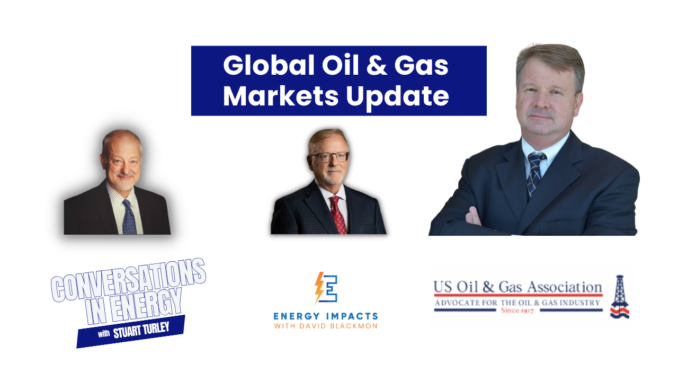
Tim Stewart stops by the Energy News Beat and Energy Impacts Podcasts
David Blackmon kicks off this joint podcast with Tim Stewart, President of the US Oil & Gas Association, and we have a wild discussion.
1. Oil and Gas Industry Volatility The speakers examine the current unstable state of the oil and gas sector, focusing on fluctuating oil prices and their impact on companies and workers. They note how the industry is adapting differently than it did during the 1970s oil crisis.
2. Middle East Geopolitical Tensions A significant portion of the discussion centers on regional instability, particularly around the Strait of Hormuz, attacks on oil infrastructure, and the U.S. response. Iran’s involvement and international sanctions are also key points of discussion.
3. California’s Energy Crisis The speakers address specific challenges in California’s energy sector, including refinery closures, companies relocating out of state, and how state energy policies are affecting the broader national energy landscape.
“ So To my point is that from the national energy policy perspective, it wouldn’t surprise me over the next six months if the energy department and department chairs start to become involved in California energy policy. It’s going to make federalism a really interesting argument because it’s a counterpoint, but it’s got to be done. “
Tim Stewart, President, US Oil & Gas Association
4. Government and Policy Involvement There’s substantial discussion about the federal government’s role in addressing energy challenges, potential federal intervention in state policies, and the relationship between the administration and Congress on energy matters.
5. U.S. Energy Dominance and Geopolitical Strategy The speakers explore how current events are reshaping global energy markets, potential shifts in international trading relationships, and America’s strategic positioning based on its energy resources and influence.
6. Industry Perception and Policy Challenges The discussion includes the oil and gas industry’s efforts to engage with policymakers, changing Congressional dynamics around energy policy, and the need for improved public understanding of the industry’s role and challenges.
We covered a lot of material and key points on this podcast. And we saw oil spike, and it’s already back down to $85 for WTI. That’s a good range for oil and gas producers to make money and not have consumers panic. Tim covered that and pointed out that there is a sweet spot: oil can be too low or too high.

Check out: https://usoga.org/ and connect with Tim Stewart on his LinkedIn: https://www.linkedin.com/in/timstewartacg/
We also covered the real problem in the Iran conflict that you won’t hear from the Main Stream Media. It’s the UK’s control of money and the financial system over other countries. That system is being dismantled, and Lloyd’s of London insurance company really brought it to full exposure by canceling the insurance for tankers. And President Trump’s response was to roll out a new insurance program backed by the US Dollar and the US military. And Tim really drove the point home.
“ The biggest way to stick it to Lloyds is to steal their market share. And I’ve been saying over and over, it’s one thing to be insured by Lloyds of London, it’s another thing to be escorted by the United States Navy, you know? “
Tim Stewart, President, US Oil & Gas Association
The Royal Navy of the UK is actually an embarrassment, and President Trump’s post on Truth Social really underscores what is going on.
I say that the UK is now in a true“Mind over Matter” scenario. President Trump does not mind that they would not support the United States because the UK does not matter anymore.
“He wasn’t helpful… I never thought I’d see that from the UK (…) It’s a different world, much different kind of relationship than we’ve had before.”
It’s not going to matter, but he should’ve helped” – President Trump.
Tim is spot on about California, and it is sad that he cannot help represent the great Oil and Gas employees and companies in the state because of the horrific overreach by California Governor Newsom and the rules he has imposed. We talked about how the US imports only 2% of its oil through the Strait of Hormuz, and all of it goes to California.
California is heating up to a National Crisis of biblical proportions, and we will see “Cats and Dogs living with each other,” so to speak, as I quote one of the greatest lines from Ghostbusters.
We opened the live map on the podcast, and as I was writing this article, we saw several tankers going through the Strait, so some traffic is making it through. I am trying to find out whether they are using the new insurance program and whether it is really working. I would love to see the US take over the global Marine Insurance Market.

It is the refineries that are the real issue. Oil is useless unless it is refined into something.
We have a lot of articles we are working on and trying to get some more great CEOs and folks on the podcast.
I believe the world is healing, and it will be a better place. It will be bumpy for a little bit, but that makes for an interesting ride.
I am interviewing Former Prime Minister Liz Truss on Thursday, and we will be discussing Net Zero and Energy policies. I hope that she can get back into the game and help get rid of Ed Miliband. It did go off on Ed Miliband a little bit, calling him a Muppet.
David and I also have Doomberg on Tuesday, and we are working to lock in other CEOs.
We are getting several new sponsors and would like to thank Steve Reese of Reese Energy Consulting for his second year of sponsoring the podcast.

Go to Reese Energy Consulting if you need Natural Gas for your Data Center, an expert witness, or auditing.


Be the first to comment