


ENB Pub Note: This article is a fantastic follow-up to the interview that Stu Turley, Mike Umbro, and Katy Grimes had on the Energy News Beat Podcast on Friday. This is a gigantic Energy Security problem that the Trump Administration is now facing. We will be following this huge crisis, and please follow Katy at the California Globe, as they are a fantastic resource. Check out the interview with Katy from Friday: Has California’s Oil and Gas Industry Hit the Point of No Return? – Major Pipelines Could Be Closing Within Weeks.
California’s in-state oil production has declined by approximately 65% since 2001, while its dependency on foreign imports has risen by nearly 70%. By Katy Grimes,
Has California’s Oil And Gas Industry Hit The Point Of No Return?” the California Globe asked Monday, after learning from a long time oil and gas expert that the state may actually have crossed a line too far to claw back the shutdowns of refineries, or those about to shut down.
California’s highest-in-the-nation gas prices are self-inflected, as is the gasoline crisis in the state. This has subsequently increased dependency on foreign oil suppliers and shippers to supply fuels, and as we reported recently, this poses a direct threat to U.S. military force readiness on the West Coast, as California Assemblyman Stan Ellis, USC Professor Professor Michael Mische, and petroleum expert Michael Ariza warned recently in their report, “CALIFORNIA ENERGY & FUEL POLICIES: A CLEAR AND PRESENT THREAT TO NATIONAL SECURITY AND FORCE READINESS?”
On Monday, USC Professor Michael A. Mische, UC Berkeley Professors James W. Rector, and Joseph B. Silvi issued another report on California’s Oil and Gas Conundrum. But this one is a blueprint for recovery.
As we have reported and the professors reiterate, “California faces immediate risks to gasoline supply due to declining in-state production, refinery closures, and an imminent northbound pipeline collapse.”
The professors prepared a Policy Brief on Stabilizing California’s Oil Supply Under SB 237 in October, which examined the ability of Senate Bill 237 to stabilize California’s energy infrastructure and supply, maintain refinery and pipeline operations, and ensure energy security amid refinery closures and increasing foreign dependence.
The professors note in the first paragraph of the October policy brief:
“California’s in-state oil production has declined by approximately 65% since 2001, while its dependency on foreign imports has risen by nearly 70%. At the same time, refinery capacity has fallen 21% since 2023 and gasoline demand remains largely unchanged at roughly 36–40 million gallons per day. SB 237, designed to permit up to 2,000 new wells annually in Kern County, will add some production but not enough to offset the overall statewide decline and will not adequately stabilize the state’s petroleum infrastructure.”
Governor Gavin Newsom in April directed state officials to increase efforts to guarantee reliable fuel supplies for the nation’s biggest auto market, prompting oil companies to blame state policies for difficult business conditions and high pump prices, thus they passed SB 277, and the governor signed it into law in September.
Note their warning: “SB 237 will add some production but not enough to offset the overall statewide decline and will not adequately stabilize the state’s petroleum infrastructure.”
California’s gas prices remain the highest in the country. Today AAA reports the national average cost of a gallon of gas at $3.01, and California’s average is at $4.56 per gallon – California’s average is $1.55 higher than the national average. The highest in California is in Mono County at $5.90 per gallon – California’s prices are slightly higher today than they were in October. And California’s gas prices remain higher than even Hawaii, at $4.41 per gallon, which imports all oil and gas.

The professors’ newest study demonstrates that “increasing crude oil production in certain regions in California will preserve and sustain both refineries and pipelines and avert severe price shocks in the consumer fuel market.”
They report that California’s gas is 51% higher than the national average.
But this is attributed to the impending loss of two refineries and the collapse of the only remaining northern pipeline, as the Globe reported Monday. They warn that “together with increasing dependency on non-U.S. gasoline sources to California could drive the price of gasoline to double that of the national average by calendar year end 2026.”

The crux of the matter is this – “After years of tearing down California’s in-state oil and gasoline production, Governor Newsom and the California legislature” think that two pieces of legislation will make the course correction needed to save their political careers.
Not so fast… the professors explain:
“SB 237, which allows for up to 2,000 new drilling permits a year in Kern County, and AB 30 that allows for the sale of E15 gasoline, form the centerpieces of Governor Newsom’s and the Legislature’s plan to alleviate gasoline supply insecurity, moderate consumer prices and stabilize the markets. Unfortunately, SB 237 is too little and too late, and AB 30 is overly optimistic. New Kern production stimulated by SB 237 will not be enough to stem the natural decline of Kern County oil production in the current low crude price and regulatory environment. Furthermore, it is highly unlikely that AB 30 will universally reduce gasoline prices by $0.20 a gallon across the state as proclaimed by the Governor. Inevitably, in state crude oil production will continue to decline unabated and lead to further pipeline and refinery shutdowns over the next few years, increasing supply instability and prices.
So what can be done? Professors Mische, Rector and Silvi lay it out:
Our analysis indicates that California can navigate its way out of this government- created crisis and avoid supply vulnerabilities and escalating consumer prices by implementing the following action steps [emphasis the Globe]:
- California’s most immediate, viable and sustainable option is to increase in-state crude oil production. The best, and essentially only way to achieve and sustain this benefit is to reopen the Las Flores Canyon pipeline system on the Central Coast and safely increase offshore crude oil production in the Santa Ynez Unit (SYU).
- Restoring production in this region would immediately provide 45,000 barrels per day of clean, low-decline California crude suited for SoCal refinery configurations. Up to 100,000 barrels per day could be produced from the Santa Barbara channel. This oil can be directed south to the Los Angeles area refineries thereby freeing up tens of thousands of barrels of Kern County oil compatible with Northern California refineries to be redirected north to the surviving PBF- Martinez refinery Additionally, 350,000 barrels of SYU crude oil is currently in onshore storage tanks which could be delivered into the California system within a few days’ notice upon reopening the Las Flores Canyon pipeline system.
They warn however:
“Failure to act and failure to increase in-state crude oil production will only accelerate the exit of California refineries from the state, increase global GHG emissions, further California’s contributions to environmental destruction, force greater reliance on foreign suppliers, increase consumer prices, and diminish U.S. national security.”
How did this happen?
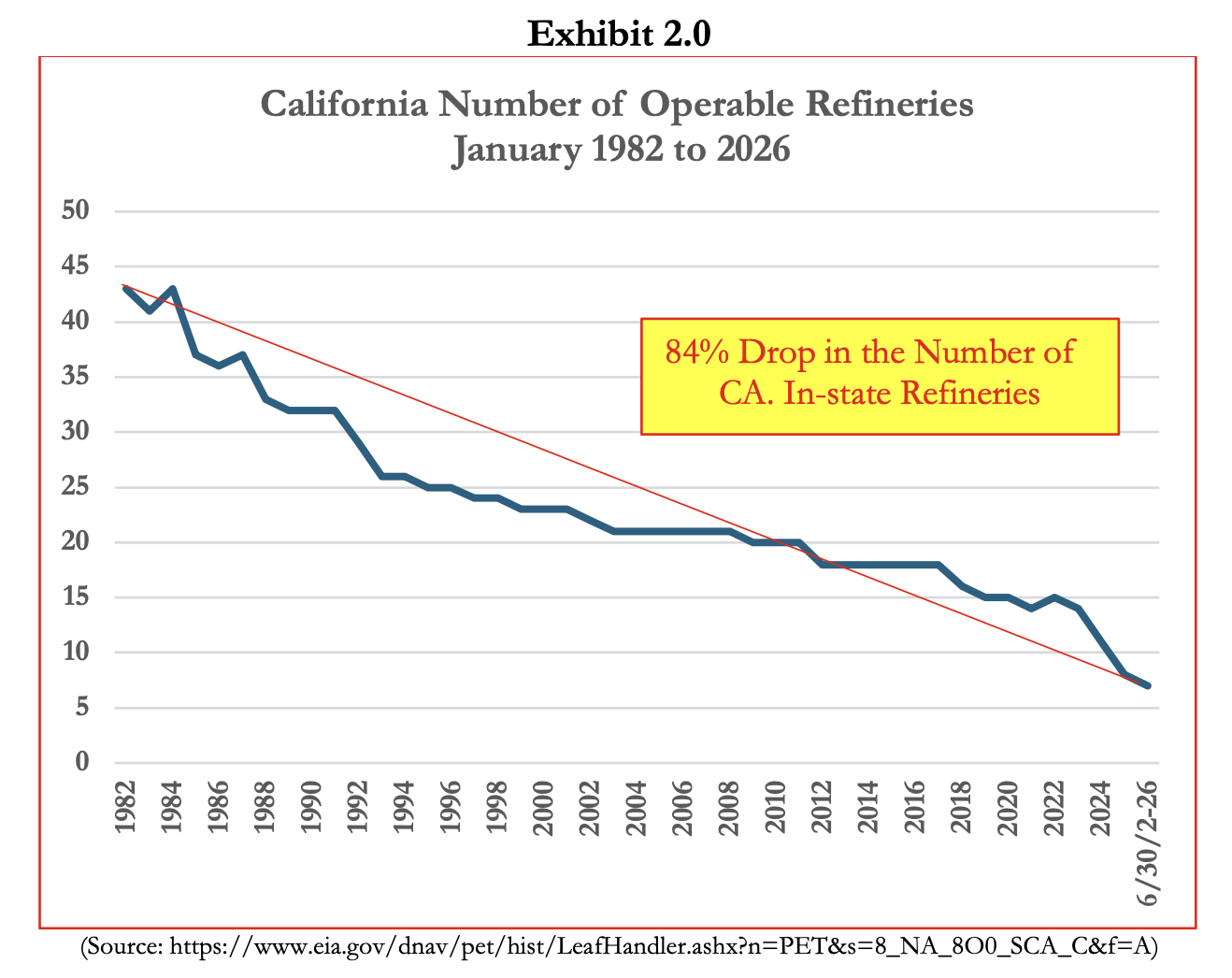
At one time California was home to over 40 operating refineries. However, due to high operating and regulatory compliance costs, a harsh political environment, conversions to bio and renewable fuels, and Governor Newsom’s 2020 directive banning the sale of new internal combustion vehicles in the state, the number of refiners has declined by 84% from 43 in 1982 to just seven survivors in 2026 (estimated). As Chevron Upstream President Andy Walz noted, “I think it’s been a tyranny of about 25 years to get the refining business to leave California.” If left uncorrected, more refinery closures are likely to follow for the 2027 to 2031 period.
This graph provides the ghastly visual:
They note:
“California refineries were designed to process the state’s predominantly heavy crude oil and are configured to produce the state-specific CARBOB gasoline and ultra-low-sulfur diesel fuel. CARBOB and ultra-low sulfur diesel fuels (CARB ULSD) are the result of California’s regulatory-mandated air quality mandates, which are the strictest in the world. Because of their unique formulations most out- of-state refineries cannot produce CARBOB or CARB ULSD without costly retrofits and retrofits. Because of California’s mandated special gasoline formula, there are only a handful of refineries outside of California in the world that can or will produce it.”
California politicians and governor arrogantly advanced “green energy” policies and regulations without a care for the down-range warnings.
In 2013 – twelve years ago – when Jerry Brown was governor, I reported that despite that California’s financial house was such a mess even then, with 9.8% unemployment, the Golden State is sitting on a lot more oil and jobs than the state has seen in decades.
Even back in 2013, the warnings and solutions were right in front of everyone, but the “green mafia” was much more sexy to Democrats than boosting California’s economy and home grown oil and gas production:
(2013) California sits on two-thirds of America’s shale oil reserves. The Monterey Shale Formation is four times the size of the Bakken Shale Reserve in North Dakota, which is now the largest oil producer in the country behind Texas.
Along the Western side of the San Joaquin Valley in the middle of the state, the Monterey Shale Formation encompasses several hundred miles, where water has dried up and unemployment is the highest in the state.
North Dakota has a monthly oil output of nearly 20 million barrels, and accounts for 11 percent of U.S. oil production. But California quickly could produce 15 million barrels a month more using today’s technology. Many experts estimate as much as 400 billion barrels of oil are in the Monterey Shale Formation.
The oil boom in North Dakota spurred the state’s $3.8 billion surplus and is responsible for the declining unemployment rate, currently at 3.2 percent, the lowest in the nation (2013).
As I concluded then, “California has implemented no real reform policies in recent years to promote jobs. Currently, Brown has not seemed to be interested in making any of these pro-growth economic moves as he pushes high-speed rail and the implementation of AB 32’s radical climate change policies.”
In 12 years, not only has Governor Newsom also pushed the deadbeat High Speed Rail scheme and radical climate change policies, he has nearly killed off the oil industry in the state.
The professors said:
“Collectively, inclusive of refineries that have converted to renewable fuels and with the loss of the Phillips 66 and Valero refineries, California will have lost close to 21% or 6.2 million gallons a day of its in-state gasoline production capacity since 2023. Based on current projections, California could possibly lose more refineries between 2027 and 2032, resulting in further substantial reductions in in- state gasoline production and further price increases.”
And:
“Gasoline demand in the Golden State has not declined anywhere near the rate anticipated by state agencies such as the CEC and CARB. Rather than the steep annual declines originally forecasted by the CEC and CARB under overly optimistic electrification scenarios, real-world demand for gasoline in California is falling at less than 2% per year. In fact, since the low point in 2020 due to the pandemic, gasoline demand in California has increased by 7.5%. Jet fuel consumption, which is the fastest growing fuel segment in California is expected to increase over 25% by 2040 to 125,000,000 barrels per year.”
The report is detailed and provides in-depth analysis of the consequences of losing refineries and pipelines, and warns:
As a result of California’s policies, refiners and pipeline operators have exited the state or are considering exiting the state. From 2023, and because of refinery conversions to renewable fuels and the loss of two refineries, California’s in-state gasoline production will have dropped by 6.2 million gallons a day. Other than SB 237 and AB 30, which are insufficient, the only public plan to replace the self-inflicted loss is of in-state crude oil and fuel supply to import gasoline and more crude oil from non-U.S. sources using foreign flagged tanker vessels.
And:
“If the SPB pipeline shuts down, the consequences cascade across the state. Northern California would lose its only pipeline access to California-produced crude.
One of their recommendations is Presidential Intervention. “California’s policies and actions affect the U.S. we are already seeing the impact of more maritime tankers being diverted to California from east coast states and the need to import considerably more jet fuel from China and India to sustain commercial air operations in the Golden State.”
The concede:
“Reopening the Las Flores Canyon pipeline system is the only immediately reasonably viable, abundantly obvious, long-term solution to California’s gasoline supplies insecurities. Increasing in- state production keeps refineries running, preserves the San Pablo Bay Pipeline, strengthens energy security, mitigates port pollution near minority communities, reduces tanker traffic, and lessens dependence on foreign oil. At the same time, it would potentially reduce natural seep emissions, providing a real environmental benefit. This approach makes California’s oil infrastructure more practical, reliable and resilient as the state moves through the multi-decade energy transition.”
This is Professor Mische, Rector, and Silvi’s report on the pipeline issue – I recommend reading it: – Here on the Globe.
A California native and Navy mom, Katy lives in Sacramento, CA.
Want to get your story in front of our massive audience? Get a media Kit Here. Please help us help you grow your business in Energy.






Be the first to comment