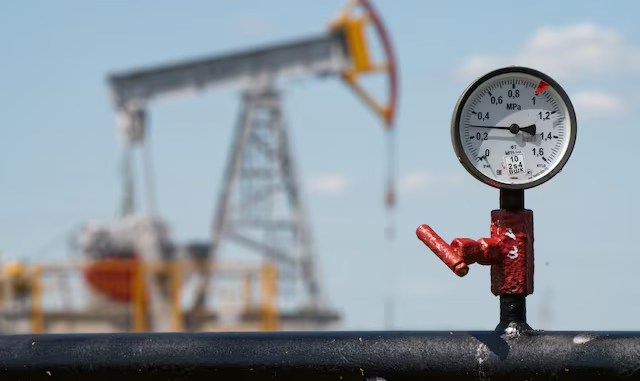
In a stark indicator of mounting pressures on Russia’s energy sector, the country’s oil and gas revenues are projected to plummet by nearly 50% in December 2025, reaching a five-year low of approximately $5.15 billion.
This sharp decline caps off a challenging year, with cumulative revenues for the first 11 months of 2025 estimated at $102 billion, marking a 22% drop from the previous year.
For the full year, total oil and gas revenues are now forecasted to shrink by nearly a quarter to around 8.44 trillion rubles (roughly $90 billion at current exchange rates), falling short of the Russian Finance Ministry’s earlier projection of 8.65 trillion rubles.
These figures underscore the cumulative impact of intensified Ukrainian drone strikes, stricter international sanction enforcement, and volatile global oil prices on Moscow’s fiscal backbone.
Looking ahead, baseline scenarios for 2025 suggest Russia’s oil and gas revenues could decline further by 12.5% year-over-year to $206.1 billion, though this assumes stable export volumes and prices amid ongoing geopolitical tensions.
However, with drone attacks escalating and sanctions tightening, analysts warn that actual revenues may undershoot even these conservative estimates, potentially exacerbating budget deficits and forcing cuts in military spending or social programs.
Escalating Drone Attacks: Caspian Sea and Recent Strikes
The past week has seen a flurry of Ukrainian drone operations targeting Russian energy infrastructure, further eroding production capacity. On December 12, Ukrainian forces struck two Russian oil rigs in the Caspian Sea for the second time this year, according to Ukraine’s Security Service (SBU).
This follows a first-of-its-kind attack on December 11, when drones hit a major Lukoil oil and gas production platform in the same region, halting operations entirely.
The Caspian strikes represent a bold expansion of Ukraine’s reach, disrupting offshore assets far from the primary conflict zones and highlighting vulnerabilities in Russia’s remote energy hubs.
Elsewhere, drone assaults continued unabated. Early on December 12, a strike ignited a major fire at the Slavneft-YANOS oil refinery in Yaroslavl, one of Russia’s five largest facilities with an annual capacity exceeding 15 million tons.
Just days earlier, on December 5, Ukrainian drones damaged Rosneft’s Syzran refinery on the Volga River, forcing a complete halt to oil processing.
This was the second attack on Syzran in 2025, targeting the same crude distillation unit previously hit in August.
Additionally, a massive barrage on December 6 involved over 700 missiles and drones aimed at Russian energy and railway targets, compounding the strain.
These incidents are part of a broader campaign: Ukraine has conducted over 200 strikes on Russian oil facilities in 2025 alone, with a record number in November.
The assaults have targeted at least 17 major refineries, affecting a combined capacity of 123 million tons per year—equivalent to about 38% of Russia’s total refining capability.
Total Damage Still Offline: A Lingering Toll on Production
Despite Russia’s efforts to leverage spare refining capacity—estimated at around 20%—to mitigate losses, the cumulative damage from 2025’s drone campaign remains significant.
Overall, oil processing has dipped by only about 3% for the year, but specific facilities are bearing the brunt. The Syzran refinery, with a capacity of over 8 million tons annually, has been fully offline since the December 5 strike, with no timeline for resumption.
Similarly, Rosneft’s Ryazan refinery has been out of commission since mid-November, when drones disabled its main unit, which handles nearly half of its 17 million-ton capacity.
Intensified attacks since August have driven refinery runs to multi-year lows, hitting 4.9-5 million barrels per day in September—a drop of about 500,000 barrels daily.
Repeated hits on sites like Afipsky near Krasnodar have further strained exports, with temporary halts at key Black Sea ports like Novorossiysk due to drone threats.
Analysts estimate that up to 10-15% of affected capacity remains offline or operating at reduced levels as of December 2025, contributing to a projected 4-5% decline in overall fossil fuel export revenues for the year.
Repair efforts are hampered by sanctions limiting access to Western technology, potentially prolonging downtime into 2026.
US Seizure of Venezuelan Shipment: Ripples for the Dark Fleet
Adding to Russia’s woes, the U.S. Navy’s seizure of the tanker Skipper off Venezuela’s coast on December 11 signals a ramped-up crackdown on the global “dark fleet” of shadow tankers evading sanctions.
The vessel, sanctioned by the U.S. in 2022 and linked to Iranian networks, was carrying 1.1 million barrels of Venezuelan oil destined for illicit markets, including China.
This operation, the first of its kind in the region under the incoming administration, has been labeled “piracy” by Caracas but is viewed by experts as a targeted strike against regimes in Iran and Venezuela that fund activities through smuggled oil.
The implications extend to Russia, Iran, Iraq, and other sanctioned players reliant on the same opaque networks. The dark fleet, which ballooned after U.S. sanctions on Russia post-2022 Ukraine invasion, often uses aging, uninsured vessels to transport oil while concealing origins—sometimes blending cargoes to mask sources.
U.S. officials have indicated plans to seize more tankers in the Caribbean, which could force black-market buyers to demand steeper discounts from Venezuela, starving the Maduro regime of revenue and indirectly pressuring interconnected fleets.
For Russia, this heightened enforcement may disrupt shadow exports, already under strain from drone-induced supply shortfalls. Similar tactics could embolden seizures in other hotspots, like the Strait of Hormuz, where Iran and Russia might respond in kind—escalating risks for global oil flows.
Iraq, though less directly involved, could face scrutiny if its oil mingles in these networks. Overall, this move amplifies sanction pressures, potentially reducing dark fleet viability and further squeezing revenues for rogue exporters.As 2025 draws to a close, Russia’s energy sector faces a perfect storm of military disruptions and diplomatic isolation. With revenues cratering and infrastructure under siege, the coming year may test Moscow’s resilience like never before.
Sources: tass.com, mezha.net, forbes.com, oilprice.com, economist.com
Want to get your story in front of our massive audience? Get a media Kit Here. Please help us help you grow your business in Energy.