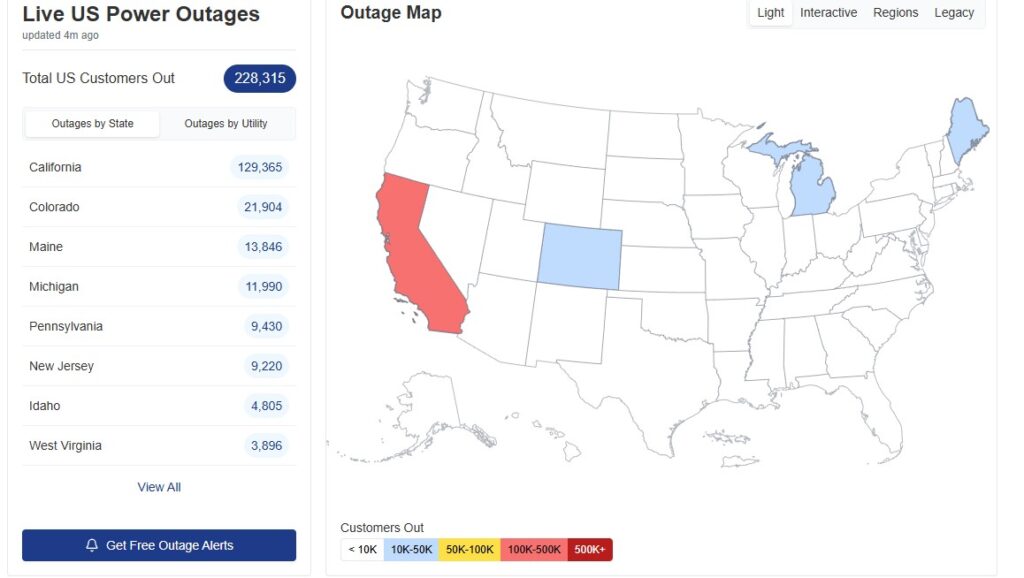
In a stark reminder of California’s ongoing energy woes, San Francisco was plunged into darkness on December 20, 2025, as a massive power outage affected approximately 130,000 customers—roughly one-third of the city’s residents and businesses.
The blackout, occurring on a peak holiday shopping day, disrupted daily life, commerce, and transportation across large swaths of the city, highlighting the fragility of the state’s power grid amid aggressive renewable energy mandates and regulatory constraints.
The Outage: Scope and Immediate Causes
The power failures began around 9:40 a.m. local time, initially hitting neighborhoods like the Inner Sunset before spreading to the Richmond District, Outer Sunset, Presidio, Golden Gate Park, Haight-Ashbury, parts of downtown, and South of Market.
By afternoon, reports emerged of a one-alarm fire at a PG&E substation near 8th and Mission streets, which authorities believe contributed to the escalating disruptions.
Pacific Gas and Electric Company (PG&E), the utility serving the area, confirmed the outages but did not immediately specify the root cause beyond stabilizing the grid to prevent further spread.
Real-time accounts from residents and observers painted a chaotic picture. Social media buzzed with videos of autonomous Waymo vehicles stalled in intersections, unable to navigate without functioning traffic signals, effectively turning streets into gridlock zones.
One witness described PG&E workers on site amid the blackout, while others reported intermittent cell service and Wi-Fi failures, compounding the isolation for those affected.
PG&E stated that restoration efforts were underway, with some areas expected to regain power by evening, though timelines varied. By late afternoon, the utility assured customers that the grid was stabilized, and no additional outages were anticipated.
Residents were advised to treat darkened traffic lights as four-way stops, conserve perishable food by minimizing refrigerator openings, and unplug appliances to avoid surges upon restoration.
Economic and Social Impacts
The timing could not have been worse. With the holiday shopping season in full swing, businesses in affected areas were forced to operate on a cash-only basis or shutter entirely, leading to significant revenue losses.
Iconic shopping districts and transit hubs ground to a halt: BART stations, including Powell, Civic Center, and Van Ness, were closed, while Muni Metro and Central Subway lines switched back at key points, bypassing underground stops from Embarcadero to Van Ness.
Non-essential travel was discouraged, stranding shoppers, workers, and tourists alike.
Socially, the outage amplified vulnerabilities. Hospitals and critical facilities reportedly switched to backup generators, but everyday inconveniences mounted—families unable to cook meals, students disrupted from online activities, and the elderly facing heightened risks in unlit buildings. One local resident quipped on social media about attending a “light show” event amid the blackout, underscoring the irony of a city known for innovation being brought low by basic infrastructure failures.
This event echoes a troubling pattern in California, where power shutoffs have surged. In 2025 alone, Public Safety Power Shutoffs (PSPS)—preemptive blackouts to mitigate wildfire risks amid high winds and dry conditions—have increased by 145%, affecting over 594,000 customers, up from 244,000 the previous year.
energynewsbeat.co
Outages have lasted up to 15 days in some cases, impacting critical sectors like healthcare and transportation.
Tying into Broader Energy Policy Failures
This latest blackout comes hot on the heels of Energy News Beat’s recent exposé on California’s regulatory decisions to slash utilities’ profits for essential grid investments.
The California Public Utilities Commission (CPUC) has prioritized curbing rate hikes to address skyrocketing electricity bills, but critics argue this short-sighted approach underfunds the infrastructure upgrades needed to handle extreme weather, renewable integration, and growing demand.
Governor Gavin Newsom’s aggressive policies, pushing for 60% renewables by 2030 and 100% clean energy by 2045 under laws like SB 350 and SB 100, have been lambasted for prioritizing environmental ideals over reliability and affordability.
High taxes, stringent regulations, and mandates have driven up costs, leading to deindustrialization as major companies like Chevron, Tesla, and ExxonMobil flee the state. This exodus erodes California’s economic base, increases dependence on foreign supply chains for energy tech, and undermines U.S. energy independence—posing a genuine national security risk in an era of global instability.
Historical precedents abound: the 2000-2001 energy crisis from deregulation and market manipulation, the 2019-2020 PSPS events during heatwaves and droughts, and now this holiday debacle. The intermittency of solar and wind requires costly backups and grid hardening, yet profit caps limit utilities’ ability to invest, resulting in a brittle system prone to failures like the substation fire that may have triggered today’s chaos.
A Call for Reform
As San Francisco scrambles to recover, the outage serves as a wake-up call. California’s energy policies, while ambitious, must balance green goals with practical resilience. Without substantial reforms—such as incentivizing grid investments and easing regulatory burdens—the state risks more frequent disruptions, further economic hemorrhaging, and broader implications for national security.
Energy News Beat will continue monitoring this developing story and its ties to systemic issues. For updates, visit our site or follow us on social media. Stay safe, San Francisco—better energy policies can’t come soon enough.
t-s.news, ground.news, @CollinRugg,@jonnycomp344502, energynewsbeat.co

,