



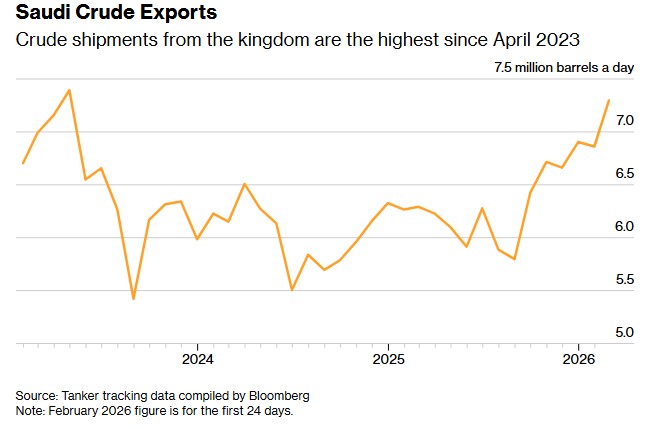
Saudi Arabia is flooding global markets with crude at the fastest pace in nearly three years, shipping 7.3 million barrels per day (b/d) in the first 24 days of February 2026 — the highest level since April 2023. Tanker-tracking data compiled by Bloomberg show the surge represents a jump of more than 400,000 b/d from January and comes as traders brace for potential supply disruptions tied to escalating U.S.-Iran tensions.
Watch the Iran tensions get solved using the same tools the United States used on Venezuela. This will funnel the money through Qatar and keep a tight rein on the government, without boots on the ground. It will be interesting if this rolls out this way.
The Kingdom is deliberately ramping up production and exports as a contingency plan in case a U.S. strike on Iranian facilities disrupts flows from the Persian Gulf. Sources familiar with the strategy told Reuters the move mirrors Saudi Arabia’s actions in 2025, when exports rose by around 500,000 b/d in June during previous U.S. strikes on Iranian nuclear sites. Riyadh will scale back later to stay within OPEC+ quotas if no major disruption materializes.“Saudi Arabia is on course to ship the most oil from its ports in almost three years this month, bringing supply to the global market at a time when crude traders are monitoring U.S.-Iran tensions,” Bloomberg reported.
Saudi Crude Oil Exports – Last 5 Years
Saudi Arabia’s annual crude oil exports (sourced from official Saudi data via Argaam and cross-checked with FRED/CEIC where available). Volumes are total annual crude exports in million barrels and the calculated average daily rate in thousand barrels per day (kbpd). (2025 is partial/projected based on the latest available data and the current February surge.)
(Data compiled from Saudi General Authority for Statistics/Argaam reports and FRED series SAUNXGOCMBD. Minor variations between sources reflect exact counting methodologies for condensate vs. pure crude.)
The February 2026 surge stands out sharply against the 2024 low of ~6.06 million b/d, highlighting Riyadh’s strategic flexibility to support market stability — or prepare for worst-case scenarios.
Strait of Hormuz: The Chokepoint at Risk
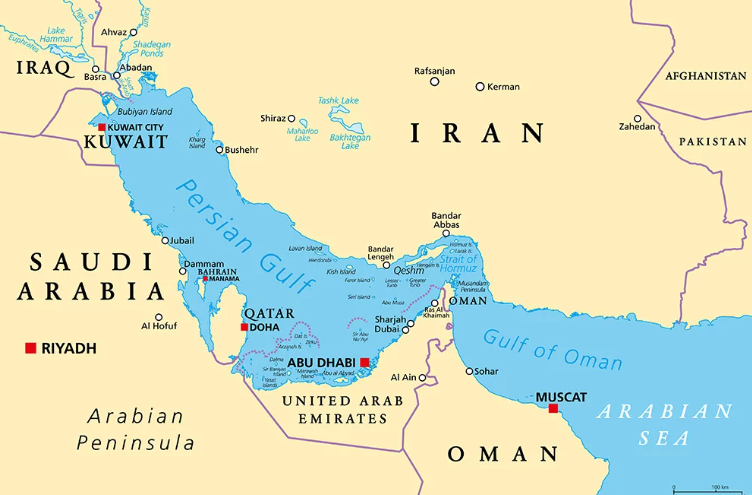
Nearly all of Saudi Arabia’s eastward exports (the vast majority of its total) must transit the Strait of Hormuz, the narrow waterway between Iran and Oman that handles roughly 20 million barrels per day of oil and petroleum products in 2024–early 2025 — about 20% of global petroleum liquids consumption and over one-quarter of all seaborne oil trade.
Key 2024 Hormuz flows (EIA/Vortexa tanker data):
Total oil: ~20 million b/d (crude + condensate ~14–15 million b/d; petroleum products ~5–6 million b/d)
Saudi Arabia: 5.5 million b/d crude & condensate (38% of all Hormuz crude flows) — the single largest contributor
Other major exporters: UAE, Iraq, Kuwait, Qatar, and Iran (combined the balance)
Destinations: 84% of crude/condensate and 83% of LNG head to Asia (China, India, Japan, South Korea alone take ~69%)
What Iran unrest could disrupt:
A full or partial closure of the Strait would immediately remove ~20 million b/d from the market — an unprecedented shock.
Asia would be hit hardest; Europe and the U.S. are far less exposed (U.S. imports from the Persian Gulf via Hormuz were only ~0.5 million b/d in 2024, the lowest in decades).
Oil prices could spike to $120–$150+/bbl in extreme scenarios, according to multiple analyst warnings.
Tanker freight rates have already surged to six-year highs in February 2026 as charterers rush to move Middle East crude ahead of potential conflict.
Mitigation options exist but are limited:Saudi East-West Pipeline (Abqaiq to Yanbu on the Red Sea): up to 7 million b/d capacity (expanded 2019).
UAE Fujairah bypass pipeline: ~1.8 million b/d.
Combined Gulf bypass capacity: roughly 2.6–3 million b/d under normal conditions, with potential to ramp higher.
Iran’s own small Jask terminal bypass is minimal (~0.3 million b/d effective).
Even with bypasses, a prolonged disruption would still cause major global shortages, higher refining margins, and volatility in petrochemical and LNG markets (Qatar LNG also transits Hormuz).OutlookSaudi Arabia’s February export surge is both a market-supporting move and prudent risk management. It ensures barrels reach customers before any potential choke-point crisis while signaling Riyadh’s readiness to fill gaps if Iranian supplies are curtailed.Energy News Beat will continue monitoring tanker flows, OPEC+ decisions, and U.S.-Iran developments. The next few weeks could determine whether this surge becomes a short-term buffer or the start of a sustained higher-output era for the Kingdom.Stay tuned — the Strait of Hormuz remains the world’s most critical energy artery.Sources: Bloomberg, Reuters, U.S. Energy Information Administration (EIA), Argaam, FRED (St. Louis Fed), Vortexa tanker data. All figures as of February 25, 2026.
Get your CEO on the #1 Energy Podcast in the United States: https://sandstoneassetmgmt.com/media/
Is oil and gas right for your portfolio? https://sandstoneassetmgmt.com/invest-in-oil-and-gas/




Be the first to comment