


Qatar-Mediated Controls on Iranian Oil
The core idea is to offer Iran limited sanctions relief in exchange for verifiable concessions, such as halting uranium enrichment beyond civilian levels or curbing support for proxy militias. Unlike full sanctions removal, this would impose strict oversight to prevent revenue from funding destabilizing activities.
- Qatar as Financial Intermediary: Qatar, with its established role in mediating Middle East disputes (including recent Gaza talks), would act as the hub for processing Iranian oil payments. Revenues would flow into escrow accounts managed jointly by Qatari and U.S. officials, ensuring transparency and compliance with international standards.
- Monitoring by Secretary Bessent: As Treasury Secretary, Scott Bessent would lead the financial oversight, leveraging the Office of Foreign Assets Control (OFAC) to track transactions. This includes real-time auditing to prevent diversions to sanctioned entities like the Islamic Revolutionary Guard Corps (IRGC). Bessent’s experience in global finance would help integrate blockchain or AI tools for tamper-proof monitoring.
- Coordination of Sales by Secretary Wright: Energy Secretary Chris Wright, with his background in oil and gas innovation, would oversee the marketing and sale of Iranian crude on open exchanges. Sales would be conducted exclusively in U.S. dollars (petrodollar system), strengthening the dollar’s dominance while excluding dark fleet tankers. Instead, vetted international carriers would handle shipments, reducing environmental risks from poorly maintained vessels.
This structure mirrors the U.S.-Venezuela deal, where proceeds from oil sales were deposited into U.S.-controlled accounts for humanitarian and reconstruction purposes. For Iran, it could unlock higher revenues while enforcing accountability.
Current Iranian Oil Dynamics: Discounts, Dark Fleets, and Proxy Funding
Iran’s oil sector operates under heavy U.S. sanctions, forcing it to rely on clandestine methods. In 2025, Iran exported an average of about 1.38 million barrels per day (bpd), with over 80% going to China at steep discounts. Production hovered around 3.3 million bpd of crude, but exports were capped by evasion tactics.
- Deep Discounts to China: Iranian Light crude traded at $8-11 per barrel below Brent benchmarks, often delivered via ship-to-ship transfers to obscure origins. With Brent averaging around $80 per barrel in early 2026 (before recent spikes), this meant Iran forfeited billions annually.
- Dark Fleet Tankers: Iran’s “shadow fleet” consists of hundreds of aging vessels—many over 20 years old—that switch off tracking systems, spoof locations, and use flag-hopping to evade detection. These tankers, often uninsured and poorly maintained, pose environmental hazards, as seen in recent spills. In February 2026 alone, Iran loaded a record 2.15 million bpd using these methods.
- Funding to Proxy War Fighters: Sanctions-constrained revenues still fuel Iran’s regional proxies. Estimates peg annual support at $1-2 billion total:
- Hezbollah: $700-800 million
- Hamas and Palestinian Islamic Jihad: $100 million
- Houthis and other militias: $200-300 million
These funds, drawn from discounted oil sales, support attacks on shipping lanes and regional conflicts, perpetuating instability.
|
Category
|
Estimated Annual Amount (USD Billion)
|
|---|---|
|
Hezbollah
|
0.7 – 0.8
|
|
Hamas/PIJ
|
0.1
|
|
Houthis & Others
|
0.2 – 0.3
|
|
Total Proxy Funding
|
1.0 – 2.0
|
Revenue Potential at Market Prices: A Game-Changer for Iran?
Under the current sanctions regime, Iran’s oil exports generate roughly $38.3 billion annually (assuming 1.5 million bpd at $70 per barrel discounted price). Shifting to open-market sales could dramatically increase this:
- Same Volume at Market Prices: At $80 per barrel, revenue jumps to $43.8 billion—a $5.5 billion gain. This extra cash could fund domestic priorities like infrastructure, but under the plan, it would be monitored to prevent proxy diversions.
- With Expanded Exports: If controls encourage higher output (e.g., 2.5 million bpd, closer to Iran’s 3.8 million bpd capacity), market-price sales could yield $73 billion annually—an additional $34.7 billion over current levels.
|
Scenario
|
Exports (bpd)
|
Price ($/bbl)
|
Annual Revenue ($ Billion)
|
Extra vs. Current ($ Billion)
|
|---|---|---|---|---|
|
Current (Discounted)
|
1,500,000
|
70
|
38.3
|
–
|
|
Market (Same Volume)
|
1,500,000
|
80
|
43.8
|
+5.5
|
|
Market (Expanded)
|
2,500,000
|
80
|
73.0
|
+34.7
|
This surplus—far exceeding the $1-2 billion spent on proxies—could be redirected toward economic reforms or debt repayment, but only if Tehran complies with oversight.
Historically, discounted sales limited Iran’s fiscal flexibility; market access would provide “how much more” in the query’s terms: up to 90% higher effective revenue per barrel, translating to tens of billions extra yearly.
Global Energy Implications
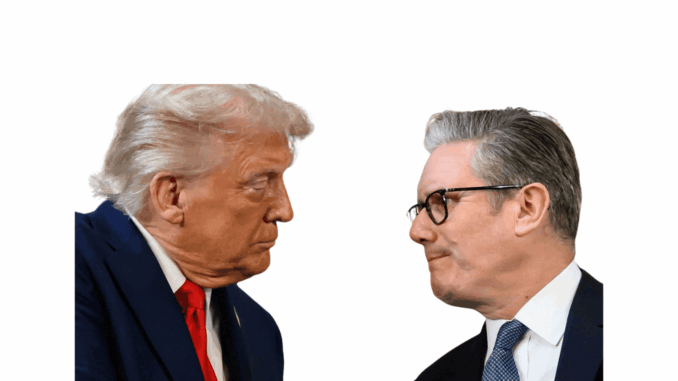
Implementing this plan could stabilize oil prices by integrating Iranian supply transparently, reducing volatility from dark fleet disruptions. It would also weaken China’s leverage over discounted crude, potentially shifting global trade dynamics. However, success hinges on Iran’s willingness to negotiate—unlikely without pressure—and coordination with allies like the UK, despite Starmer’s skepticism.
Trump’s Venezuela reference isn’t just rhetoric; it’s a blueprint. If applied to Iran, it could mark a pivotal shift in energy geopolitics, turning sanctioned chaos into controlled prosperity. As Wright might put it, “It’s time to bring Iran’s oil out of the shadows and into the light.”



Be the first to comment