


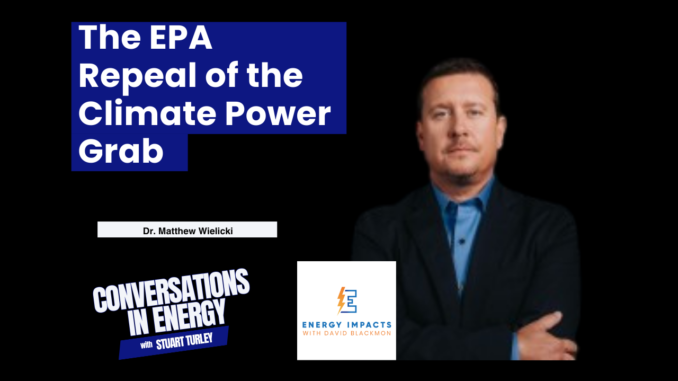
Dr. Matthew Wielicki stops by as a self-proclaimed Earth Science Professor-in-exile. He is one to listen to on key issues. His Substack is “Irrational Fear,” and he has 95K Followers on X. We have questions and hope to get them answered. Like, how will this impact consumers, investors, and even our education system? Dr. Matthew Wielicki stops by as a self-proclaimed Earth Science Professor-in-exile. He is one to listen to on key issues. His Substack is “Irrational Fear,” and he has 95K Followers on X. We have questions and hope to get them answered. Like, how will this impact consumers, investors, and even our education system?
The repeal of the Climate Power Grab by the Trump Administration brings up a lot of questions, and we cover a lot of them today. This podcast went out live on X, YouTube, and LinkedIn on both the Energy News Beat and Energy Impacts Podcasts with Stu Turley and David Blackmon hosting.
The main topics discussed in this Podcast are:
Throughout the conversation, the overarching theme is the critique of the scientific and policy narratives surrounding climate change, with the guest arguing that the observational data and economic realities do not support the alarmist claims and the resulting policy responses.
**1. The EPA Endangerment Finding**
The conversation centers on the 2009 EPA Endangerment Finding that declared greenhouse gas emissions endanger public health. The guest argues this finding was “precooked” without proper review and has become the legal foundation for numerous climate regulations under the Obama and Biden administrations. The recent rescission of this finding could undermine the legal standing of these policies.
**2. Global Temperature Record Reliability**
There’s significant discussion about concerns regarding the accuracy and transparency of global temperature data. The guest raises allegations about data manipulation and suppression of historical heat wave data, arguing that this lack of trust in temperature records undermines the scientific basis for climate policies.
**3. Observed vs. Predicted Climate Impacts**
They talk about examining observational data on extreme weather, hurricanes, and sea level rise, with the guest arguing that actual observed impacts don’t match the dire predictions made by climate models. This discrepancy is presented as evidence questioning the validity of the underlying climate projections.
**4. Economic and Social Costs of Climate Policies**
A major focus is on the negative impacts of climate policies, including increased energy prices, reduced affordability, and harm to developing nations. The discussion also touches on the “climate industrial complex” and how perpetuating climate crisis narratives maintains funding and business opportunities.
**5. Nuclear Power as a Solution**
Dr. Wielicki advocates for nuclear power as a key solution for reliable, low-emission baseload electricity, contrasting this with the focus on intermittent renewables and discussing regulatory and political barriers to modern nuclear development.
The overarching theme is a critique of climate change narratives, arguing that observational data and economic realities don’t support alarmist claims and resulting policies.
This Podcast was broadcast on the Energy Impacts as well as the Energy News Beat Channels.
We recommend following Matthew on X. @MatthewWielicki
“ Yeah, the irony here is just it’s too much. “
Matthew Wielicki, Earth Science Professor-in-exile
Check out the Irrational Fear on Substack: https://irrationalfear.substack.com/

What Is the Correct CO2 Concentration?
A Scientific Thought Experiment in a Post-Endangerment World
We have a lot of work to do on how badly kids were harmed by misleading them on the climate crisis narrative.
BackGround
Historical Context: From Obama-Era Regulations to Trump Rollbacks
The Endangerment Finding, established in 2009 under President Obama, classified carbon dioxide (CO2) and five other greenhouse gases as pollutants that endanger public health and welfare.
This served as the legal foundation for sweeping regulations, including vehicle emission standards and the Clean Power Plan, aimed at curbing climate change. During his first term, Trump attempted to weaken these through measures like replacing the Clean Power Plan with the Affordable Clean Energy rule, but the core finding remained intact.
Now, in his second term, Trump and EPA Administrator Lee Zeldin have fully rescinded the finding, arguing that CO2 is not a pollutant but a natural byproduct of life.
The repeal also axes all greenhouse gas emission standards for vehicles, potentially saving automakers $2,400 per vehicle and lowering consumer prices.
This action echoes earlier rollbacks but goes further, dismantling the bedrock of federal climate policy.
Impact on Global Energy Markets: Boosting Fossil Fuels Amid Transition Pressures
The repeal has rippled through global energy markets, signaling a U.S. pivot toward fossil fuel dominance. By removing regulatory burdens, it encourages increased domestic oil and gas production, potentially stabilizing prices and enhancing energy independence. Trump administration officials estimate it will cut energy and transport costs by over $1 trillion, benefiting manufacturers and consumers alike.
This could lead to cheaper U.S. exports, pressuring OPEC+ nations and reshaping global supply dynamics.
Still, lower U.S. regulatory costs may attract investment back to fossil fuels, countering the $2.4 trillion poured into clean energy worldwide in 2024.
Overspending on Renewables: Trillions Invested, Minimal Energy Gains
Over the past decade, global investments in wind, solar, battery storage, and hydrogen have skyrocketed, yet the net addition to society’s energy supply remains disproportionately small relative to the costs. In 2024 alone, renewable energy investments hit $807 billion, with solar PV leading at $554 billion—a 49% jump.
Total clean energy spending reached $2.4 trillion, including grids and electrified transport.
By 2025, clean energy investments are projected at $2.2 trillion, outpacing fossil fuels
Despite this, renewables’ intermittency means they often require backup from fossil fuels, limiting their standalone contribution. For instance, while solar and wind yielded 2.5 times more output per dollar in 2023 than a decade ago, global grid bottlenecks and storage needs have curtailed efficiency.
Hydrogen investments fell 21% to $102 billion in 2024, reflecting challenges in scaling.
Critics argue this spending—totaling trillions—has added only marginal baseload energy compared to fossil fuels, which still dominate 80% of global supply.
Consumer Backlash: The Hidden Costs of the Green Push
Consumers are feeling the pinch from this renewable overinvestment. Subsidies and mandates have driven up electricity prices in regions reliant on intermittent sources, with green certificate schemes sometimes allowing dominant producers to bid higher, passing costs to households.
The Trump repeal aims to reverse this, potentially saving households $500 annually through lower fuel and vehicle costs.
Meanwhile, the fossil fuel sector faces its own consumer burden: trillions spent on exploration amid depleting fields. Global upstream oil and gas investment hit $603 billion in 2023, rising to $629 billion in 2024, with needs escalating to $738 billion by 2030 to offset declines.
This shortfall drives up costs, ultimately hitting consumers at the pump.
The Reality of Depleted Fields: 90% Depletion and Accelerating Declines.
A critical question looms: Are we sourcing oil and gas from fields that are 90% depleted and rapidly declining? Data shows many mature fields are indeed nearing exhaustion. Global average post-peak decline rates are 5.6% for conventional oil and 6.8% for natural gas, accelerating due to shale reliance.
Shale wells drop 35% in the first year alone, with onshore supergiants declining at 1.8% versus 10.3% for deep offshore.
About 20% of global production comes from marginal or mature fields, projected to exceed 40% by 2050, with production costs up to $15 per barrel higher.
Annual conventional discoveries have plummeted from 20 billion boe in the 2010s to 5.5 billion recently, far below consumption.
This depletion treadmill requires $540 billion annually just to maintain output, underscoring the need for new fields amid green energy’s shortcomings.
Conclusion: A Path Forward for Energy Realism
The EPA repeal dismantles a climate power grab that prioritized ideology over economics, potentially revitalizing U.S. energy markets. Yet, as renewables absorb trillions with limited baseload gains, and depleting oil fields demand massive investments, consumers bear the brunt. Balancing fossil fuel reliability with targeted innovation is key to affordable energy. As global demand evolves, this repeal could foster a more pragmatic approach, ensuring energy security without breaking the bank.
We need leaders like Dr. Wielicki to change the university systems and what our kids are learning.

Shout out to Steve Reese and Reese Energy Consulting for sponsoring the Energy News Beat Channel https://reeseenergyconsulting.com/
The EPA Repeal of the Climate Power Grab
In a landmark move that reshapes America’s energy landscape, the Trump administration has officially repealed the Obama-era Endangerment Finding, stripping the Environmental Protection Agency (EPA) of its authority to regulate greenhouse gas emissions under the Clean Air Act. This decision, announced in February 2026, eliminates federal standards on vehicle emissions and paves the way for broader deregulation of power plants and industrial sources. President Trump hailed it as the “largest deregulation in American history,” projecting savings of up to $1.3 trillion by reducing compliance costs for industries.
Critics, however, warn of increased emissions and long-term environmental risks, but the repeal signals a return to prioritizing affordable, reliable energy over what many see as bureaucratic overreach.
Historical Context: From Obama-Era Regulations to Trump Rollbacks
The Endangerment Finding, established in 2009 under President Obama, classified carbon dioxide (CO2) and five other greenhouse gases as pollutants that endanger public health and welfare.
This served as the legal foundation for sweeping regulations, including vehicle emission standards and the Clean Power Plan, aimed at curbing climate change. During his first term, Trump attempted to weaken these through measures like replacing the Clean Power Plan with the Affordable Clean Energy rule, but the core finding remained intact.
Now, in his second term, Trump and EPA Administrator Lee Zeldin have fully rescinded the finding, arguing that CO2 is not a pollutant but a natural byproduct of life.
The repeal also axes all greenhouse gas emission standards for vehicles, potentially saving automakers $2,400 per vehicle and lowering consumer prices.
This action echoes earlier rollbacks but goes further, dismantling the bedrock of federal climate policy.
Impact on Global Energy Markets: Boosting Fossil Fuels Amid Transition Pressures
The repeal has rippled through global energy markets, signaling a U.S. pivot toward fossil fuel dominance. By removing regulatory burdens, it encourages increased domestic oil and gas production, potentially stabilizing prices and enhancing energy independence. Trump administration officials estimate it will cut energy and transport costs by over $1 trillion, benefiting manufacturers and consumers alike.
This could lead to cheaper U.S. exports, pressuring OPEC+ nations and reshaping global supply dynamics.
However, the move comes as the world accelerates toward renewables. Analysts warn that abandoning clean vehicle standards risks isolating U.S. automakers from the global electric vehicle (EV) boom, where competitors like China dominate.
Increased U.S. emissions—potentially adding 7.9 to 15.3 billion metric tons by 2055—could exacerbate climate volatility, indirectly hiking global energy costs through extreme weather disruptions.
Still, lower U.S. regulatory costs may attract investment back to fossil fuels, countering the $2.4 trillion poured into clean energy worldwide in 2024.
Overspending on Renewables: Trillions Invested, Minimal Energy Gains
Over the past decade, global investments in wind, solar, battery storage, and hydrogen have skyrocketed, yet the net addition to society’s energy supply remains disproportionately small relative to the costs. In 2024 alone, renewable energy investments hit $807 billion, with solar PV leading at $554 billion—a 49% jump.
Total clean energy spending reached $2.4 trillion, including grids and electrified transport.
By 2025, clean energy investments are projected at $2.2 trillion, outpacing fossil fuels for the 10th year.
Despite this, renewables’ intermittency means they often require backup from fossil fuels, limiting their standalone contribution. For instance, while solar and wind yielded 2.5 times more output per dollar in 2023 than a decade ago, global grid bottlenecks and storage needs have curtailed efficiency.
Hydrogen investments fell 21% to $102 billion in 2024, reflecting challenges in scaling.
Critics argue this spending—totaling trillions—has added only marginal baseload energy compared to fossil fuels, which still dominate 80% of global supply.
Consumer Backlash: The Hidden Costs of the Green Push
Consumers are feeling the pinch from this renewable overinvestment. Subsidies and mandates have driven up electricity prices in regions reliant on intermittent sources, with green certificate schemes sometimes allowing dominant producers to bid higher, passing costs to households.
In the U.S., fossil fuel subsidies totaled $620 billion in 2023, but clean energy support was just $70 billion, yet the latter’s inefficiencies often inflate bills.
The Trump repeal aims to reverse this, potentially saving households $500 annually through lower fuel and vehicle costs.
americanprogress.org
Meanwhile, the fossil fuel sector faces its own consumer burden: trillions spent on exploration amid depleting fields. Global upstream oil and gas investment hit $603 billion in 2023, rising to $629 billion in 2024, with needs escalating to $738 billion by 2030 to offset declines.
Exploration spending topped $50 billion in 2023, but discoveries lagged at 2.6 billion barrels of oil equivalent in the first half—42% below 2022.
This shortfall drives up costs, ultimately hitting consumers at the pump.The Reality of Depleted Fields: 90% Depletion and Accelerating DeclinesA critical question looms: Are we sourcing oil and gas from fields that are 90% depleted and rapidly declining? Data shows many mature fields are indeed nearing exhaustion. Global average post-peak decline rates are 5.6% for conventional oil and 6.8% for natural gas, accelerating due to shale reliance.
Shale wells drop 35% in the first year alone, with onshore supergiants declining at 1.8% versus 10.3% for deep offshore.
About 20% of global production comes from marginal or mature fields, projected to exceed 40% by 2050, with production costs up to $15 per barrel higher.
Annual conventional discoveries have plummeted from 20 billion boe in the 2010s to 5.5 billion recently, far below consumption.
This depletion treadmill requires $540 billion annually just to maintain output, underscoring the need for new fields amid green energy’s shortcomings.
Conclusion: A Path Forward for Energy Realism
The EPA repeal dismantles a climate power grab that prioritized ideology over economics, potentially revitalizing U.S. energy markets. Yet, as renewables absorb trillions with limited baseload gains, and depleting oil fields demand massive investments, consumers bear the brunt. Balancing fossil fuel reliability with targeted innovation is key to affordable energy. As global demand evolves, this repeal could foster a more pragmatic approach, ensuring energy security without breaking the bank.




