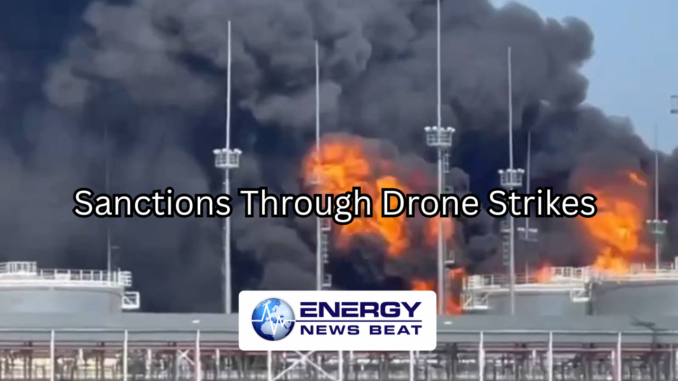
In a bold escalation of its campaign against Russia’s war machine, Ukraine launched overnight drone strikes on key energy infrastructure deep inside Russian territory. The attacks targeted the Slavyansky Oil Refinery in the Krasnodar region and the Nikolaevskaya oil depot in Rostov, disrupting fuel supplies critical to Moscow’s military operations. Confirmed by Kyiv’s military intelligence via Telegram, these strikes are part of a broader strategy to cripple Russia’s energy sector, which funds much of its aggression in Ukraine.
The refinery in Slavyansk-on-Kuban, a supplier to Russian occupation forces, suffered undetermined damage, while the Rostov depot saw a storage tank and the docked river vessel Captain Gibert hit, igniting fires and halting operations.
These latest hits come amid a surge in Ukrainian drone operations, extending even to remote assets like the Caspian Sea. Just days earlier, on December 14, Ukraine struck the “Grayfer” drilling rig, damaging its gas processing module and shutting down 14 wells producing around 3,500 tons of oil daily.
This followed a December 11 assault on the Vladimir Filanovsky offshore field, suspending output from over 20 wells.
An SBU source emphasized the message: “The Caspian Sea is another reminder that every enterprise supporting Russia’s war effort is a legitimate target—no matter where it is located.”
These deep strikes, hundreds of miles from the front lines, highlight Ukraine’s evolving capabilities in asymmetric warfare, targeting Russia’s lucrative oil and gas exports that account for a significant portion of its budget.
A Pattern of Escalating Strikes on Both Sides
The December 17 attacks are not isolated incidents but part of an intensifying tit-for-tat energy war that has unfolded over the past six months. Ukraine has ramped up its drone campaign against Russian oil facilities, aiming to erode Moscow’s economic resilience.
Notable strikes include:
December 1-2: A precision UAV hit on the massive Livny oil depot in Oryol region, destroying nearly 4,000 tons of fuel and sparking enormous fires.
December 12: The Slavneft-YANOS refinery in Yaroslavl, one of Russia’s largest, caught fire after a drone assault, with damage assessments ongoing.
November 15: A refinery near Moscow was targeted in retaliation for Russian drone barrages on Ukrainian cities.
October 29: The Afipsky refinery near Novorossiysk burned after an SBU-orchestrated drone strike.
Ongoing Caspian Campaign: Multiple hits on platforms like Filanovsky and Korchagin in early December, marking the third wave of attacks in the region.
These operations have forced Russia to dip into spare refining capacity, offsetting up to 20% downtime from attacks and maintenance between August and October.
Fires, evacuations, and airport disruptions have become commonplace, with naval drones even targeting Russia’s “shadow fleet” tankers in the Black Sea.
Russia, in turn, has unleashed devastating assaults on Ukraine’s energy grid, exacerbating winter hardships as temperatures plummet. Over the last six months, Moscow has intensified its bombardments, focusing on power plants and gas systems to deny Ukrainians heat, light, and water:
December 13: Massive strikes left over one million households without power across multiple regions, with blackouts persisting amid ongoing repairs.
December 10: A hit on Odesa’s gas transport system, part of a sharp increase in attacks on energy infrastructure.
December 3-4: Power plants in Odesa and Kherson obliterated, including the complete destruction of the Kherson Thermal Power Plant.
Broader Trend: Since spring 2024, Russia has targeted Ukraine’s energy system relentlessly, causing widespread disruptions that even spilled over to neighboring Moldova.
This mutual targeting of energy assets has turned the conflict into a full-blown resource war, with both sides seeking to undermine the other’s economic and military sustainability.
Layering on Geopolitical Pressures: Trump’s Dark Fleet Crackdown and Rising Insurance Risks
Compounding these disruptions is the incoming Trump administration’s aggressive stance on global oil sanctions. President Trump has ordered a “complete blockade” of sanctioned oil tankers entering or leaving Venezuela, ramping up pressure on Nicolás Maduro’s regime.
This includes the recent seizure of a supertanker off Venezuela’s coast, with sanctions extended to Russian giants like Rosneft and Lukoil.
The move targets the “dark fleet”—a shadowy network of aging, uninsured vessels smuggling sanctioned oil from Russia, Venezuela, and Iran. If fully enforced, it could slash Venezuelan exports and force buyers like China and India to seek alternatives, potentially tightening global supply.
Meanwhile, the risks associated with dark fleet operations are driving up insurance costs for ship captains and owners. War risk premiums in the Black Sea have spiked to 0.6%-1% of a vessel’s value, up significantly amid escalating threats from Ukrainian drones.
Dark fleet ships, often poorly maintained and lacking proper coverage, pose massive claims risks to insurers, with potential for environmental disasters or sabotage shifting costs to governments and taxpayers.
These hikes make smuggling less viable, further constraining sanctioned oil flows.
Oil Market Response: Volatility Amid Oversupply Fears
The confluence of these events is injecting uncertainty into oil markets, but prices have paradoxically trended downward. As of December 17, 2025, Brent crude hovers around $59 per barrel, while WTI sits at approximately $56, the lowest levels since early 2021.
Weak Chinese demand and fears of a 2026 glut have overshadowed supply risks, leading to a 7-8% monthly decline.
Russia’s oil export revenues plummeted to $11 billion in November, the lowest since the 2022 invasion, due to lower volumes and prices amid Ukrainian strikes and sanctions.
Trump’s Venezuela blockade could exacerbate this, potentially reducing global supply by disrupting 1-2% of world oil if shadow fleet operations grind to a halt.
However, analysts warn that stricter enforcement might initially boost prices by creating bottlenecks, only to ease if non-sanctioned producers like Saudi Arabia ramp up output.
What It Means for Oil Prices, Investors, and Consumers
For oil prices, the short-term outlook remains bearish, with oversupply concerns dominating despite geopolitical risks. A ceasefire in Ukraine or eased sanctions could push prices lower, but sustained attacks or a full dark fleet crackdown might spark volatility, driving Brent toward $65-70 if disruptions mount.
Longer-term, reduced Russian and Venezuelan exports could tighten markets in 2026, supporting higher prices amid growing demand for petrochemicals.
Investors face a high-risk environment. Energy stocks tied to Russian assets may suffer from revenue hits, while those in renewables or diversified majors could benefit from diversification away from sanctioned oil.
Opportunities exist in hedging against volatility, but dark fleet uncertainties amplify downside risks for the shipping and insurance sectors.
For consumers, lower current prices offer relief at the pump, but escalation could reverse this. Higher insurance and sanctions might filter through to elevated fuel costs, particularly in Europe and Asia, which are reliant on discounted Russian crude.
In the U.S., Trump’s policies may stabilize domestic supply but risk broader inflationary pressures if global tensions flare. As the energy war intensifies, the world watches closely—geopolitics, not just supply and demand, is shaping the future of oil.
Sources: oilprice.com, X, kyivindependent.com, carnegieendowment.org, insurancejournal.com