



In a dramatic turn of events on January 3, 2026, U.S. forces captured Venezuelan President Nicolás Maduro, sparking immediate reactions across global markets. President Donald Trump has vowed to involve American firms in reviving Venezuela’s beleaguered oil industry, which holds the world’s largest proven reserves but has seen production plummet from over 3 million barrels per day (bpd) to around 800,000 bpd due to years of mismanagement, sanctions, and neglect.
This development has fueled optimism among investors, leading to a surge in U.S. oil company stocks on January 5, 2026, as traders anticipate eased sanctions and new opportunities in Venezuelan fields. However, the rally comes amid falling oil prices and lingering uncertainties, raising questions about whether this is sustainable growth or merely a speculative bubble.
Key U.S. Oil Companies Seeing Gains Today
Wall Street’s energy sector led the charge in Monday’s trading session, with the S&P 500 Energy Index up 1.3%.
Major players with historical or potential ties to Venezuela, such as those involved in production, refining, and services, posted notable increases. Here’s a rundown of the top performers based on real-time market data and reports:
Chevron (CVX): Up 5.40% in early trading, making it the standout leader.
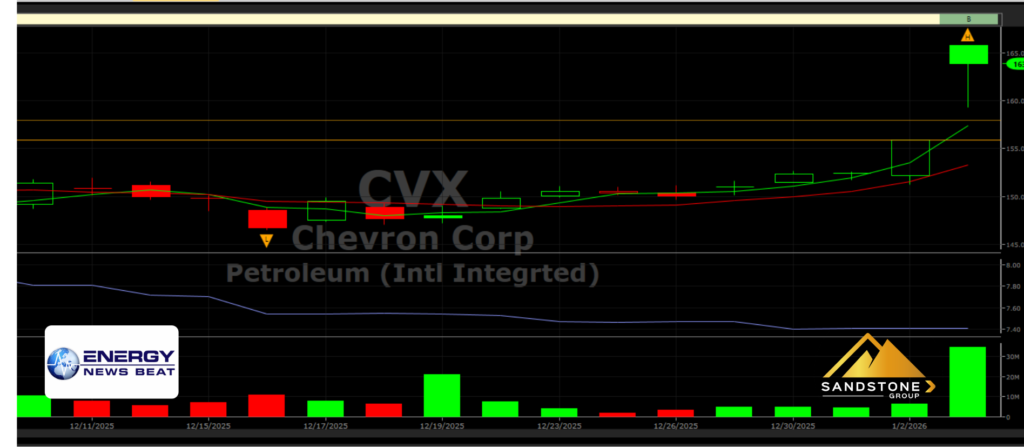
As the only remaining U.S. major operating in Venezuela, Chevron has been producing around 200,000 bpd through joint ventures with state-owned PDVSA, even under sanctions.
The company’s shares surged over 7% in pre-market before settling, reflecting investor bets on expanded access to the Orinoco Belt’s heavy crude reserves.
ExxonMobil (XOM): Rose 2.23%.
Exxon has a history of disputes with Venezuela, including a $1.6 billion arbitration win over expropriated assets in 2007, and could seek re-entry into offshore projects.
ConocoPhillips (COP): Gained 3.00-10%, depending on intraday fluctuations.
Conoco has outstanding claims against PDVSA for seized assets worth billions and stands to benefit from any U.S.-led restructuring.
Valero Energy (VLO): Jumped 11%.
As a refiner, Valero could capitalize on increased Venezuelan crude imports, which are well-suited for its Gulf Coast facilities designed for heavy, sour oil.
Marathon Petroleum (MPC): Up 10%.
Similar to Valero, Marathon’s refining operations could see cost advantages from cheaper Venezuelan feedstock.
Occidental Petroleum (OXY): Reported gains of around 4-5% in broader energy rallies.
While less directly tied, Occidental’s focus on Permian Basin efficiency might complement Venezuelan opportunities.
Oilfield Services Firms (e.g., Schlumberger (SLB), Halliburton (HAL)): Up 3-5%, as reviving Venezuelan fields would require massive infrastructure investments in drilling and maintenance.
These gains contributed to over $100 billion in added market value for U.S. oil stocks in a single session, driven by Trump’s statements that American companies will be “very much involved” in Venezuela’s transition.
Recent Earnings Reports: A Mixed Bag Amid Lower Oil Prices
The latest earnings from Q3 2025 (reported in October-November 2025) provide context for these companies’ financial health heading into this geopolitical shift. Overall, Big Oil saw modest profit declines of 2-12% year-over-year due to weaker crude prices and refining margins, but strong balance sheets and cost controls kept most in positive territory.
Here’s a snapshot:
US May Now Hold Pricing Sway Over Oil After Maduro Capture
In a stunning early-morning raid that shook global markets, U.S. forces captured Venezuelan leader Nicolás Maduro on January 3, 2026, hauling him off to face drug trafficking charges in a New York courtroom.
Maduro pleaded not guilty, calling it a “kidnapping,” but the bold Trump administration gambit has investors buzzing: Could this finally unlock Venezuela’s vast oil reserves, giving the U.S. unprecedented leverage over global crude prices?The capture comes amid escalating geopolitical tensions, with international outcry from allies like Cuba and Russia, but for the energy sector, it’s a game-changer.
Venezuela, once a powerhouse pumping over 2 million barrels per day (bpd), has seen output crater to around 800,000 bpd under sanctions and mismanagement. Now, with Maduro out, the Trump team is moving fast to revive the fields, potentially adding hundreds of thousands of barrels to the market in months.
Trump’s Energy Play: Secretary Wright Steps In
This week, newly appointed Energy Secretary Chris Wright is set to huddle with top oil execs from Chevron, ConocoPhillips, and ExxonMobil at the Goldman Sachs energy conference.
The agenda? Getting American firms back into Venezuela to crank up production. Trump has even floated using U.S. taxpayer dollars to reimburse companies for past losses, signaling a full-court press to “make Venezuelan oil great again.”
If sanctions lift, experts say output could surge by 150,000 bpd short-term, with long-term potential hitting 2 million bpd or more.
This isn’t just about supply – it’s about control. With U.S. companies leading the revival, America could dictate terms, influence global flows, and challenge OPEC+’s grip. As one analyst put it, this “Trump gambit” holds the chance for rising U.S. sway over crude, flipping the script on years of Venezuelan chaos.
A New Pricing Model?
OPEC+ Eyes Production-Demand ShiftOPEC+ isn’t sitting idle. Just days after Maduro’s capture, the cartel reaffirmed its pause on production hikes through Q1 2026, citing market volatility and weak demand signals.
Eight core members, controlling over half the world’s supply, are holding output steady to stabilize prices amid the turmoil.
Is this the dawn of a new pricing model? OPEC+ has long balanced cuts and quotas, but recent moves suggest a sharper focus on real-time production tweaks tied to demand forecasts.
With non-OPEC supply surging (think U.S. shale and now potentially Venezuela), the group is adapting – pausing increments in February and March to avoid a glut.
Critics say it’s reactive, but proponents argue it’s smart: Pricing oil more dynamically on supply-demand fundamentals could prevent wild swings, keeping markets bullish for producers.
Global output is projected to hit 106.1 million bpd in 2025, rising to 108.5 million in 2026, but demand growth is sluggish at 0.7-1.4 million bpd annually.
If OPEC+ nails this shift, it could counter U.S. gains and maintain cartel influence.
Demand Dynamics: China Slumps, Africa Rises – Bullish Enough?
Shifting demand paints a mixed picture. In China, the world’s top importer, oil appetite is waning fast. Economic slowdowns, EV booms, and efficiency gains mean demand growth could limp to just 150,000-300,000 bpd in 2026.
Forecasts show global demand peaking soon, with China’s hoarding masking deeper weakness.
This bearish signal has prices dipping nearly 20% in 2025 to around $60 per barrel.
But look south: Africa’s demand is exploding, fueled by population booms and industrialization. The continent could add 4.2 million bpd by 2050, with Sub-Saharan growth at 240,000 bpd in 2025 and 150,000 in 2026.
Emerging markets in Asia and Latin America are picking up slack too, with non-OECD demand driving the bus.
Is it enough for a bullish 2026? OPEC says yes, forecasting 106 million bpd demand with 1.3 million bpd growth.
But broader outlooks scream caution: Inventory builds, ample supply, and U.S. production dips could keep prices soft, making 2026 the cheapest gas year since COVID.
Venezuelan revival might add to the glut short-term, pressuring prices further.Yet, for bold investors, this chaos spells opportunity. U.S. oil stocks surged post-capture, and if Wright’s meetings deliver, American firms could dominate Venezuelan flows, bolstering U.S. energy security and market clout.
OPEC+’s adaptive stance might stabilize things, but with Africa hungry for more and China cooling off, the pricing power play is on – and the U.S. just grabbed a stronger hand.Stay tuned as Energy News Beat tracks this whirlwind: From Caracas to Wall Street, the oil game’s never been hotter.
Sources: wsj.com, reuters.com, theguardian.com, energynewsbeat.co, cnn.com, oilprice.com



Be the first to comment