


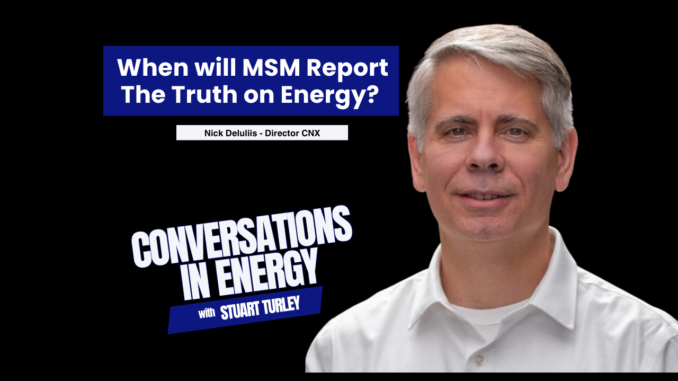
Nick Deluliis is a Director on the CNX Board and an author, bringing decades of experience to the discussion. On his website, he cites WSJ reporting and notes that the mainstream media (MSM) is letting the American Public down. He also raises some compelling points about how this can play out.
With Bill Gates admitting we are not going to die from “Climate Crisis” to Larry Fink admitting at Davos that we need stable power, when will the MSM follow these stories? Is it up to the podcasts and Substack authors to spread the truth?
Connect with Nick on his LinkedIn:https://www.linkedin.com/in/nick-deiuliis/
Nick just rolled out a great post today.
7 Days in January That Exposed PJM Grid Truths
Power demand in the PJM Interconnection during the week of January 25, 2026 was exceptionally high due to Winter Storm Fern, reaching levels that challenged all-time winter records.
Peak demand consistently exceeded 130,000 MW, an unprecedented winter streak for the region. Despite the gargantuan demand, PJM delivered, though it issued precautionary alerts.
The historic week provides a valuable opportunity to glean lessons. Based on real-world data, the takeaways are clear. Not everyone will like them, but all should heed them.
Natural gas generation was the unequivocal workhorse for the week. It held the highest absolute and percentage share of the PJM grid every day of the week.
Nuclear power was the rock of the PJM grid for the week. The nuclear fleet provided a steady, high-volume baseload that prevented widespread blackouts. Nuclear power was immune to the wind-chill.
Coal generation rose to the occasion when it was needed most. Coal power surged to nearly double its mid-January output, providing a critical baseload contribution during the storm and keeping the grid functional.
Solar failed miserably, with its output across PJM down 80+% compared to typical clear-winter-day expectations. The reasons were obvious: snow-covered panels, cloud cover, and long nights.
Wind power in PJM during the week was erratic, unpredictable, and dropped off during the most critical periods. Although it wasn’t quite the disaster that solar was, it was far from being a dependable and major contributor to the PJM generation mix.
The numbers for the week:
The ‘Reliables’ share of total PJM generation: Natural gas 41%, Nuclear 26%, Coal 22%
The ‘Unreliables’ share of total PJM generation: Solar <2%, Wind 3%
Fossil fuel + nuclear generation comprised more than 90% of total PJM generation for the week, outperforming wind + solar by a factor of 19-to-1.
Mother Nature has just confirmed the need for reliable generation from natural gas, nuclear, and coal. Mother Nature just obliterated the popular myth of reliable renewables at scale in PJM.
PJM needs more natural gas, nuclear, and coal generation. PJM should stop prioritizing unreliable solar and wind projects, especially where they delay/replace the installation of reliable power sources.

Key points in our discussion.
1. Concerns about biased and inaccurate energy news reporting:
Nick and I discuss how energy news reporting, particularly in outlets like the Wall Street Journal, often fails to provide objective, fact-based coverage. They cite the “Gell-Mann amnesia effect” where readers trust the reporting on topics they are unfamiliar with, even when the reporting on the guest’s area of expertise (energy) contains significant flaws and omissions.
2. The challenges of transitioning the energy grid to renewable sources:
We also explore how the push for large-scale adoption of wind and solar power has led to “manufactured inefficiencies” in energy systems. The guests argue that intermittent renewable sources are not viable replacements for reliable baseload power from fossil fuels and nuclear, resulting in grid instability and higher costs for consumers.
3. The importance of rational, fact-based energy policies:
The discussion highlights how ideologically-driven energy policies, often favoring renewable energy over more reliable sources, have had negative consequences for energy affordability, grid reliability, and industrial competitiveness. The guests advocate for policymaking grounded in scientific and economic realities rather than political agendas.
4. The potential of the Marcellus Shale region for reviving American manufacturing:
Nick expresses optimism about leveraging the abundant natural gas resources in the Marcellus Shale to support domestic manufacturing and economic growth, if policies enable the efficient development and utilization of these energy assets.
5. The emerging global divide on energy and climate policies:
I suggest a bifurcation of the world into two camps: those pursuing net-zero emissions policies that undermine industrial competitiveness, versus those focused on energy affordability and reliability to support economic prosperity. But Nick breaks it down to a
We emphasized the need for objective, fact-based journalism to inform the public and policymakers on the complex realities of the energy transition.
On Nick’s webiste his article covers some key points:
Caveat Lector: Gell-Mann Amnesia and WSJ Energy Reporting
The media has always enjoyed special protections in our unique form of republican democracy – with the First Amendment of the Constitution serving as Exhibit A. A free press is vital to the proper functioning of America, providing transparency on key issues and holding those in power accountable.
Yet today, the mainstream media is failing us, particularly with its inability or unwillingness to expose the seeming malfeasance of the expert elite, the Left, and the administrative state. Indeed, sensing mainstream media bias in news reporting these days is certainly more prevalent. Hindsight over the past few years has confirmed the media’s shortcomings when reporting news across a spectrum of critical issues.
But a few outlets avoided the self-inflicted trauma to their reputation better than their peers. The Wall Street Journal (WSJ) is one such organization, still enjoying the badge of objective authority on business matters.
That was certainly my view. For years, I held the WSJ in great reverence and viewed it as the standard of excellence in news.
But I slowly realized I was afflicted with a condition that clouded my rational assessment of the WSJ. I was giving the outlet’s news reporting too much benefit of the doubt. After self-analysis and a little research, I learned that I suffered from a severe case of the Gell-Mann Amnesia effect.
Since the diagnosis, my view of the WSJ’s news reporting has changed. I became concerned and desperately wanted to help the newspaper regain mastery of journalistic fundamentals, so that it could once again be the rightful beacon for other news organizations to follow.
That was my intention at the start of this effort, and that’s what I hope will manifest.
I highly recommend going to Nick’s site and reading the rest of the article.
Time Stamps:
01:04 WSJ Pivots from Trusted Reporting to Propaganda
04:00 The founding of the nation was on trust, and the press was afforded protections
08:59 Texas ERCOT, even with problems, is better off than other areas
12:42 Manufactured inefficiency on the grid
15.13 Ds and Rs it is simpler – it’s ideological
17:39 the Reliables are nat gas, coal, and nuclear
20:11 Power sources next to generation
Shout out to Reese Energy Consulting for sponsoring the Podcast:




Be the first to comment