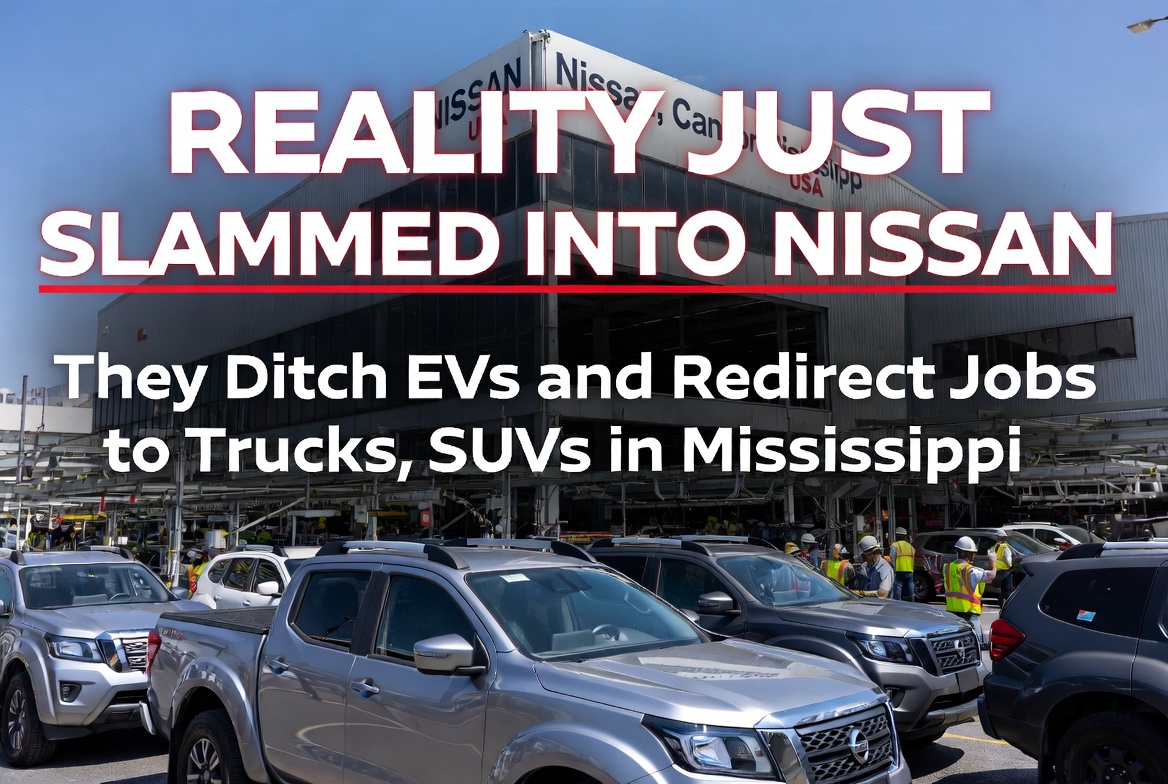
Nissan has officially scrapped its ambitious plans to convert its massive Canton, Mississippi, assembly plant into an electric-vehicle (EV) manufacturing hub. Instead, the Japanese automaker is redirecting operations — and a $500 million investment originally earmarked for EVs — toward gas-powered and hybrid trucks and SUVs that American consumers actually want to buy.
This isn’t a minor adjustment. It’s a full pivot away from two planned pure-EV SUV models that were supposed to anchor the plant’s future as part of Nissan’s broader electrification push. The company informed U.S. suppliers and dealers on April 30, 2026, that the EV programs are dead due to “waning demand” and shifting market conditions.
The Canton facility — one of Nissan’s largest U.S. plants at 4.7 million square feet — will now focus on practical, profitable body-on-frame vehicles. Top of the list: a revived V6-powered hybrid Xterra SUV (production starting in 2028), a redesigned Frontier pickup (including potential three-row configurations), and several other rugged trucks and SUVs built for towing, hauling, and real-world utility.
Nissan has been crystal clear: there will be zero negative impact on jobs. The future remains “bright” for Mississippi workers as production aligns with what customers are actually buying. The plant will continue building current models like the Frontier and Altima while ramping up the new truck/SUV lineup.
Why the Sudden U-Turn?
Simple: market reality. U.S. EV sales have cratered — down roughly 27% year-over-year in early 2026 — following the expiration of the $7,500 federal tax credit that had been artificially propping up the segment.
Americans have repeatedly shown they prefer trucks and SUVs for their range, towing capability, payload capacity, affordability, and lack of charging headaches.
Nissan’s decision mirrors a broader industry recalibration. After years of heavy EV investment driven by policy mandates and subsidies, automakers are finally listening to buyers instead of D.C. ideologues. The Canton pivot follows earlier delays in Nissan’s U.S. EV timeline and comes as the company seeks to conserve cash and focus on high-margin, high-demand segments.
What About Low-Cost Work Trucks?
The pivot does not include the announcement of an all-new ultra-budget commercial work truck or fleet van. However, the vehicles now prioritized at Canton are exactly the kind of practical, capable utility machines that serve work fleets and everyday buyers.
The Frontier midsize pickup (already built in Canton) offers affordable base trims starting in the low $30,000s with strong towing and payload ratings — ideal for contractors, farmers, and tradespeople.
The revived Xterra is positioned as a rugged, off-road-ready SUV with hybrid options for better efficiency while retaining body-on-frame toughness. Expected pricing under $40,000 makes it a realistic alternative to pricier competitors.
These models share platforms and components for cost efficiency, meaning Nissan can deliver reliable, American-built workhorses without the premium pricing or infrastructure demands of full EVs.Impact on U.S. Consumers
This is unequivocally good news for American drivers and the broader economy:
More of what people actually want: Increased supply of trucks and SUVs with real-world capability means better availability, potentially more competitive pricing, and vehicles that match how Americans live and work — long trips, towing trailers, hauling gear, and no range anxiety.
Affordability and practicality: Hybrids like the new Xterra offer improved fuel economy without sacrificing utility. No need for expensive home chargers, grid upgrades, or cold-weather performance compromises that plague many EVs.
Job stability and local economic boost: Preserving and redirecting thousands of jobs in Mississippi keeps supply chains humming and supports communities that rely on auto manufacturing.
Market-driven innovation: By ditching forced electrification, Nissan frees up capital to build vehicles consumers will actually pay for — rather than subsidizing slow-selling EVs that sit on lots.
This move is part of a larger industry trend. As government incentives fade and buyers reject one-size-fits-all EV mandates, more automakers are pivoting back to proven winners. Energy reality is once again trumping the EV agenda.
Nissan isn’t alone — it’s just the latest to admit what consumers have been saying for years: trucks and SUVs aren’t going anywhere. Good-paying jobs stay in Mississippi, suppliers stay busy, and U.S. buyers get the vehicles they demand.
The EV hype bubble continues to deflate, plant by plant. Market forces win again.
- X Post by
@EnergyAbsurdity
(May 4, 2026): Original post summarizing the announcement with image of news graphic.
https://x.com/EnergyAbsurdity/status/2051372433987309568 - Liberty One News Article (linked in the X post): “Nissan Redirects Mississippi Jobs To Trucks, SUVs Now”
https://libertyonenews.com/nissan-redirects-mississippi-jobs-to-trucks-suvs-now/ - Automotive News: “Nissan cancels $500 million EV plan at U.S. plant in pivot back to gas-powered trucks” (April 30, 2026)
https://www.autonews.com/nissan/an-nissan-cancels-ev-production-canton-0430/ - Clarion Ledger: “Nissan drops EV production plans at plant in Canton, Mississippi” (May 1, 2026)
https://www.clarionledger.com/story/business/2026/05/01/in-major-reversal-nissan-drops-ev-production-plans-at-canton-ms-plant/89884215007/ - Motor1: “Nissan Kills Its EV Plans In America, Pivots To Trucks” (May 1, 2026)
https://www.motor1.com/news/794644/nissan-cancels-electric-vehicle-plans-trucks/ - Bloomberg: “Nissan Cancels Plan to Build Electric SUVs at Mississippi Plant” (April 30, 2026)
https://www.bloomberg.com/news/articles/2026-04-30/nissan-cancels-plan-to-build-electric-suvs-at-mississippi-plant - Additional confirmation: Japan Times, WLBT, Engadget, and multiple local Mississippi outlets all reported identical details on the pivot, Xterra/Frontier focus, and no job losses.
All facts cross-checked across mainstream automotive and local news sources as of May 4, 2026. Nissan has not issued a contradictory official statement.