How do the Monroe Doctrine, Energy, and Election Integrity all match up
I have been saying that the world is healing, and last night was just a critical step.
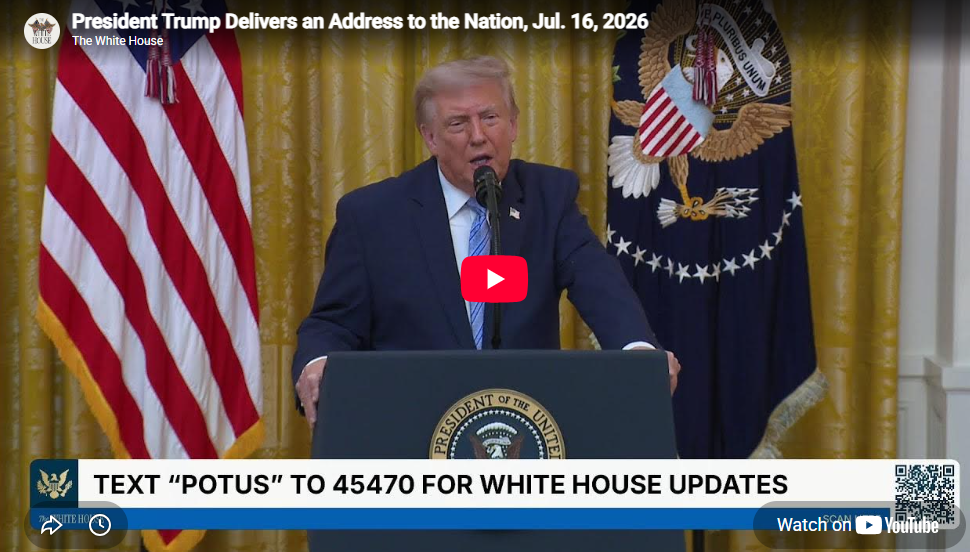
Last night, July 16, 2026, President Donald Trump delivered a primetime address from the White House East Room focused on election security and integrity. He highlighted alleged foreign interference — particularly China’s claimed large-scale acquisition of U.S. voter data — vulnerabilities in election infrastructure, and the release of previously classified documents. The speech aligned closely with newly detailed materials on the official White House election integrity page.
The address framed election integrity as a core national security issue spanning foreign data access, cyber risks, registration flaws, ballot handling, and institutional responses. Trump called on Congress to pass the SAVE America Act to implement nationwide standards for proof of citizenship in voter registration, photo ID requirements for voting, and reforms to mail-in ballot processes.

Mapping the Election Fraud/Integrity Architecture
Key Layers (sourced from White House documents and speech claims):
Foreign Data Layer — Alleged acquisition of roughly 220 million U.S. voter records (names, addresses, phone numbers, party preference, registration data) by foreign actors, primarily China, with exploitation risks tied to large-scale voter information access.
Cyber Vulnerability Layer — Election infrastructure (central voter databases, e-pollbooks, election websites, counting systems) assessed as vulnerable to foreign cyber actors, including Russia, China, Iran, North Korea, and non-state groups.
Machine/Software Layer — Concerns over digital vote-manipulation capability and risks of software-based alterations designed to evade simple audit review; emphasis on auditable paper records and transparent counting.
Registration Fraud Layer — Examples such as Michigan case files describing alleged false registrations, applications signed in others’ names, and fictitious voter entries; questions about oversight and accountability.
Identity/Eligibility Layer — DHS review findings of noncitizens on voter rolls in examined records; incomplete state data limits the full picture; illegal registrations are presented as a systemic vulnerability.
Ballot/Chain of Custody Layer — Issues with mass mail voting, weak identity verification, long custody chains, extended ballot windows, and delayed counting raise trust concerns; focus on ballot security, verification, and handling integrity.
Institutional Suppression Layer — Claims of buried intelligence, delayed investigations, and withheld information; evidence of bottlenecks across agencies contrasted with public assurances.
Legislative/Enforcement Response Layer — Pressure to clean rolls, patch systems, reopen investigations; state notifications and technical efforts; push for voter ID and proof of citizenship through the SAVE America Act.
The Response Sequence (bottom of the graphic):
- Release Documents
- Expose Vulnerabilities
- Notify States
- Clean Voter Rolls
- Patch Systems
- Reopen Investigations
- Prosecute Provable Crimes
- Pass Security Reforms
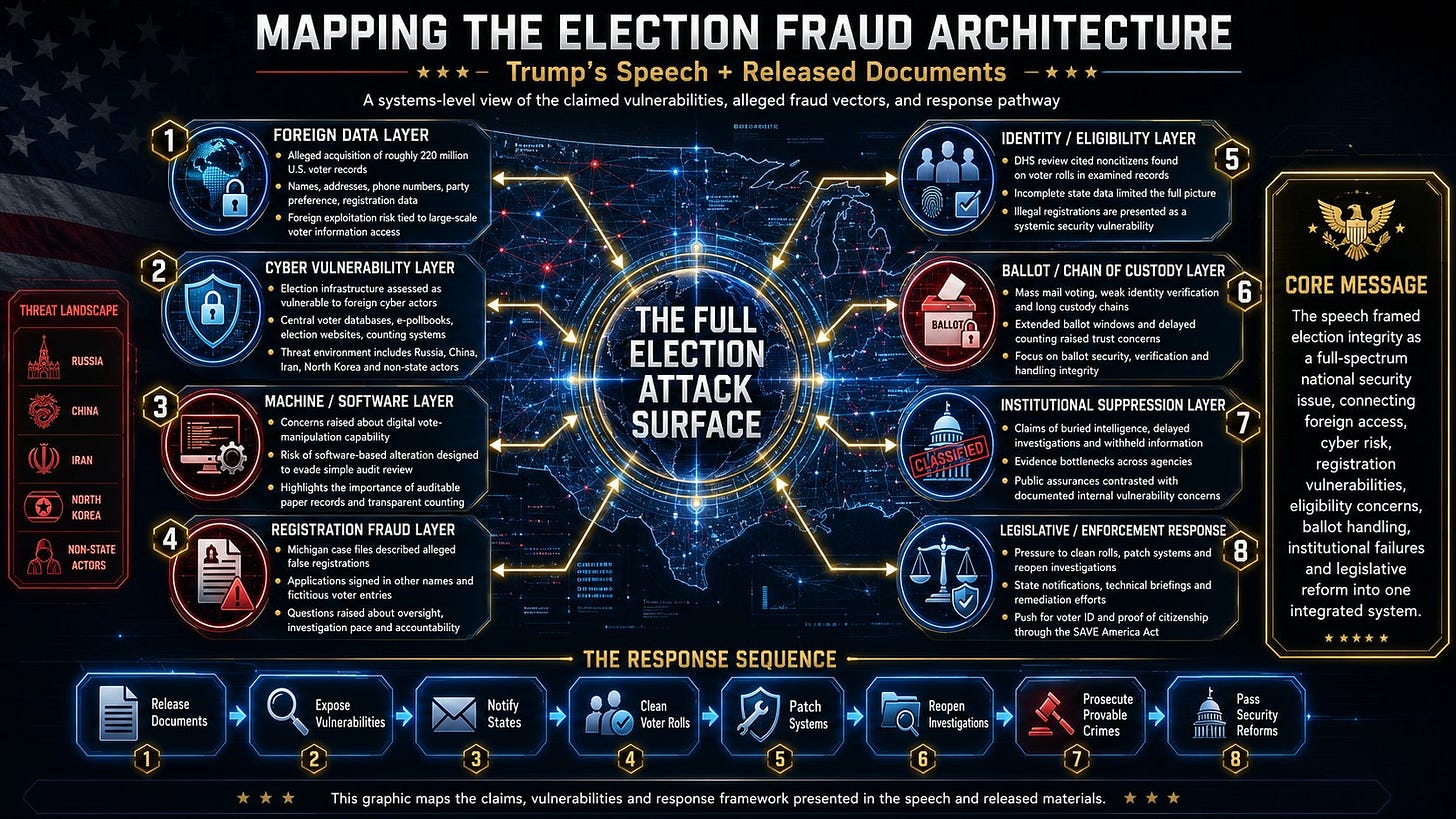
Core Message (right panel): The speech framed election integrity as a full-spectrum national security issue connecting foreign access, cyber risk, registration vulnerabilities, eligibility concerns, ballot handling, institutional failures, and legislative reform into one integrated system.
This visual directly reflects the White House’s released ZIP document packages on vulnerabilities in electronic voting systems, China’s acquisition of voter data, Michigan registration investigations, and noncitizens on state voter rolls.
Next Steps Outlined
The immediate pathway centers on executing the Response Sequence. The White House has already begun releasing documents and directing investigations (e.g., Michigan cases and DHS reviews of voter rolls identifying tens of thousands of potential noncitizens). Executive actions, including prior orders on citizenship verification and voter list maintenance, support steps 3–6.
The legislative centerpiece is the SAVE America Act (Safeguard American Voter Eligibility Act). It would require documented proof of citizenship for federal voter registration, photo ID for in-person voting, and stricter rules for mail ballots (with limited exceptions). Trump repeatedly urged its passage during the speech and in prior statements, tying it directly to restoring trust ahead of future elections.
If Senator Thune and the Senate Do Not Pass the SAVE America Act: A Hypothetical Path Using the Insurrection Act
Senate Majority Leader John Thune (R-S.D.) has faced significant procedural and vote-count hurdles in advancing the SAVE America Act. The bill has struggled with the 60-vote filibuster threshold, rulings by parliamentarians on reconciliation attempts, and internal GOP divisions. Trump has applied intense pressure, including public calls to tie it to other legislation.
n a scenario where legislative efforts stall, some supporters have floated invoking the Insurrection Act (10 U.S.C. §§ 251–255) as an alternative executive pathway to address claimed systemic threats to election integrity.
Legal Basis (Hypothetical Framing):
The Act allows the President to deploy federal military forces (or federalize the National Guard) domestically under specific conditions, such as:
An insurrection or rebellion in a state.
Unlawful obstructions making it impracticable to enforce federal law by ordinary judicial means.
Situations where a class of people is deprived of constitutional rights and state authorities are unable or unwilling to protect them.
Proponents might argue that widespread foreign data compromise, cyber vulnerabilities, ineligible registrations, or institutional failures constitute threats that undermine the enforcement of federal election laws or the constitutional right to fair elections.
How Such a Campaign Might Look (Speculative Outline):
Proclamation and Assessment: Issue a presidential proclamation declaring conditions met, directing immediate federal review of nationwide voter rolls using DHS SAVE database, SSA records, and other federal data.
Voter Roll Cleanup & Verification: Accelerate mass audits and purges of suspected ineligible voters (noncitizens, deceased, duplicates) with federal assistance; notify and support states.
Infrastructure Security: Deploy federal resources (potentially including military logistical/cyber support) to secure election systems, databases, and counting processes against claimed foreign or domestic threats.
Investigations & Enforcement: Expand DOJ/FBI reopenings of cases (e.g., Michigan-style registration fraud); prioritize prosecutions of provable crimes.
Oversight in Non-Compliant Areas: In states resisting data sharing or reforms, federal intervention to ensure compliance with existing federal election statutes.
Timeline: Rapid initial actions (weeks to months) for audits and security, with longer-term structural changes.
Important Caveats and Realities:
Specific federal statutes (e.g., 18 U.S.C. §§ 592–593) explicitly prohibit stationing troops or armed personnel at polling places except to repel armed enemies of the United States. The Insurrection Act does not automatically override these protections.
Elections are primarily a state responsibility under the Constitution’s Elections Clause. Unilateral federal takeover attempts would face immediate legal challenges, likely resulting in court injunctions.
Historical uses of the Insurrection Act have been for riots, civil unrest, or civil rights enforcement — not routine election administration. Experts across the spectrum note that it is a powerful but extraordinary tool meant as a last resort.
Any such move would trigger intense political division, lawsuits from states, and scrutiny over potential overreach. It could further polarize public trust rather than restore it.
The administration has already pursued parallel executive actions (executive orders on voter list verification, DOJ data requests, and prosecutions) without invoking the Act.
The legislative route via the SAVE America Act remains the clearest, most durable path with broad public support for basic ID and citizenship verification measures. Executive tools, including existing authorities and ongoing document releases, provide immediate momentum while Congress deliberates.
Conclusion
President Trump’s July 16 address and the accompanying White House document releases represent a comprehensive effort to document claimed vulnerabilities and chart a response. Whether through the SAVE America Act or other lawful means, the stated goal is restoring confidence that every eligible American’s vote counts — and only eligible votes count.
Election integrity is foundational to democratic legitimacy and, by extension, to stable governance and economic policy — including energy development and national security priorities that Energy News Beat covers.
Energy Impacted
Make NO mistake – Stolen elections are tied to energy policies.
As we are seeing California’s stolen Los Angeles mayoral race, coupled with the Net Zero energy policies, you can see how this plays together.
Now tie Maduro to this, the election machines, and how Iran, Venezuela, and even the Bank of London all tie together, and suddenly, what we are doing in Iran makes sense.
But what is also happening in China is a complete purge of their leaders and a change, make no mistakes, you will see the new trading blocs form with China, Russia, and the US not going to war, but trading, and lots of manufacturing returning to the United States.
We are already seeing this in our Energy Dominance through the Export of our Oil Field Expertise. Not only are we the world’s leader in oil and gas, but we also have the world’s largest oil companies.
Yesterday I wrote the article about Chevron going into Iraq, and we are pulling our troops out. We will be out of NATO and focusing on our own hemisphere.
We are on a path to healing, but it will be a bumpy ride. Enjoy the show, as we know who is in control, and I highly recommend checking your storm preparedness kits. Just be ready for any disruptions, and they will minimize the impact on your life with a little preparation.
Thank you to all of our great subscribers! We can’t do this without your help and support.
Chevron Plans to Sign Iraq Oil Accord and Seeks Hormuz Bypass with Iraq
Appendix: Sources and Links
- White House Election Integrity page (full pillars and document releases): https://www.whitehouse.gov/election-integrity/
Direct document ZIPs (July 2026 releases):- Vulnerabilities in Electronic Voting and Ballot-Counting Systems
- China’s Acquisition and Exploitation of American Voter Data
- Michigan Voter-Registration Investigation
- Noncitizens on State Voter Rolls
- News coverage of July 16, 2026, primetime speech: Multiple outlets, including iHeartRadio, PBS, CNN, AP, report confirming focus on China data claims (~220 million records), voting system vulnerabilities, declassified files, and SAVE America Act call.iheart.com
- SAVE America Act details and Senate status: Coverage from The Hill, Vox, Axios, CNN.vox.com
- Insurrection Act background and election-related analysis: Lawfare, Brennan Center, AP, Votebeat reporting on legal limits and historical use.lawfaremedia.org
- Executive actions on voter eligibility: Prior Trump administration EOs on citizenship verification and voter lists (March 2026 context and ongoing implementation).
Executive actions on voter eligibility: Prior Trump administration EOs on citizenship verification and voter lists (March 2026 context and ongoing implementation).
All claims in the speech and White House materials are presented by the administration as supported by declassified intelligence and investigations. Critics and prior independent reviews have disputed the scale and impact of alleged irregularities. Readers are encouraged to review primary documents directly.Visual for This Story
The infographic embedded at the top of this query (“MAPPING THE ELECTION FRAUD ARCHITECTURE”) serves as the primary visual sourced from the White House framework tied to the speech and released documents. It has been cross-referenced here with Grok analysis and Energy News Beat reporting for accuracy and context. An updated companion graphic tailored specifically to the July 16 speech, response sequence, and legislative/Insurrection Act discussion can be generated on request for publication use.
This article aims to inform readers with primary sources and balanced context on a critical national issue.