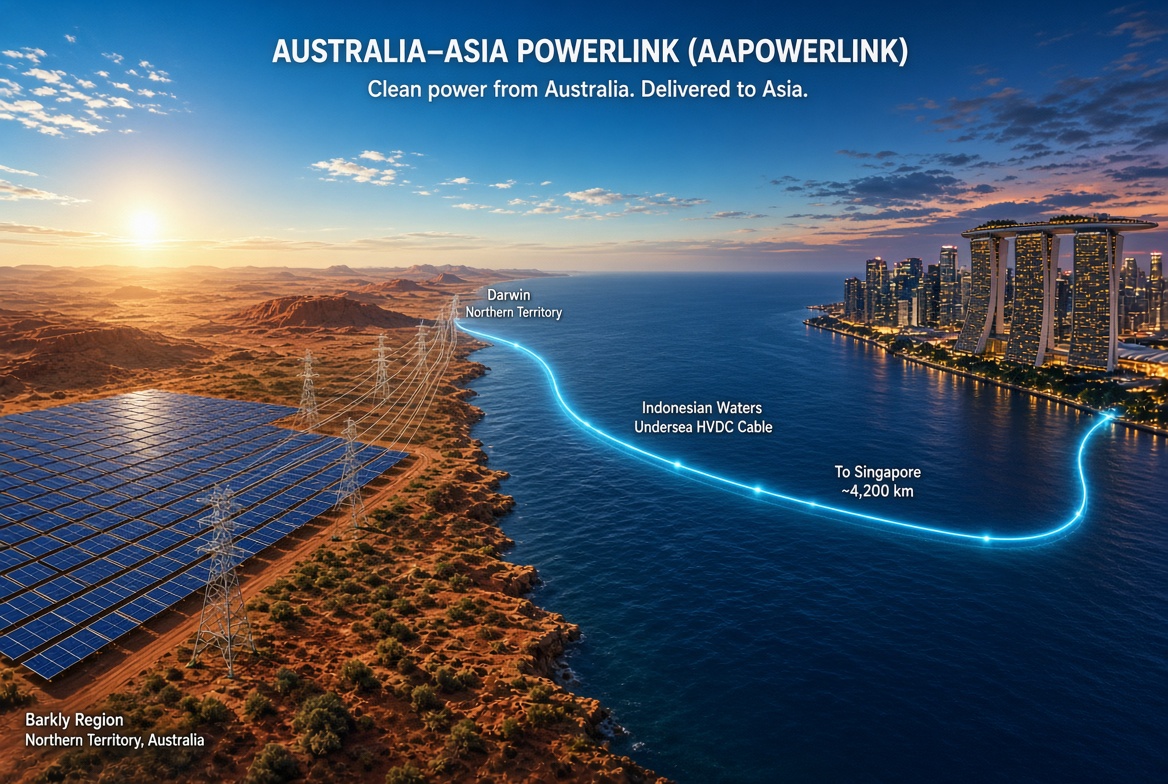
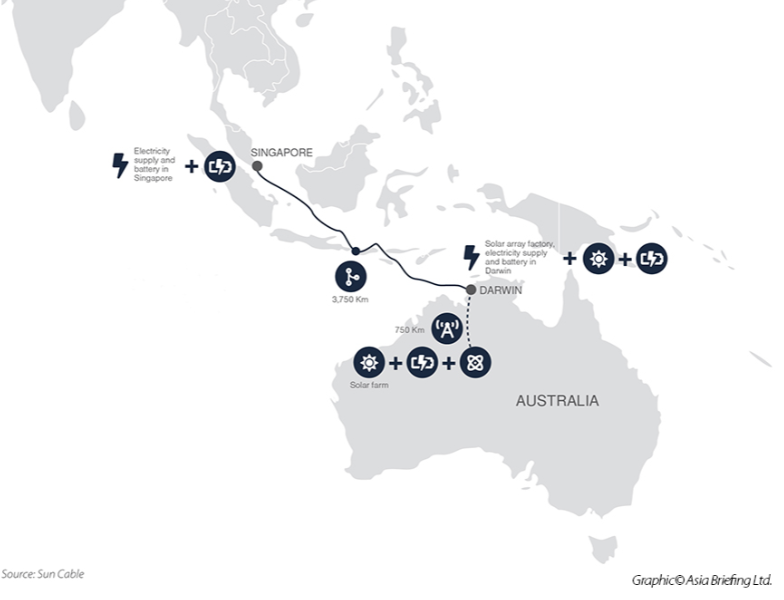
Australia’s Australia-Asia PowerLink (AAPowerLink), the flagship project of SunCable (now controlled by Mike Cannon-Brookes’ Grok Ventures), is sold as the pathway to making Australia a “Green Energy Superpower.” It promises the world’s largest solar array, the world’s largest battery, and the world’s longest subsea HVDC cable—exporting firmed renewable power from the Northern Territory’s Barkly region to Darwin and Singapore.aseanbriefing.com
Reality is far bleaker. With a price tag now exceeding A$35–40 billion (and historically cited as high as that range after multiple revisions), the project is one of the most expensive energy ventures in Australian history. It forms part of broader net-zero ambitions whose total public and private capital costs are projected in the trillions. Three colossal engineering challenges define it: a ~12,000-hectare solar array (roughly 40 million panels, equivalent to the surface area of San Francisco or 17,000 AFL fields), an ~800 km HVDC overhead line to Darwin plus a 4,300 km undersea cable to Singapore, and massive utility-scale battery storage for purported 24/7 dispatch.
The project has already collapsed once into voluntary administration in 2023 amid disagreements between early backers Cannon-Brookes and Andrew Forrest over funding and viability. It has been scaled back from original visions of 17–20 GW solar and 36–42 GWh storage to roughly 6 GW total (up to ~4 GW for Darwin industrial use and 1.75 GW to Singapore). Environmental approvals have been secured in Australia, and Singapore has given conditional approval, with a final investment decision targeted for 2027 and first power in the early-to-mid 2030s. Yet the fundamental physics, economics, and operational realities remain unchanged—and fatal.
Capital Costs and the Crushing Cost of Capital
Official figures put Australian investment during construction around A$8 billion, with broader economic value claimed at A$20 billion over decades for the Northern Territory. Independent and historical estimates for the full system (solar + storage + transmission) have ranged from A$23–35 billion and higher. Early breakdowns suggested solar at hundreds of dollars per kWp, batteries at ~US$160/kWh (now lower but still substantial at scale), and the interconnector alone consuming a large share.
Cost of capital is the silent killer. Australian utility-scale solar WACC estimates hover around 7% real pre-tax in more mature, lower-risk settings, but this project is anything but mature or low-risk. It involves first-of-a-kind ultra-long subsea HVDC through Indonesian waters, extreme remote construction, geopolitical exposure, offtake uncertainty, and execution risk on a scale never before attempted. Higher risk premia for novel mega-projects, merchant or partially contracted exposure, and construction delays push effective WACC well into double digits in stressed scenarios. High gearing is difficult; equity requirements are enormous. The project has already burned hundreds of millions in development capital and needed a rescue acquisition. Financing A$35–40+ billion for an asset whose cash flows depend on Singapore offtake, Indonesian transit rights, and desert performance is a herculean—and likely impossible—task at acceptable rates.
Transmission losses alone compound the problem: roughly 3% per 1,000 km on HVDC implies ~13% losses on the subsea leg before converter and other system losses. Capital is spent generating power that never arrives.
Maintenance and Replacement: The Operational Nightmare That Official Timelines Ignore
Proponents claim system lives of 20–30 years (or longer for cables). That is fantasy in the Barkly desert. Extreme heat, dust storms, monsoonal downpours, thermal cycling, and abrasive soiling create an operational nightmare that standard models ignore.
Solar soiling in arid Australian conditions routinely cuts output 10–35% (or more after dust events) without frequent cleaning. Global soiling losses average 3–5% but spike far higher in deserts. Cleaning 120 km² of glass is not routine O&M—it is an industrial-scale water, logistics, and labor challenge in a water-scarce, remote region with extreme heat. Even optimized O&M for large Australian solar has been modeled at A$7–10+/kWp/year; at multi-GW scale in the Outback, the true figure will be higher, and performance will still degrade.
Desert degradation rates for crystalline silicon modules frequently exceed the typical 0.5–0.8%/year warranty assumptions. Field data from hot deserts show 0.9–1.5%+/year (and higher for some modules), driven by UV-induced discoloration, thermal stress, micro-cracks, abrasion, and corrosion. Projected lifetimes to 80% of original power can fall to 13–23 years under realistic conditions rather than the marketed 25–30+. Structures require 400,000–600,000 tonnes of steel and aluminum framing anchored in harsh soils—subject to corrosion, wind, and dust. Full panel and structural replacement cycles will be required far earlier and more frequently than claimed, turning the project into a perpetual capital sink.
The undersea cable faces its own realities. While modern HVDC submarine cables have low average fault rates (~0.07–0.1 faults per 100 km-year in some datasets), when faults occur, repair times average 60 days or more. Limited specialized vessels, weather windows, permitting across jurisdictions (especially Indonesia), and deep-water sections make rapid restoration nearly impossible. Repair costs run into the millions per incident. Cable lifetimes are typically cited at 40 years, but real-world experience with older systems and the extreme length/depth here make mid-life interventions or full replacement highly probable within any realistic project horizon. The current longest comparable cables are a fraction of this length; this one is a leap into the unknown.
Let alone the GeoPolitical risks now with undersea cables and intentional malicious behavior. Tankers and military ships, when going over, can cause serious breaks or ruin connections with specially designed anchors.
Battery Storage: Upfront Cost, Short Life, and Recycling Black Hole
Massive storage is essential for any claim of 24/7 firmed power. Original plans called for 36–42 GWh; even the scaled project requires multi-GWh capacity. Current all-in utility-scale BESS costs outside China/US are roughly US$125/kWh (core equipment ~US$75/kWh). At tens of GWh the capital outlay is still measured in billions.
Li-ion batteries degrade to ~70–80% capacity in 10–15 years under typical utility cycling (one or more cycles per day). Full replacement will be required multiple times over any multi-decade project life. Round-trip efficiency losses (~10%) and calendar/cycle aging further erode economics. Decommissioning and recycling add more: estimates for a 1 MWh NMC system run ~US$90,000 (roughly 40% dismantling/packaging, 30% transport, 30% recycling), with wide ranges depending on chemistry, density, and location. Recycling costs vary from ~US$1–20+/kg depending on process (pyro, hydro, direct), scale, and recovered materials value. At the volumes implied here, end-of-life liabilities are enormous and rarely fully provisioned in early project economics. Second-life applications may defer but do not eliminate the problem.
Unlisted Costs and Systemic Risks
Materials intensity is staggering: 80,000–100,000 tonnes of high-purity polysilicon and significant silver for the panels alone, plus the steel/aluminium. Supply-chain, manufacturing, and logistics risks in a remote location are severe. Insurance for novel ultra-long cables and desert mega-arrays will be expensive or limited. Geopolitical risk on the Indonesian transit corridor, Indigenous land agreements (recently progressed but long-term), environmental management of dust and land disturbance, and offtake price risk in Singapore (where gas still dominates) are all under-weighted in promotional materials. Opportunity cost is clear: equivalent reliable capacity could be delivered with far fewer moving parts via nuclear, gas with CCS, or more conventional generation closer to load.
The project has already demonstrated fragility—administration, scaling back, delayed timelines, and funding struggles. Maintenance that is “almost impossible” at this scale, repeated replacements of short-lived components, high cost of capital, transmission losses, and end-of-life liabilities that are never fully listed will turn the AAPowerLink into a capital destroyer rather than an energy superpower asset.
History is littered with energy megaprojects that ignored physics, logistics, and full lifecycle costs. This one is set to join—and potentially top—the list.
Appendix: Sources and Links
- Peter Clack X post (15 Aug 2026): https://x.com/PeterDClack/status/2088565481381003476
- SunCable official project page: https://www.suncable.energy/our-projects
- Wikipedia – Australia-Asia Power Link: https://en.wikipedia.org/wiki/Australia-Asia_Power_Link
- Infrastructure Australia evaluation: https://www.infrastructureaustralia.gov.au/ipl/australia-asia-powerlink
- Reuters (Singapore conditional approval, 2024): https://www.reuters.com/business/energy/singapore-approves-import-solar-energy-australia-via-undersea-cable-2024-10-22/
- Global Energy Monitor / GEM wiki solar farm details
- Academic/industry analyses of HVDC costs, losses, and reliability (CIGRE, ENTSO-E, various papers on subsea cable fault rates and repair times)
- Solar soiling and desert degradation studies (IEA PVPS, Atacama and Australian field data, NREL-related work)
- Battery cost and LCOS data (Ember 2025 analyses, Lazard, NREL cost projections)
- WACC / cost of capital for Australian renewables (Oxford Economics / AEMO IASR inputs, CEPA, academic papers on project finance)
- Decommissioning/recycling cost estimates (EPRI and related studies)
- Additional coverage: pv magazine Australia, AP News, Big Think, The Australian, Reuters administration reporting (2023), and NT EPA assessment documents
(Note: Cost and capacity figures have evolved across project iterations; the analysis uses publicly reported ranges and conservative engineering benchmarks rather than promotional claims.)