America needs every reliable megawatt it can get. Restarting a proven nuclear plant is one of the fastest ways to put firm, around-the-clock power back on the grid.
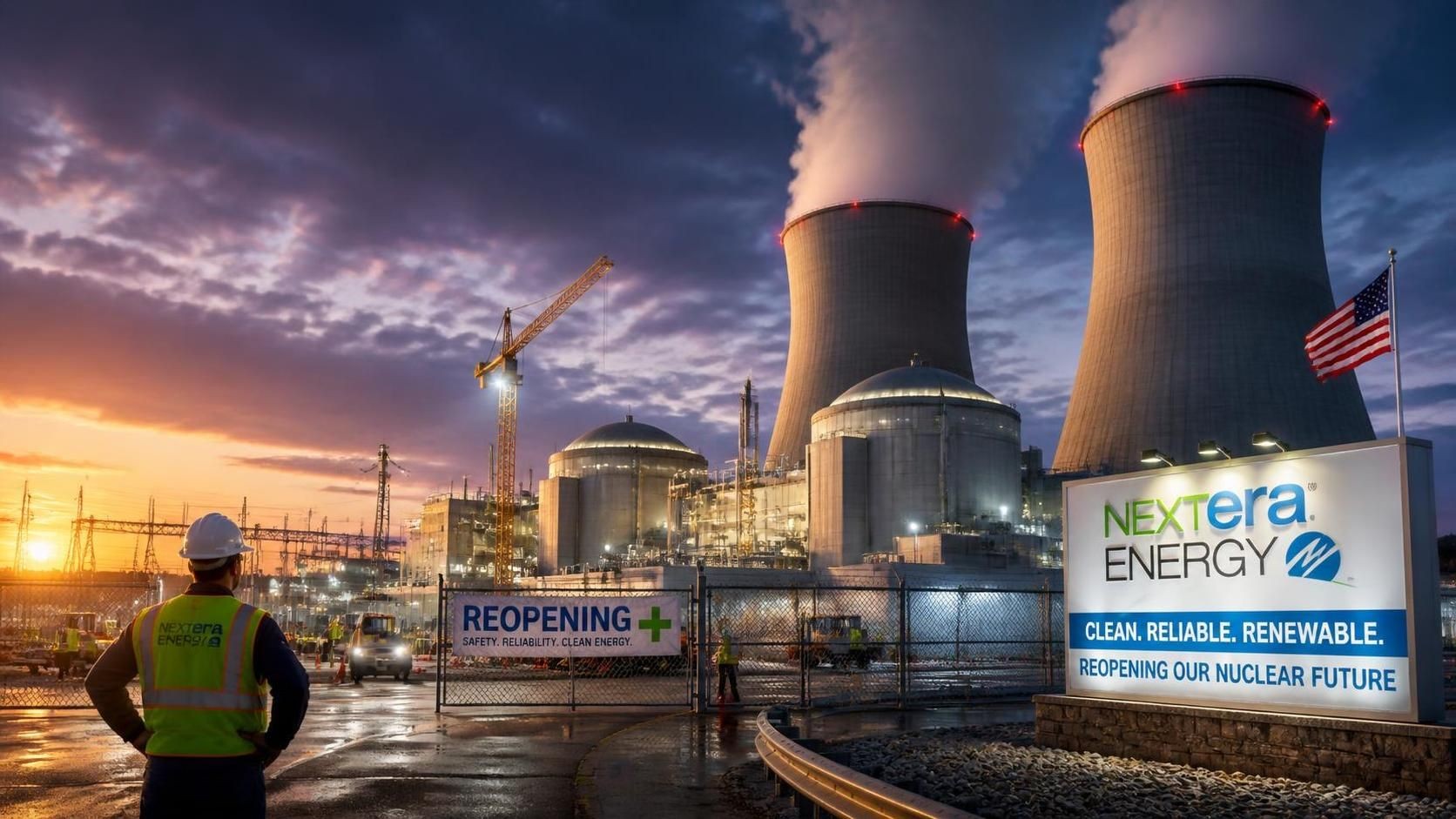
The U.S. Department of Energy has closed a loan of up to $1.9 billion to NextEra Energy to restart the Duane Arnold Energy Center in Linn County, Iowa. The plant is Iowa’s only nuclear station. It shut down in 2020 after 45 years of operation. NextEra aims to bring it back by the first quarter of 2029, pending Nuclear Regulatory Commission approvals.
The 615-megawatt boiling-water reactor would supply enough electricity for nearly 500,000 homes. DOE estimates the project will create about 1,500 construction jobs and support more than 450 jobs once the plant is running again.
A 25-year power purchase agreement with Google, signed last year, underpins the restart. That deal reflects the surge in electricity demand from AI data centers and the broader need for baseload power that does not depend on the weather. Only a small slice of output—about 50 megawatts—has been described as reserved for a local cooperative; the rest is tied to the Google offtake.
Deputy Energy Secretary James Danly called the restart another step in “America’s nuclear renaissance,” arguing that returning 615 MW of reliable generation will help drive down electricity costs and support reindustrialization. NextEra CEO John Ketchum framed it as adding new supply for new demand so Iowa families and businesses are not left carrying the cost of growth.
Duane Arnold began commercial operation in February 1975. It was licensed to run until 2034, when it closed. In August 2020, a derecho damaged non-safety cooling towers. The plant had already been heading toward an earlier retirement under a power-purchase agreement, and repairs were judged uneconomic at the time. Demand, federal financing, and a long-term buyer have changed that math.
This is the third shuttered U.S. nuclear plant receiving federal restart support. Palisades in Michigan and Three Mile Island Unit 1 in Pennsylvania—now called the Crane Clean Energy Center—are also in the restart pipeline. Palisades received earlier Biden-era financing of about $1.5 billion. Constellation received about $1 billion under the current administration for Three Mile Island. No mothballed U.S. commercial reactor has actually returned to service yet. These three projects are the test cases.
America’s nuclear fleet: large, aging, and still the workhorse
The United States still runs the world’s largest commercial nuclear fleet. As of 2026, official tallies put operable reactors in the mid-90s—EIA cited 96 commercial reactors at 57 plants as of March 2026, while World Nuclear Association and IAEA-style counts list 94 operable units with roughly 97,000 MW of capacity. The difference largely reflects how restart-bound units such as Palisades and Crane are classified. Nuclear still supplies about 18% of U.S. electricity and more than 40% of the country’s zero-carbon generation. Capacity factors routinely exceed 90%.
The fleet is old. EIA puts the average age of operating reactors at about 44 years as of March 2026. World Nuclear Report data around August 2026 put mean age near 44.8 years. The oldest operating unit is Nine Mile Point Unit 1 in New York, which entered commercial service in December 1969. Almost all of today’s capacity was built between the late 1960s and 1990.
That age is not an automatic death sentence. NRC licenses start at 40 years. Most plants have already received a 20-year extension to 60 years. A growing group has received a second extension to 80 years. DOE has highlighted an “80 Club” of plants with subsequent license renewals, including Turkey Point, Peach Bottom, Surry, North Anna, Monticello, Oconee, V.C. Summer, Point Beach, Browns Ferry, Dresden, H.B. Robinson, St. Lucie, and Hatch. Operators are also pursuing uprates to squeeze more megawatts from existing units.
The last reactors to come online
New U.S. nuclear construction dried up for a generation. The last units to enter commercial service were:
- Watts Bar Unit 2 (Tennessee Valley Authority, Tennessee): commercial operation on October 19, 2016. Construction originally started in 1973, stopped, and later resumed. It was the first new U.S. reactor to enter commercial service since Watts Bar Unit 1 in 1996.
- Vogtle Unit 3 (Southern Company / Georgia Power, Georgia): commercial operation on July 31, 2023. First U.S. AP1000.
- Vogtle Unit 4: commercial operation on April 29, 2024. Together with Unit 3, Vogtle added more than 2,200 MW and made Plant Vogtle the largest nuclear station in the country.
Those two Vogtle units were the first truly new large reactors completed in the United States in decades. They were also late and far over budget. That experience is exactly why restarts, uprates, and smaller or standardized designs now sit at the center of policy.
What is actually under construction—and what is promised
As of mid-to-late 2026, conventional large light-water reactors under construction in the United States stand at zero. The pipeline is a mix of restarts, first-of-a-kind advanced reactors, and a political target for 10 new large reactors.
On the advanced side, TerraPower’s 345 MW Natrium sodium-cooled reactor at Kemmerer, Wyoming, received an NRC construction permit in March 2026. Non-nuclear construction began in April 2026, with completion targeted around early 2031. Kairos Power broke ground on its Hermes 2 demonstration plant in Oak Ridge, Tennessee, in April 2026. X-energy is advancing Xe-100 projects, including a planned plant for Dow in Texas. Several other SMRs and microreactors are in licensing, site work, or DOE demonstration programs. DOE’s Reactor Pilot Program produced multiple advanced-reactor criticality demonstrations in 2026.
On the large-reactor side, the administration has set a goal of 10 large conventional reactors under construction by 2030 and a longer-term target of quadrupling U.S. nuclear capacity toward 400 GW by 2050. In June 2026, DOE announced up to $17.5 billion in conditional loans to support long-lead procurement for as many as five projects, each with two Westinghouse AP1000 units. That package is meant to rebuild the supply chain and pull construction starts forward. Sites and final investment decisions are not all locked. History says large U.S. nuclear projects slip. The financing is real; steel in the ground is still the test.
Restarting Duane Arnold will not solve the capacity gap by itself. Neither will Palisades or Three Mile Island. Together they add more than 2 GW of firm power that already has a site, a license history, transmission, and a trained workforce. That is cheaper and faster than a greenfield gigawatt plant.
The United States cannot meet rising load from data centers, manufacturing, and electrification with intermittent generation alone. Nuclear is the only proven large-scale, always-on, low-carbon source that can run for 60 to 80 years. Restarting a shuttered plant is not a silver bullet. It is a practical start—and the country needs more of them.
Appendix: Sources and linksDuane Arnold loan and restart
- U.S. Department of Energy press release, Sept. 8, 2026: https://www.energy.gov/articles/energy-department-closes-19-billion-loan-restart-duane-arnold-nuclear-plant
- Bloomberg: https://www.bloomberg.com/news/articles/2026-09-08/us-loans-1-9-billion-to-restart-shuttered-nextera-nuclear-plant
- Reuters: https://www.reuters.com/business/energy/nextera-secures-up-19-billion-us-loan-restart-duane-arnold-nuclear-center-2026-09-08/
- World Nuclear News: https://www.world-nuclear-news.org/articles/us-department-of-energy-closes-loan-for-duane-arnold-restart
- TechCrunch: https://techcrunch.com/2026/09/08/googles-revived-nuclear-power-plant-gets-1-9b-loan-from-us-government/
- WSJ: https://www.wsj.com/business/energy-oil/nextera-energy-doe-close-on-1-9-billion-loan-for-nuclear-power-plant-in-iowa-381c2994
- NextEra Duane Arnold FAQ: https://www.nexteraenergy.com/duane-arnold-energy-center/faq.html
- NRC Duane Arnold page: https://www.nrc.gov/info-finder/reactors/duan.html
U.S. fleet size, age, and operations
- EIA FAQ, plant age and newest reactors: https://www.eia.gov/tools/faqs/faq.php?id=228&t=21
- EIA, U.S. nuclear industry: https://www.eia.gov/energyexplained/nuclear/us-nuclear-industry.php
- EIA, number and location of plants: https://www.eia.gov/tools/faqs/faq.php?id=207
- World Nuclear Association, Nuclear Power in the USA: https://world-nuclear.org/information-library/country-profiles/countries-t-z/usa-nuclear-power
- World Nuclear Report, United States: https://www.worldnuclearreport.org/United-States
- IAEA Country Nuclear Power Profiles: https://cnpp.iaea.org/public/countries/US/profile/highlights
- DOE, “The 80 Club”: https://www.energy.gov/ne/articles/80-club-celebrating-americas-longest-serving-nuclear-reactors
- NRC subsequent license renewal status: https://www.nrc.gov/reactors/operating/licensing/renewal/subsequent-license-renewal.html
Last reactors online
- Georgia Power, Plant Vogtle: https://www.georgiapower.com/about/energy/plants/plant-vogtle.html
- World Nuclear Association, Vogtle 3: https://world-nuclear.org/nuclear-reactor-database/details/vogtle-3
- World Nuclear Association, Watts Bar 2: https://world-nuclear.org/nuclear-reactor-database/details/Watts-Bar-2
- POWER Magazine, Watts Bar 2 commercial operation: https://www.powermag.com/its-official-watts-bar-unit-2-begins-commercial-operation/
New construction, advanced reactors, and policy
- DOE collection on unleashing commercial nuclear power: https://www.energy.gov/collection/filter/1381150
- Reuters, $17.5 billion nuclear supply-chain loans: https://www.reuters.com/business/energy/us-announces-175-billion-conditional-loans-nuclear-power-2026-06-23/
- Nuclear News Network, U.S. plants under construction 2026: https://www.nuclearnewsnetwork.com/news/us-nuclear-plants-under-construction-2026
- Reuters, next-gen nuclear construction: https://www.reuters.com/business/energy/us-cost-sharing-thrusts-next-gen-nuclear-into-construction-phase–reeii-2026-06-23/
- NRC combined license applications: https://www.nrc.gov/reactors/new-reactors/large-lwr/col
- CSIS Advanced Nuclear Deployment Dashboard: https://www.csis.org/programs/energy-security-and-climate-change-program/projects/advanced-nuclear-deployment-dashboard