

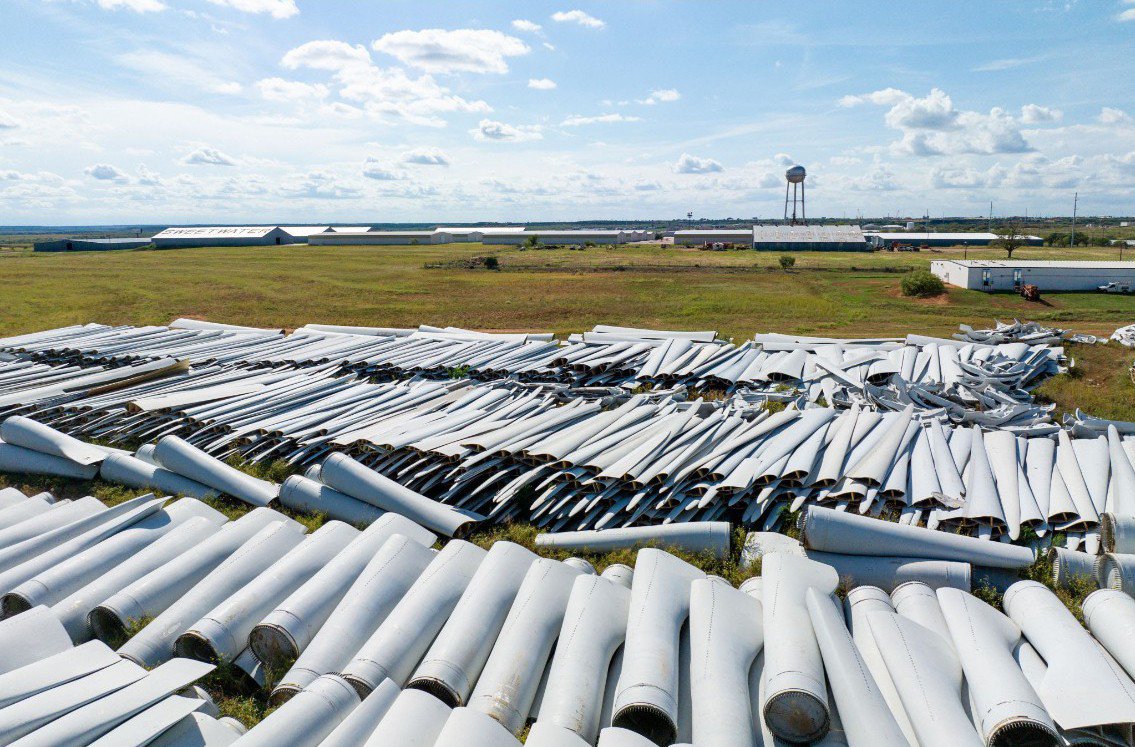
The wind industry is approaching a structural inflection point. Early fleets in Europe and the United Kingdom are aging faster than advertised, composite blade waste is outrunning recycling capacity, and decommissioning liabilities are coming due just as subsidy structures change.
Two recent posts by Peter Clack capture the twin problems: rapid performance decay well short of the claimed 20–25-year life, and a growing blade-disposal bottleneck as landfill options close.
Clack highlighted a 2012 analysis by Professor Gordon Hughes of the University of Edinburgh, using UK and Danish data, that found average UK onshore load factors had fallen roughly 33 percent by year 10. Leading-edge erosion, gearbox wear, and rising maintenance costs made many sites uneconomic after about 12 years, prompting early retirement or repowering rather than operation to the industry’s stated design life. A second post noted that Germany, Finland, the Netherlands, and Austria moved in early 2026 to restrict landfilling of decommissioned blades.
Waste is often simply exported to jurisdictions that still allow it, while downcycling into benches, barriers, or playground equipment cannot absorb the volume. Global blade waste is projected at 43 million tonnes by 2050. Energy-intensive pyrolysis or solvolysis undercuts the claimed lifecycle carbon savings.
The EU’s Net-Zero Industry Act now requires 70 percent recyclability for blades in public procurement; France uses a 55 percent quota. Projects such as REWIND are trying to recover fibers for secondary uses, including automotive parts, but commercial scale remains limited.
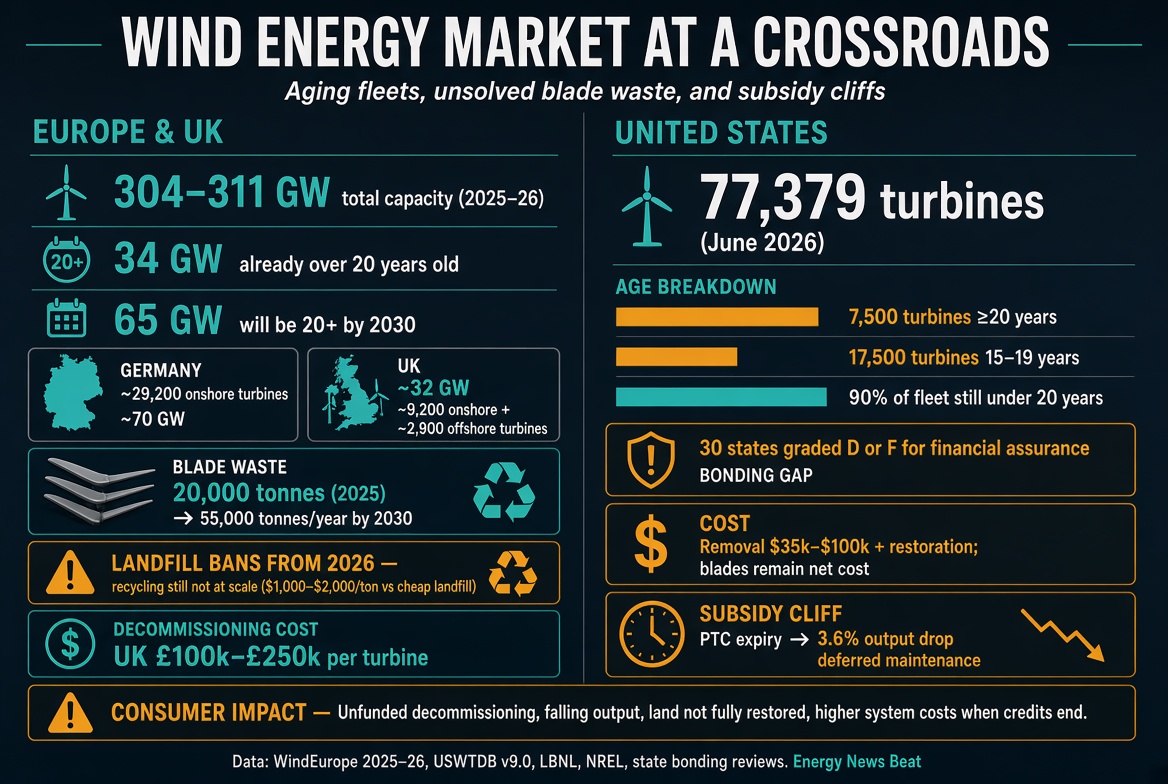
These observations align with official statistics. Europe ended 2025 with 304 GW of wind capacity (265 GW onshore, 39 GW offshore); the EU-27 held 246 GW.
Mid-2026 figures had already risen above 311 GW. WindEurope reports that 34 GW of the European fleet is already more than 20 years old; that figure is expected to reach 65 GW by 2030. Denmark, Spain, and Portugal have the oldest average fleets. Germany and Spain hold the largest volumes of capacity older than 15 years (22 GW and 20 GW respectively).
Germany alone operates roughly 29,200 onshore turbines totaling about 70 GW. The United Kingdom has more than 32 GW (split roughly evenly between onshore and offshore), with approximately 9,200 onshore turbines and nearly 2,900 offshore turbines. Older machines are smaller, so the turbine count associated with the aging gigawatts is large.
In 2025, Europe decommissioned 0.9 GW while adding 2.0 GW of repowered capacity—repowering typically triples output while reducing turbine numbers, but it still requires full dismantling of the old units.
Recycling infrastructure has not kept pace.
The European industry imposed a self-ban on blade landfilling from 1 January 2026, and several member states already prohibit it. Annual decommissioned blade material in Europe is estimated at about 20,000 tonnes in 2025, rising toward 55,000 tonnes by 2030. Mechanical recycling, cement co-processing, and pyrolysis exist, yet costs run $1,000–$2,000 per tonne versus $60–$150 per tonne for landfill where still permitted. Full circular “blade-to-blade” recycling remains years away. Isolated successes—such as a Scottish project claiming nearly 100 percent recycling and reuse of one farm—do not yet constitute a system-wide solution. Waste codes still treat turbine composites as generic construction waste, complicating tracking and investment.
Decommissioning and land-reclamation costs add another layer.
UK benchmarks put the figure at £100,000–£250,000 per turbine, covering dismantling, foundation and cable removal, and site restoration. U.S. estimates for turbine removal alone range from $35,000 to $100,000 (2023 dollars), with full restoration (foundations, roads, topsoil) adding tens of thousands more; net costs after scrap steel, copper, and aluminum salvage can fall to a few thousand dollars per machine in favorable cases, but blade composites remain a net cost of several thousand dollars each.
Foundations are often left in place below a few feet to limit disturbance. Across tens of thousands of aging European turbines, the aggregate bill is measured in billions of euros, much of it unfunded at the project level.
The U.S. fleet looks younger on paper but faces similar mechanics. The U.S. Wind Turbine Database listed 77,379 turbines as of June 2026. Roughly 7,500 are 20 or more years old, and another 17,500 are 15–19 years old; 90 percent of the fleet is still under 20 years. Historical decommissioning has concentrated on very old, small machines (often 30-plus years and under 200 kW). Larger modern units have so far shown shorter-than-advertised lives when they are removed. Most decommissioned sites have been repowered with fewer, higher-capacity turbines. Cumulative U.S. decommissioned turbines already exceed 12,800.
Financial assurance for decommissioning is uneven. Many states require bonds, letters of credit, or escrow, but a 2025 state-by-state assessment graded 30 states D or F for wind and solar requirements—far weaker than oil-and-gas well bonding. Some states allow delayed or self-determined amounts; others cap the obligation or wait until late in the project life. Federal lands and offshore leases (BOEM) impose more structured bonds, but the bulk of the onshore fleet sits on private or state land. Salvage value can offset 60–70 percent of costs when metal prices are high, yet blade recycling and full land restoration are not reliably covered. Taxpayers and landowners therefore carry residual risk.
The United States has an estimated $89 billion land reclamation bill due. This is about to come due quickly, first on 7,500 turbines now, and in the next 2 years another 17,500. Buckle up for an ugly baby of GhostBusters magnitude.
Subsidy design magnifies the problem.
The federal Production Tax Credit historically ran for ten years. Lawrence Berkeley National Laboratory analysis found output dropped 3.6 percent between years 10 and 11 as owners deferred maintenance once the credit expired; capacity factors fell and gearbox/generator replacements were postponed. Newer studies confirm a further decline after the subsidy window. The Inflation Reduction Act extended credits, but subsequent legislation has created a construction-start cliff: many new wind and solar projects that miss 2026–2027 deadlines lose eligibility. After the credit ends, operators face a commercial choice—spend on aging machines whose output is already declining or walk away. Maintenance is not guaranteed to continue at prior levels.
Consumers will feel the effects through several channels. Premature or unfunded decommissioning can leave restoration costs with landowners or ratepayers. Reduced output from aging, under-maintained turbines raises the need for backup generation or new capacity, increasing system costs. Land that is not fully reclaimed stays unavailable for agriculture or other uses. In Europe, many 20-year support contracts are expiring; operators must choose lifetime extension, market-price operation, or dismantling.
In the United States, the same dynamic will appear as the large 2000s-era cohort ages out of tax credits. Reliability and price volatility rise if replacement capacity is delayed by permitting or grid constraints.
The market is therefore at a genuine crossroads.
Repowering can extract more energy from proven sites, but it still generates a wave of composite waste and capital expenditure. Recycling technologies are advancing, yet they remain more expensive and energy-intensive than landfilling. Bonding regimes in many U.S. jurisdictions are insufficient to guarantee restoration.
When subsidies expire, the economic incentive to keep older machines running at high availability weakens. Policymakers and operators who treat 20–25-year lives as a planning assumption rather than an upper bound will confront both an environmental cleanup bill and a reliability gap. Transparent accounting of full-cycle costs—installation, operation, decline, dismantling, and disposal—is now essential if wind is to remain a durable part of the energy mix rather than a deferred liability.
In the United States, the $89 billion price tag for cleanup and land reclamation is already starting to show up. As stated above, $ 7,500 is due now, and in two years another 17,500. Buckle up, it is going to get ugly. We cannot find 1% that has bonds in place, and companies will just declare bankruptcy, leaving the landowners with worthless land.
Making Appendices Great Again
Check out the World’s Greatest Podcast Show Notes at EnergyNewsBeat.co or EnergyNewsBeat.com.
Appendix: Sources and links
- https://x.com/PeterDClack/status/2102697547773157779
- https://x.com/PeterDClack/status/2102679892592902467
- Hughes study referenced: The Performance of Wind Farms in the United Kingdom and Denmark, Renewable Energy Foundation, 2012.
European fleet and aging
- WindEurope, Wind energy in Europe: 2025 Statistics and the outlook for 2026–2030: https://windeurope.org/data/product/wind-energy-in-europe-2025-statistics-and-the-outlook-for-2026-2030
- WindEurope European Stats 2025 PDF: https://www.rinnovabili.it/wp-content/uploads/2026/02/WindEurope-European-Stats-2025.pdf
- Windletter summary of 2025 report: https://www.linkedin.com/pulse/windletter-131-breaking-down-europes-wind-power-numbers-2025-njs6e
- German onshore statistics (WindGuard / VDMA): end-2025 ~29,190 turbines, 68.2 GW; mid-2026 ~29,250 turbines, ~70 GW.
UK fleet
- RenewableUK EnergyPulse / facts: https://www.renewableuk.com/news-and-resources/facts-and-figures/
- Ember 25 years of British offshore wind: https://ember-energy.org/app/uploads/2025/12/25-years-of-British-offshore-wind-1.pdf
- Wikipedia list of UK offshore wind farms (July 2025: 2,809 turbines, 16 GW).
Recycling and landfill policy
- WindEurope: Where do wind turbine blades go when they are decommissioned? https://windeurope.org/news/where-do-wind-turbine-blades-go-when-they-are-decommissioned/
- WindEurope circularity commitment: https://windeurope.org/news/no-blade-left-behind-the-wind-sectors-commitment-to-sustainable-blade-solutions/
- IEA Wind Task 45 Annual Report 2025: https://iea-wind.org/annual-report-2025-task-45/
- JRC material streams to 2050: https://publications.jrc.ec.europa.eu/repository/handle/JRC139814
- Cost comparisons: https://energy-solutions.co/articles/sub/wind-turbine-blade-recycling
- Scottish Hagshaw Hill recycling report: https://www.energyglobal.com/wind/11092026/report-reveals-almost-100-of-scottish-wind-farm-recycled-and-reused/
Decommissioning and reclamation costs
- NREL report (FY25): https://docs.nrel.gov/docs/fy25osti/87970.pdf
- UK landowner guide: https://lumifyenergy.com/blog/decommissioning-a-wind-farm/
- Wood Mackenzie on ageing turbines: https://www.woodmac.com/news/opinion/the-big-question-for-onshore-wind-what-to-do-with-ageing-turbines/
- German Bundestag research on Rückbaukosten.
U.S. fleet
- USWTDB v9.0 (June 2026): 77,379 turbines: https://energy.usgs.gov/uswtdb/ and https://doi.org/10.5066/F7TX3DN0
- Rand et al., “Out With the Old,” Wind Energy, 2026: https://onlinelibrary.wiley.com/doi/10.1002/we.70099
U.S. bonding and financial assurance
- National Center for Energy Analytics, State Financial Assurance Requirements, October 2025: https://energyanalytics.org/wp-content/uploads/2025/10/State-Financial-Assurance-Requirements-FINAL_10.7.25.pdf
- JD Supra renewable end-stage planning: https://s3.amazonaws.com/documents.jdsupra.com/8d918684-73f9-4fe8-8f22-6f7bd44ffe93.pdf
- BLM and BOEM federal land/offshore rules.
Subsidies, maintenance, and output after PTC expiry
- Reuters Events / LBNL Joule study summary: https://www.reutersevents.com/renewables/wind-energy-update/us-turbine-output-drops-36-ptc-expiry-owners-revalue-repairs
- Dallas Fed working paper on PTC time limit: https://www.dallasfed.org/~/media/documents/research/papers/2025/wp2530.pdf
- Wood Mackenzie on U.S. tax-credit cliff: https://www.woodmac.com/news/opinion/us-wind-growth-is-becoming-a-race-against-the-clock/
- IER summary of LBNL findings: https://www.instituteforenergyresearch.org/renewable/wind/doe-lab-finds-wind-output-plunges-when-tax-credits-end/
DOE recyclability
- DOE report (90 percent of mass recyclable): https://www.utilitydive.com/news/department-energy-wind-turbine-recycling-recyclable/736688/ and https://www.energy.gov/cmei/systems/wind-turbine-recycling
All figures are drawn from the cited public reports and databases current as of late 2025–mid-2026. Capacity and turbine counts continue to change with new installations and decommissioning.