The San Antonio refiner’s third-quarter profit rose about sixfold from a year ago, beating Wall Street’s forecast. Here is what a $72-a-barrel diesel margin means, what it doesn’t, and why it swings.
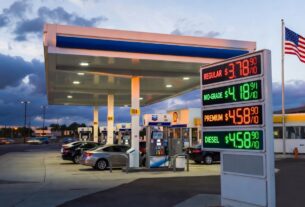
Diesel costs $6.31 a gallon this morning, the AAA national average at 6:24 a.m. CT, up from $3.63 a year ago. That is about $80 more for a 30-gallon fill (ENB calculation). On the other side of the pump, Valero Energy, which runs 14 refineries in the U.S., Canada and the U.K., reported this morning that it earned $6.8 billion in the third quarter.
Valero reported net income of $6.8 billion, or $23.89 a share, up from $1.1 billion, or $3.53, a year earlier. Adjusted earnings were $23.90 a share versus $3.66 (Valero). Analysts polled by Investing.com expected $20.90, and revenue of $46.1 billion beat their $43.36 billion consensus; shares rose 1.89% in premarket trading after the release (Investing.com, 5:55 a.m. CT).
“Our refineries operated at near-record utilization rates, providing a reliable supply of critical transportation fuels during the quarter,” Chairman and CEO Lane Riggs said (Valero).
The $72 number
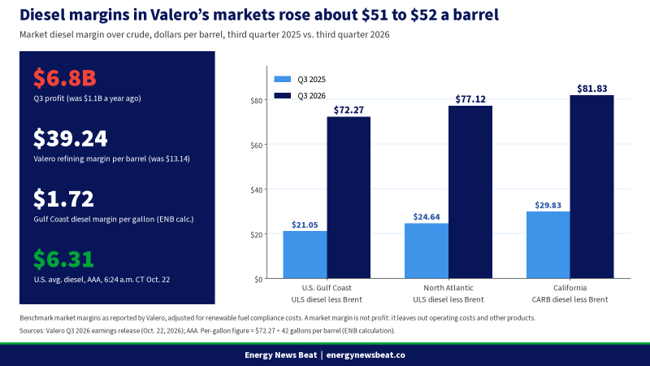
Valero’s refining segment earned $8.8 billion in operating income, up from $1.6 billion. Its refining margin was $39.24 a barrel of throughput, versus $13.14 a year ago, on about 2.97 million barrels a day. The benchmark Valero tracks for Gulf Coast ultra-low-sulfur diesel over Brent crude averaged $72.27 a barrel, up from $21.05. North Atlantic was $77.12, and California’s CARB diesel was $81.83 (Valero).
What a crack spread is, and isn’t
That $72.27 is a “crack spread”: the market price of a barrel of diesel minus the price of a barrel of crude. It works out to about $1.72 a gallon (ENB calculation). It is a market benchmark, not Valero’s profit. It leaves out the cost of running the plants ($5.03 a barrel for Valero in the third quarter), and diesel is only part of what a refinery makes: distillates were about 39% of Valero’s output (ENB calculation from Valero figures). After operating costs and depreciation, Valero’s refining business earned $32.09 a barrel of throughput on an adjusted basis (Valero).
It also isn’t the whole pump price. EIA splits a gallon into crude, refining, distribution and taxes. In May, its latest breakdown, the refining share of the diesel price (refining costs and profits) was 25.3% of a $5.60 gallon of diesel, up from 14.9% a year earlier (EIA). Crude was still the largest piece.
Margins swing because markets, not refiners, set them: the gap between crude and fuel prices moves with supply and demand. This year it widened as the war disrupted supply through the Strait of Hormuz (Argus) and U.S. distillate (mostly diesel) stocks fell to the lowest for mid-October in EIA records back to 1982 (ENB). The same gauge averaged $47.80 for the first nine months of 2026 (Valero), and Valero’s margin was $23.62 a barrel in the second quarter (Investing.com). When supply returns or demand softens, spreads can shrink as fast as they grew.
Cash, debt and Benicia
Valero generated $6.9 billion of operating cash and returned 52% of its $7.3 billion adjusted operating cash flow to shareholders (Valero), roughly $3.8 billion in dividends and buybacks (ENB calculation; Valero did not split the total in the release). Ahead of the report, UBS had projected $3.3 billion of buybacks (Investing.com). Valero repaid $526 million of debt and ended with $9.8 billion of cash and $8.6 billion of debt. Renewable diesel posted $353 million of operating income, after a $28 million operating loss a year ago, and ethanol $272 million of operating income on record output of 4.8 million gallons a day (Valero).
One plant sat out the boom. Valero finished idling its Benicia, Calif., refinery in April (Valero), and its West Coast throughput fell to 119,000 barrels a day from 259,000. Washington has floated restarting closed plants; ENB looked at whether the Defense Production Act could reopen Benicia (ENB). Management’s 9 a.m. CT call may add detail on buybacks and the outlook.
| Stu’s Take (opinion)
A $72 diesel margin and $6.8 billion in one quarter will make people angry, and I get it when diesel is $6.31. But margins that fat are the market screaming for more refining capacity. Valero ran near-record rates while Benicia sat idle and U.S. distillate (mostly diesel) stocks hit a mid-October low. If we want that $1.72-a-gallon spread (ENB calculation) to shrink, we need more plants running, not fewer, and states that stop chasing them out. |
Sources
- Valero: Valero Energy Reports Third Quarter 2026 Results (Business Wire, 5:30 a.m. CT, Oct. 22, 2026)
- com: Valero Energy stock rises 2% on beating Q3 estimates (Oct. 22, 2026)
- com: Valero earnings loom as refining margins hit record highs (Oct. 21, 2026)
- AAA national average fuel prices (accessed Oct. 22, 2026, 6:24 a.m. CT)
- EIA: Diesel fuel pump components history (Oct. 20, 2026 release)
- Argus: US seeking to re-open shuttered oil refineries (Oct. 20, 2026)
- Valero: Benicia Refinery
- Energy News Beat: Washington Is Pushing Refiners for More Diesel. Relief at the Pump Will Take Time (Oct. 21, 2026)
- Energy News Beat: Could the DPA Reopen Benicia? (Oct. 21, 2026)