The Nuclear Waste Fund is real money. Spending it, siting a repository and turning used fuel back into fuel are three different challenges.
By Energy News Beat | As of November 8, 2026 CST
A real fund, a real stalemate
Finland just did something no country had done before. On October 22, 2026, its government granted Posiva an operating licence for a deep repository for spent nuclear fuel at Olkiluoto. Even then, disposal does not start immediately: commissioning tests and regulator checks come first (Posiva).
That news is the backdrop for a recent OilPrice.com piece by Haley Zaremba that puts it bluntly: the United States has more than $50 billion for nuclear waste “and nowhere to put it” (OilPrice.com, Nov. 7, 2026). The money part checks out. The “nowhere” part needs a little more care, because the answer depends on what “put it” means.
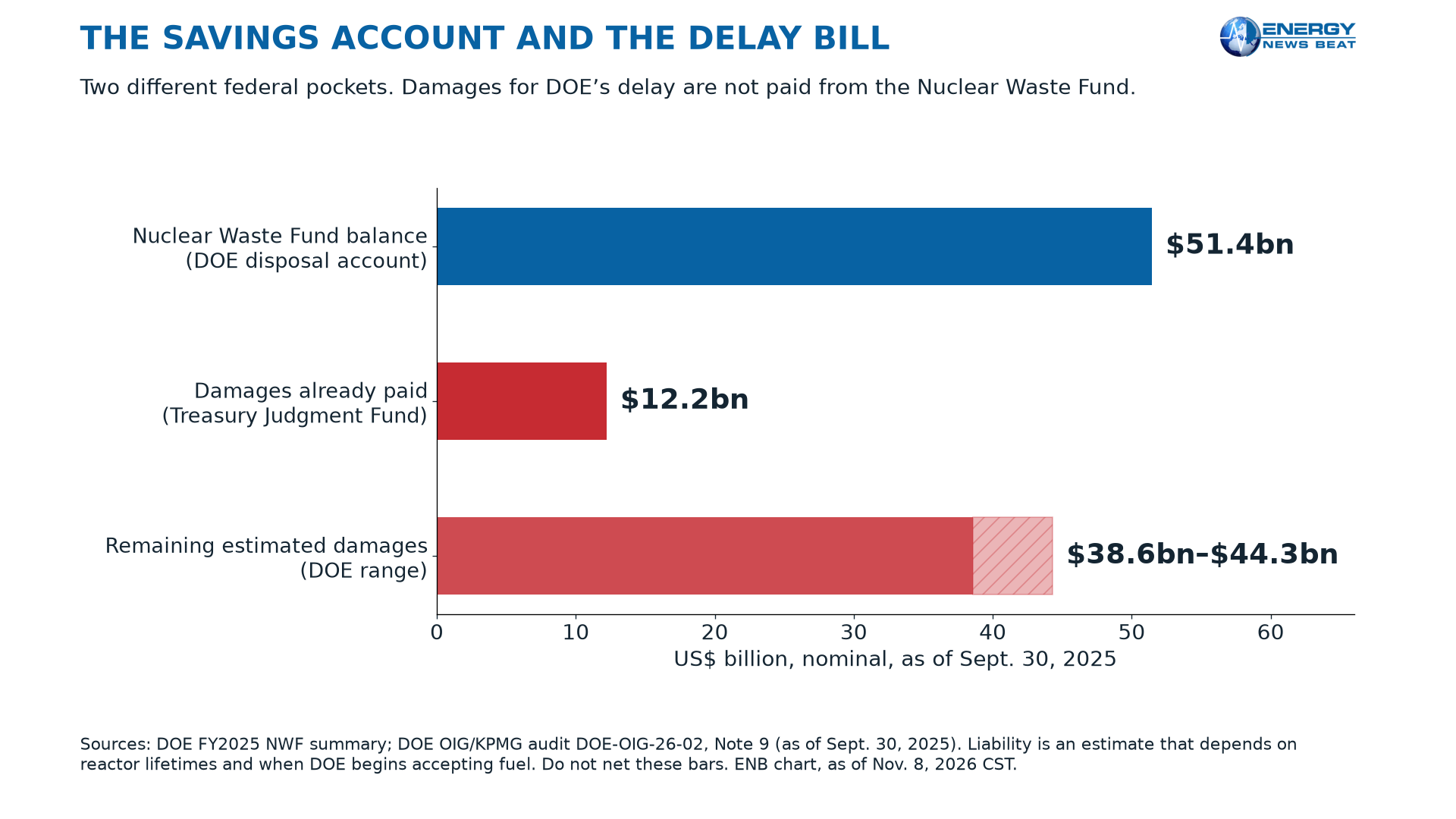
The latest audited figures we found are for the fiscal year ended September 30, 2025. DOE’s fund summary shows $51.435 billion in the Nuclear Waste Fund, counting Treasury balances, investments and related interest, net, plus small unexpended appropriations (DOE FY2025 summary). The independent audit says the fund held $51.4 billion of U.S. Treasury securities, with a fair value of $51.3 billion (DOE OIG/KPMG audit, Nov. 2025). We did not find a released fiscal 2026 fund audit as of November 8, 2026, so the headline should be read as a September 2025 balance.
Where the money came from, and why it sits still
Utilities paid a fee of one mill per kilowatt-hour of nuclear electricity sold, and those costs ultimately trace back to electricity customers. After a 2013 federal appeals court ruling, DOE set that fee to zero effective May 16, 2014 (audit). Since then, growth has come mostly from interest. DOE’s cumulative summary shows $21.8 billion received from commercial generators, $3.8 billion from defense nuclear waste payments, $37.3 billion of interest and gains, and $11.5 billion spent since 1983 (DOE summary).
Here is the catch. The law lets DOE spend the money only as Congress provides in advance through appropriations (audit notes). DOE’s summary shows fiscal 2025 expenditures of only about $22 million. The fund is not a locked vault of cash; it is invested in Treasury securities, which are claims on the federal government.
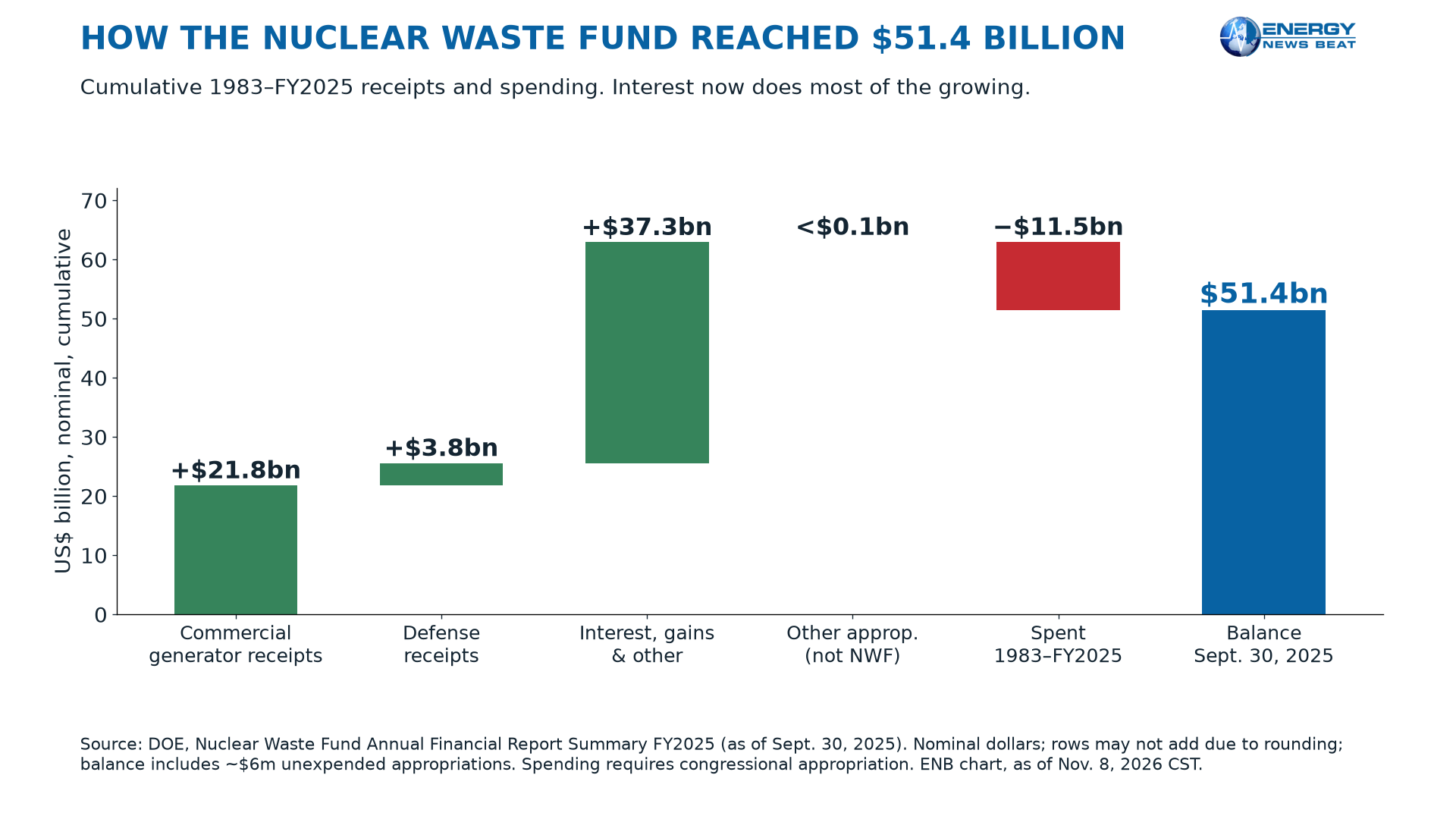
The money that pays for the delay comes from a different pocket. DOE signed contracts to begin taking spent fuel by 1998 and did not. Utilities sued. As of September 30, 2025, the Treasury’s Judgment Fund had paid $12.2 billion in settlements and judgments. DOE estimated the remaining liability at $38.6 billion to $44.3 billion (audit Note 9).
Those damages are not paid out of the Nuclear Waste Fund. They come from the Judgment Fund, a permanent federal appropriation. So ratepayers funded the disposal account, while taxpayers are covering much of the cost of the delay. GAO said in 2021 that Congress should restructure the fund and authorize a consent-based siting process. As of February 2026, GAO listed those matters as still open (GAO-21-603).
Not nowhere, just not final
Spent fuel is not homeless in a legal sense. An Idaho National Laboratory inventory counts 95,117 metric tons of commercial spent fuel at 73 reactor and storage sites at the end of 2024, plus about 2,482 metric tons at DOE sites (INL inventory, Jan. 2026). That is consistent with the article’s “about 97,000 metric tons.” It sits in licensed pools and dry casks. DOE says it can safely stay at reactor sites or at a future consolidated facility until a permanent solution is chosen (DOE).
What America lacks is a permanent repository for commercial spent fuel. Yucca Mountain remains the site named in law. NRC’s licensing proceeding was suspended in 2011, and NRC has no active oversight at the site (NRC). Privately licensed interim storage sites in Texas and New Mexico survived court challenges, but Holtec has paused its New Mexico plans amid state opposition (ANS). In January 2026 DOE invited states to volunteer for “Nuclear Lifecycle Innovation Campuses” that could combine enrichment, recycling and waste disposition (DOE).
One more fair point: the U.S. does run a deep geologic repository. The Waste Isolation Pilot Plant in New Mexico has disposed of defense transuranic waste since 1999, about 2,150 feet underground in salt (DOE). It is not licensed for commercial spent fuel.
The 90% question
That is the context for ENB’s published discussion of laser-assisted fuel recycling.

DOE says more than 90% of the potential energy remains in fuel after about five years in a reactor (DOE). A published ENB episode summary dated September 19, 2026, attributes a roughly 3%-burned claim to LIS co-founder Christo Liebenberg and discusses laser-assisted recovery of uranium from used fuel (ENB episode summary).
Both statements point to something real, but “energy remaining” is not the same as “energy we can practically recover.” Used light-water fuel is roughly 95.6% uranium, mostly uranium-238, with only about 0.5–1% uranium-235, plus about 0.9% plutonium and a few percent fission products (World Nuclear Association). Most of the theoretical energy sits in uranium-238, which today’s reactors mostly cannot use directly. Tapping it at scale points to fast reactors. Conventional recycling in today’s fleet has historically yielded about 25–30% more energy from the original uranium, not 90% (WNA).
In plain terms, laser isotope separation sorts atoms of the same element by isotope. Recycling first has to chemically pull uranium away from plutonium and fission products. WNA notes that no chemical process separates isotopes, and that future laser techniques may help remove unwanted uranium isotopes from recycled uranium (WNA). In 2023, LIS signed a memorandum with recycler Curio to study that pairing. This exploratory memorandum establishes neither a demonstrated recycling plant nor a proven commercial supply arrangement (LIS release).
Where LIS actually stands
LIS has real milestones. On October 8, 2026, it said it had accepted its first uranium hexafluoride shipment for demonstration testing in Oak Ridge, aiming for Technology Readiness Level 5 on a nine-level scale (LIS). On October 15 it said NRC had approved a security procedures plan, which takes effect after an operational readiness review (LIS). The same episode summary lists company targets of a pilot plant around 2030 and a commercial facility around 2032 (ENB episode summary).
Those are targets, not proven throughput. We found no public evidence of LIS processing uranium recovered from U.S. commercial spent fuel, and no NRC license for a commercial enrichment plant. The company itself says it will be able to make realistic economic predictions only after its pilot-plant demonstration (LIS forward-looking statement).
What it means for families and investors
Recycling may reduce the waste volume and stretch uranium supplies; DOE awarded more than $19 million for research toward that goal (DOE, Feb. 2026). It does not eliminate the need for disposal. Fission products and other high-level waste still need a permanent home, and transmutation can shrink a repository but not eliminate it (WNA).
For households, the near-term cost risk is mostly the delay bill: taxpayer-funded damages that keep growing while fuel waits. For investors, this is an early-stage field. Licensing, financing, feedstock and customers decide winners, not press releases. The fund proves America saved for the job. It does not prove anyone has finished the job.
Proposed Stu’s Take
Folks, America did save the money. Utilities and their customers paid into the Nuclear Waste Fund, and it still holds about $51 billion on paper. The problem is Washington cannot agree on how to spend it, while taxpayers have already paid more than $12 billion in damages for the delay.
I am excited about recycling used fuel, and I’m interested in what laser technology might contribute. But let’s be straight with our listeners. The 90% figure is potential energy, not what a recycling plant can deliver tomorrow. Getting there needs chemistry, licensing, new reactors and real-world production numbers.
Finland proved a permanent repository can be done. We should finish ours, build safe interim storage where communities want it, and let recycling prove itself without pretending it erases the need for disposal.
Appendix A | Nuclear Waste Fund figures
Nominal U.S. dollars. Latest audited period located: fiscal year ended September 30, 2025. Summary and audit-narrative presentations differ and are labeled, not merged.
| Item | Value | Period | Source |
| Fund balance with Treasury, investments and related interest, net, plus unexpended appropriations | $51.435bn | Sept. 30, 2025 | Source 02 |
| U.S. Treasury securities held (carrying) | $51.4bn | Sept. 30, 2025 | Source 03 |
| Fair value of those securities | $51.3bn | Sept. 30, 2025 | Source 03 |
| Cumulative receipts from commercial generators | $21.790bn | 1983–FY2025 | Source 02 |
| Commercial fee and interest billings, less receivable | $24.593bn billed; $2.803bn receivable | 1983–FY2025 | Source 02 |
| Cumulative receipts from defense nuclear generators | $3.768bn | 1983–FY2025 | Source 02 |
| Cumulative interest income, gains and other revenues | $37.349bn | 1983–FY2025 | Source 02 |
| Audit narrative: cumulative fee and DNWDA billings / interest and other revenue | about $25.5bn / about $40.3bn | to Sept. 30, 2025 (different presentation from summary rows) | Source 03 |
| Cumulative expenditures | $11.513bn | 1983–FY2025 | Source 02 |
| FY2025 total income / expenditures | $1.963bn / $22m | FY2025 | Source 02 |
| Ongoing 1 mill/kWh fee | Set to zero effective May 16, 2014 | Unchanged in FY2025 | Source 03 |
| Deferred revenue balance | $54.2bn | Sept. 30, 2025 | Source 03 |
Sources 02 and 03: DOE FY2025 summary; DOE OIG/KPMG audit DOE-OIG-26-02.
Appendix B | Delay damages and federal storage estimates
Paid by the Treasury Judgment Fund, not the Nuclear Waste Fund. Liability is an estimate sensitive to reactor operating lives and DOE’s assumed acceptance date.
| Item | Value | Basis |
| Paid by Judgment Fund: settlements | $8.9bn | to Sept. 30, 2025 |
| Paid by Judgment Fund: final judgments (63 cases with awards) | $3.3bn | to Sept. 30, 2025 |
| Cumulative paid (DOE total) | $12.2bn | to Sept. 30, 2025 |
| Total estimated liability (incl. paid) | $50.8bn–$56.5bn | as of Sept. 30, 2025 |
| Remaining estimated liability | $38.6bn–$44.3bn | as of Sept. 30, 2025 |
| Federal consolidated interim storage (DOE CD-0, May 2024) | $4.6bn–$10.5bn project cost range; completion FY2042–2047 | planning estimate, not a construction award |
Source 03: DOE-OIG-26-02, Note 9 and attachment.
Appendix C | Storage and disposal status, as of November 8, 2026 CST
| Facility / pathway | Status | Scope / limit | Source |
| On-site storage at reactor/ISFSI sites | Operating, NRC-licensed | 95,117 MTHM commercial at 73 sites (end-2024); DOE sites 2,482 MTHM | Source 07 |
| Yucca Mountain repository | Site named in law; NRC adjudication suspended Sept. 30, 2011; no active NRC oversight at site | No commercial spent fuel disposal | Source 11 |
| ISP (Andrews County, TX) and Holtec HI-STORE (NM) private interim storage | NRC licenses stand after court challenges; Holtec paused NM plans | Neither operating | Source 12 |
| DOE Nuclear Lifecycle Innovation Campuses | RFI to states Jan. 28, 2026; responses requested by Apr. 1, 2026 | Voluntary concept; no site selection established here | Source 10 |
| Waste Isolation Pilot Plant (WIPP), NM | Operating since 1999 | Defense transuranic waste only; not commercial spent fuel | Source 13 |
| Onkalo, Finland (comparison) | Operating licence Oct. 22, 2026; commissioning before disposal | First licence worldwide for spent-fuel final disposal | Source 14 |
Appendix D | Claim register
| Claim | Evidence | Assessment |
| “$50 billion” fund (OilPrice) | Consistent with audited $51.4bn at Sept. 30, 2025; no FY2026 audit located as of Nov. 8, 2026. | Supported with date |
| “Nowhere to put it” | No permanent U.S. repository for commercial spent fuel; fuel is stored legally on site; WIPP is a deep repository for defense TRU waste. | Headline shorthand; qualify |
| “~97,000 metric tons at nearly 75 sites in more than 30 states” | INL: 95,117 MTHM commercial at 73 sites plus 2,482 MTHM at DOE sites (end-2024); DOE: >70 sites in 35 states. | Supported, approximate |
| “A dollar can’t move without Congress” | Audit: NWPA bars obligations except as provided in advance by appropriation acts. | Supported |
| DOE: >90% of potential energy remains | DOE page (2022) and DOE 2026 (<5% extracted). | Accurate as theoretical potential |
| Published ENB episode summary (Sept. 19, 2026): ~3% burned / 97% left, attributed to Liebenberg | Published episode-summary attribution, not independently watched speech; company/guest framing; consistent in direction with DOE; not a recoverable-energy figure. | Attributed opinion |
| Recoverable in today’s reactors | WNA: conventional recycling yields about 25–30% more energy from original uranium. | Context |
| Laser separation removes contaminant isotopes from recovered uranium | WNA: future laser techniques “may” remove them; LIS–Curio MOU (2023) explores feasibility. | Plausible concept, not demonstrated at scale |
| LIS pilot ~2030 / commercial ~2032 | Company targets listed in published ENB episode summary (not independently watched speech); Oct. 2026 releases show demonstration-stage testing and NRC security-plan approval. | Forward-looking |
| Recycling solves waste | Not supported. Fission products remain for disposal; transmutation reduces but does not eliminate repository need (WNA). | Rejected |
Appendix E | Linked sources and selected evidence
All sources accessed November 8, 2026 CST. Sources keep their own dates. Selected excerpts are not complete reproductions. Company statements are forward-looking and attributed.
01. Haley Zaremba, “The U.S. Has $50 Billion for Nuclear Waste and Nowhere to Put It,” OilPrice.com, Nov. 7, 2026
Selected excerpt: “It’s not that the United States doesn’t have the money – the country’s Nuclear Waste Fund holds over $50 billion.”
Commentary and starting source; its Washington Post and Atlantic Council quotations are relayed as quoted by OilPrice, not independently read.
02. DOE, Nuclear Waste Fund Annual Financial Report Summary, FY2025 and Cumulative
Selected excerpt: “Current Balance in the Nuclear Waste Fund (Fund Balance with Treasury and Investments and Related Interest, Net) and Unexpended/Undisbursed Appropriations $ 51,435”
Dollars in millions; numbers may not add due to rounding.
https://www.energy.gov/documents/fy-2025-nwf-annual-financial-report-summary
03. DOE OIG / KPMG, DOE-OIG-26-02, Nuclear Waste Fund FY2025 Financial Statement Audit (memo dated Nov. 14, 2025)
Selected excerpt: “As of September 30, 2025, the U.S. Treasury securities held by the NWF were $51.4 billion, and had a fair value of $51.3 billion.”
Statements are scanned images; figures read from page images. Note 9 also gives the $12.2bn paid and $38.6bn–$44.3bn remaining liability.
https://www.energy.gov/sites/default/files/2025-11/DOE-OIG-26-02.pdf
04. Oversight.gov listing for DOE-OIG-26-02
Selected excerpt: “Date Issued Wednesday, November 19, 2025”
Publication date of the latest located fund audit.
05. DOE Financial Management Handbook, Chapter 19.1 – Nuclear Waste Fund
Selected excerpt: “The Treasury Bulletin’s March issue features the annual report from Treasury, covering the Nuclear Waste Fund”
Reporting framework.
https://www.energy.gov/documents/chapter-191-nuclear-waste-fund
06. GAO-21-603, Commercial Spent Nuclear Fuel (Sept. 23, 2021; status updated Feb. 2026)
Selected excerpt: “As of February 2026, Congress has not acted on this matter.”
Recommendations on consent-based siting and fund restructuring.
https://www.gao.gov/products/gao-21-603
07. INL, Spent Nuclear Fuel and Reprocessing Waste Inventory (OSTI, Jan. 29, 2026)
Selected excerpt: “Total Amount of Commercial Discharged … 95,117 MTHM”
As of Dec. 31, 2024; Table 1-1.
https://www.osti.gov/biblio/3015718
08. DOE Office of Nuclear Energy, “5 Fast Facts about Spent Nuclear Fuel” (Oct. 3, 2022)
Selected excerpt: “More than 90% of its potential energy still remains in the fuel, even after five years of operation in a reactor.”
Source of the 90% framing; also “more than 70 sites in 35 states.”
https://www.energy.gov/ne/articles/5-fast-facts-about-spent-nuclear-fuel
09. DOE, awards $19 million for used fuel recycling (Feb. 5, 2026)
Selected excerpt: “Less than five percent of the potential energy in the nation’s nuclear fuel is extracted after five years of operation”
Release states over $19 million; research awards to Alpha Nur, Curio, Flibe, Oklo, SHINE; minimum 20% cost share.
10. DOE, Nuclear Lifecycle Innovation Campuses RFI (Jan. 28, 2026)
Selected excerpt: “including fuel fabrication, enrichment, reprocessing used nuclear fuel, and disposition of waste”
Voluntary state partnerships under consideration.
https://www.energy.gov/articles/department-energy-seeks-hosts-nuclear-lifecycle-innovation-campuses
11. NRC, Yucca Mountain licensing process (page updated Sept. 14, 2026)
Selected excerpt: “On September 30, 2011, the Board suspended the proceeding.”
Also: NRC has no active safety oversight at the site.
https://www.nrc.gov/waste/hlw-disposal/licensing-process
12. ANS Nuclear Newswire, Jan. 13, 2026
Selected excerpt: “Holtec has indicated it is pausing plans on the New Mexico project, citing ongoing state resistance”
Trade press summary of court status.
https://www.ans.org/news/2026-01-13/article-7671/supreme-court-nixes-beyond-nuclears-cisf-challenge/
13. DOE Office of Environmental Management, WIPP
Selected excerpt: “the nation’s only repository for the disposal of transuranic waste generated by atomic energy defense activities”
Operating since 1999.
https://www.energy.gov/em/waste-isolation-pilot-plant-wipp
14. Posiva, Oct. 22, 2026
Selected excerpt: “The operating licence does not imply an immediate start to production operation.”
Finnish comparison.
15. World Nuclear Association, Processing of Used Nuclear Fuel (updated Oct. 23, 2026)
Selected excerpt: “gaining some 25-30% more energy from the original uranium in the process”
Also composition of used fuel; isotope separation note; transmutation limits.
16. Energy News Beat, “Laser Enrichment: America’s Path to Nuclear Fuel Independence” (Sept. 19, 2026)
Selected excerpt: “only 3% of nuclear fuel is burned in reactors, leaving 97% as spent fuel”
Published episode-summary attribution, not independently watched speech; company views and targets.
17. LIS Technologies release, Oct. 8, 2026
Selected excerpt: “mature the technology to a Technology Readiness Level 5”
Company milestone and forward-looking caution.
18. LIS Technologies release, Oct. 15, 2026
Selected excerpt: “The SPPP will take full effect upon the completion of a successful NRC operational readiness review.”
Security procedures plan approval, not a facility operating licence.
19. LIS Technologies release, Nov. 28, 2023
Selected excerpt: “determining the feasibility of the efficient enrichment of uranium recovered from UNF via laser isotope separation”
MOU, exploratory.
Appendix F | Method
- Fund figures use DOE’s FY2025 summary and the FY2025 audited statements (as of Sept. 30, 2025), the latest located as of Nov. 8, 2026 CST. A fiscal 2026 audit was not located; prior-year audits were issued in mid/late November.
- The summary’s cumulative income rows and the audit narrative’s “about $25.5bn billings / $40.3bn interest and other revenue” use different presentations (billings vs receipts; accrued items). We report both with labels and do not merge them.
- Damages paid and estimated liabilities are from DOE’s audited Note 9 and are paid by the Judgment Fund, not the Nuclear Waste Fund. They are not added to or subtracted from the fund balance.
- Spent fuel quantities are metric tons of heavy metal from INL’s end-2024 inventory. OilPrice’s ~97,000 t is treated as an approximate all-sources figure.
- “Potential energy remaining” (DOE) and “recoverable in practice” (WNA historical 25–30% more energy in today’s reactors) are kept separate. No fast-reactor fleet is assumed.
- Laser isotope separation is described only at a public conceptual level. No operating parameters, designs or optimization details are included.
- Company statements, timelines and targets are attributed as forward-looking. LIS is privately held per its release; no stock valuation view is offered.
Appendix G | Limits
- The Washington Post op-ed and Atlantic Council report are quoted only as relayed by OilPrice.com.
- The DOE OIG audit statements are image scans; figures were read from page images and cross-checked with DOE’s summary.
- The original episode video was not watched; podcast references are attributed to the published ENB episode summary dated Sept. 19, 2026.
- No public data on LIS throughput, costs, or processing of uranium recovered from U.S. commercial spent fuel were found.
- Yucca Mountain status reflects NRC’s licensing page; congressional appropriations for FY2026 Yucca work were not independently itemized here.