Tesla’s North American warranty, effective Sept. 1, 2026, adds an Emissions Performance Warranty for 2027 and later Model 3 and Model Y vehicles: 8 years or 128,700 kilometers, whichever comes first. It sits beside the longer battery-and-drive-unit coverage, not in place of it. Tesla stock closed Friday, Nov. 20, at $345.82, down 23.1% this year, in a week when the S&P 500 and the Nasdaq also sold off sharply. Third-quarter revenue was roughly flat. External Optimus deliveries are a late-2027 target, not a delivered result.
Drive Tesla Canada reported that Tesla has added an 8-year Emissions Performance Warranty for 2027 and later Model 3 and Model Y vehicles. Tesla’s New Vehicle Limited Warranty for North America, effective Sept. 1, 2026, covers “Major Emission Control Components” for 8 years or 80,000 miles (128,700 km), whichever comes first, on model year 2027 and later vehicles with a United States or Canada warranty region.
Disclosure: Stu Turley, publisher of Energy News Beat, personally owns shares of Tesla and of SpaceX.
Tesla closed at $345.82 on Friday, down 23.1% this year, in a week when the broader market sold off. Third-quarter revenue was $28.0 billion, “roughly flat” from a year earlier. The questions are what the warranty covers, and how much of Full Self-Driving, Robotaxi, and Optimus has been delivered.
What the new warranty means for a Canadian buyer
It is an added layer, not a replacement. Tesla’s Battery and Drive Unit Limited Warranty still covers the battery and drive unit for 8 years, with a 70% capacity floor. On Model 3 and Model Y, the limit is 160,000 km for Standard or Standard Range Plus and 192,000 km for Long Range or Performance. The new emissions coverage stops at 128,700 km and has no separate capacity guarantee.
Tesla’s Model 3 and Model Y parts list covers eight systems. Components in those systems “that are not needed to charge the high voltage battery, store energy, or transmit power to move the vehicle are not covered.” In an April 18, 2024, final rule, EPA designated “the high-voltage battery and associated electric powertrain components as specified major emission control components,” with “a warranty period of 8 years or 80,000 miles,” starting with model year 2027. A Feb. 18, 2026, EPA rule that repealed federal greenhouse-gas vehicle standards dropped the separate battery-durability requirements, but the agency said it was “not taking final action at this time on the proposal to remove batteries serving as a RESS for electric vehicles and plug-in hybrid electric vehicles from the list of specified major emission control components.” EPA added, “We may consider revisions in a future criteria pollutant rule.” Tesla’s booklet applies that coverage to Canada-region vehicles as well as U.S. ones. A separate Canadian statute requiring this exact term was not independently confirmed. Drive Tesla Canada’s report, by Darryn John, said 127,800 km in one sentence; Tesla’s document says 128,700 km, the figure used here.
The shares, and a market that sold off with them
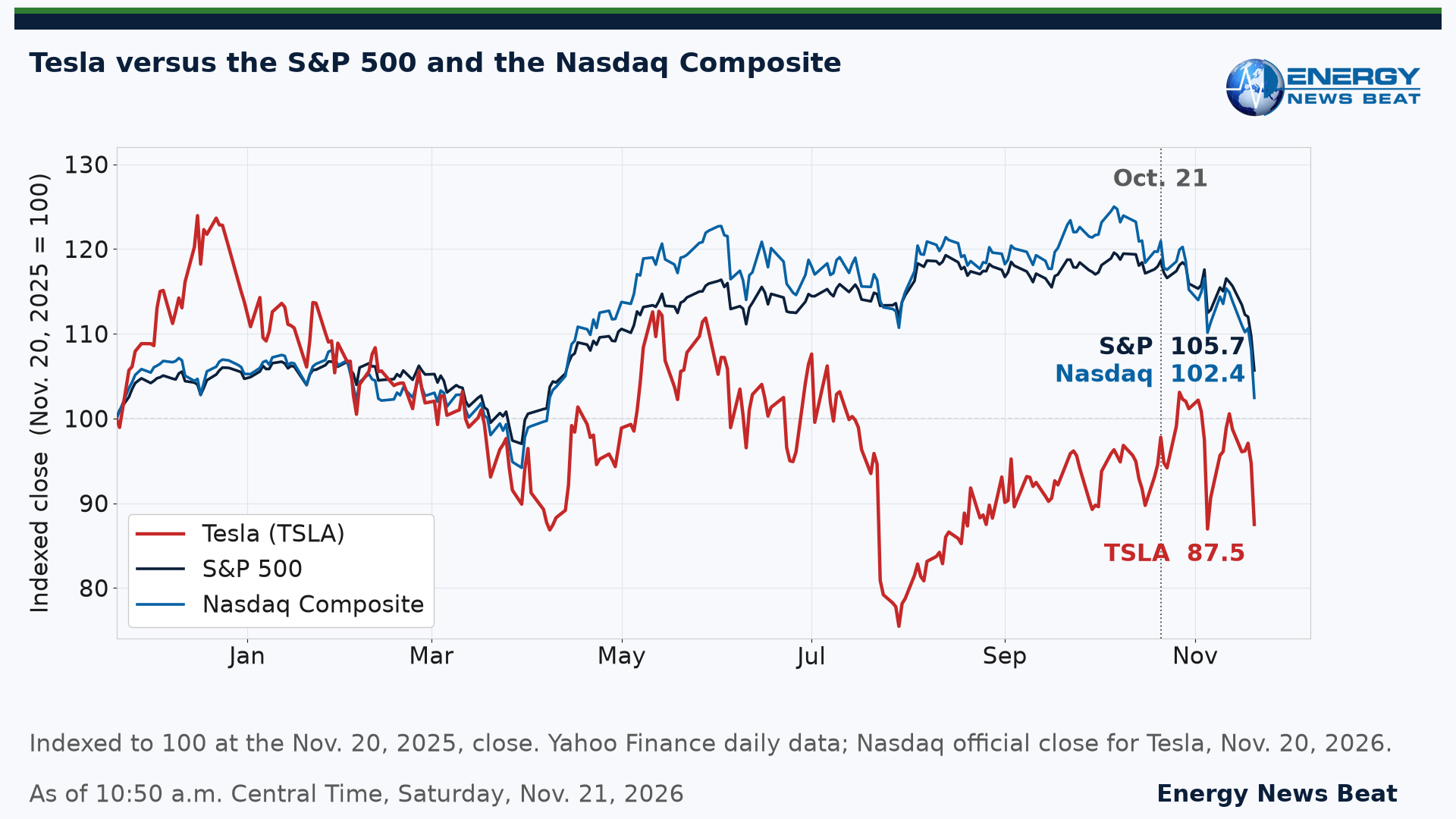
Tesla closed at $345.82 on Friday, Nov. 20, 2026. That is down 23.1% from the Dec. 31, 2025, close of $449.72, and down 12.5% from the Nov. 20, 2025, close of $395.23.
For the week, the S&P 500 fell 8.6%, the Nasdaq Composite 10.0% and Tesla 11.4%. Prices are regular-session closes from Yahoo Finance and Nasdaq.
A flat quarter, better auto margins, and a capex bill still double last year’s
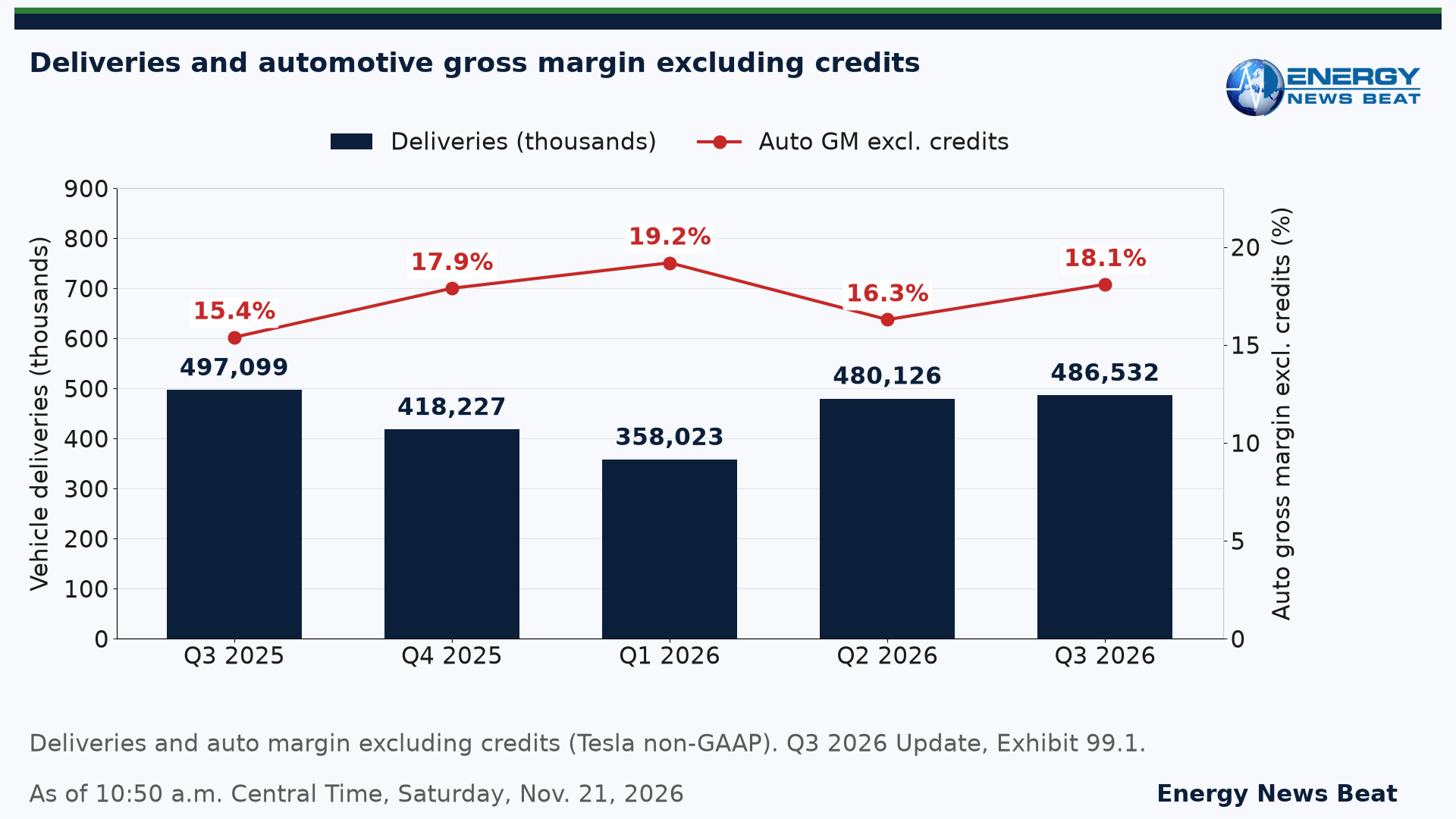
Tesla released its third-quarter 2026 update on Oct. 21. Total revenue was $28.046 billion. The deck said “Total quarterly revenue was roughly flat YoY at $28.0B,” slightly above the $27.9 billion analysts expected, per LSEG data cited by CNBC. Automotive revenue was $20.560 billion, down 3%; energy, $2.881 billion, down 16%; services and other, $4.605 billion, up 33%. GAAP net income was $787 million, or $0.22 a share, down from $1.373 billion, or $0.39. Automotive gross margin was 18.5% GAAP, and 18.1% excluding credits, up from 16.3% in the second quarter and 15.4% a year earlier. CFO Vaibhav Taneja said the sequential gain was driven by “a higher mix of deliveries in APAC.” Regulatory credits were $113 million, down from $417 million. Deliveries were 486,532, down 2%; production, 464,391, up 4%. The deck said “battery availability continued to be the limiting factor in increasing auto volumes in the quarter.” Taneja said “over 75% of deliveries in North America included a sign-up for paid FSD subscription at the time of delivery, which is approximately 20% higher than Q2” (the deck calls it nearly 20 percentage points).
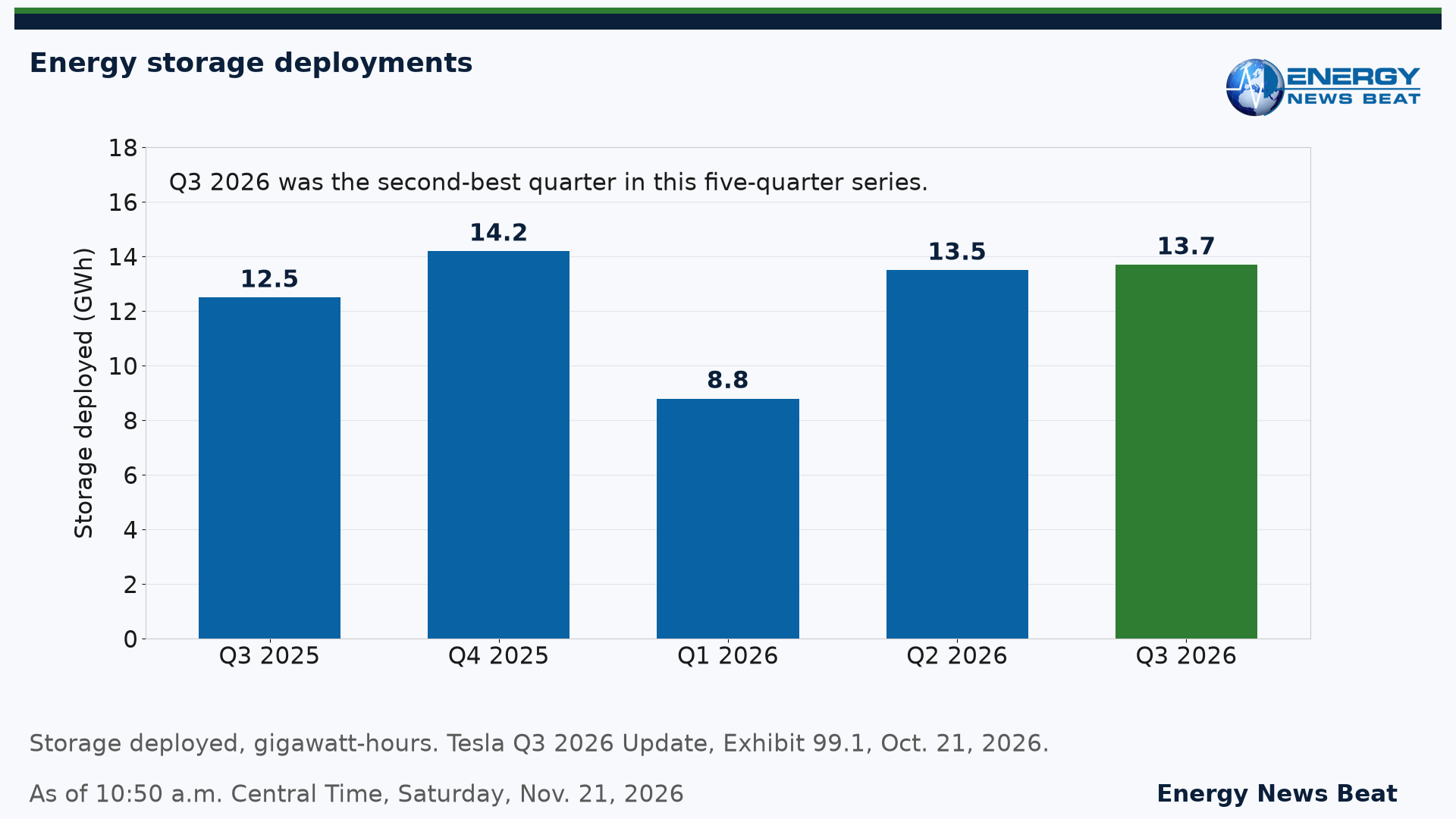
Energy storage deployments were 13.7 gigawatt-hours. Taneja said energy gross margins “improved from 20.4% to 33.1%,” versus 31.4% a year earlier in the 10-Q, attributed “primarily” to “tariff refunds recognized in the quarter and warranty true-downs.” Capex was $4.732 billion in the quarter. Taneja said Tesla is “revising our CapEx guidance to be approximately $20 billion for the current year.” That is down from the “in excess of $25 billion” Tesla gave in its second-quarter 10-Q; the third-quarter 10-Q puts 2026 capex “in excess of $20 billion.”
Optimus has begun early production. External deliveries are still a target.
Tesla’s deck says “Optimus production began in Fremont on our high-volume lines,” and that “the bots coming off this line are the first production-quality bots that we have manufactured.” Tesla did not report a unit number for the quarter.
Elon Musk said it would take “probably at least a year, maybe a little longer, to get to that annualized rate, to get to 20,000 units a week.” Remaining issues, he said, should “be solved around the end of next year,” which he called “the time to expect when we’re delivering Optimus to companies outside of Tesla.” He also said he remains “convinced that Optimus will be the biggest product on Earth.”
The deck says Tesla “started providing Robotaxi rides using Cybercabs on September 3 in Austin,” and that cumulative unsupervised miles “grew eightfold quarter over quarter,” reaching “nearly two million” by quarter end. Asked when customer-owned cars could run unsupervised, Ashok Elluswamy, Tesla’s vice president of AI, said, “We suspect somewhere around Q2 next year is when we can turn on some of the first customer vehicles to be part of the Robotaxi fleet.”
In an Oct. 22 roundup, CNBC’s Liz Napolitano reported Canaccord Genuity at Buy, target $442; Deutsche Bank at Buy; Goldman Sachs Neutral at $360, writing that “we expect profitability and FCF to remain somewhat pressured from higher opex and capex”; HSBC Reduce at $157; and William Blair’s Jed Dorsheimer, at Market Perform, saying Musk “tempered expectations on the Optimus ramp-up expectations and Robotaxi tangible revenue impacts for a year.”
U.S. electric-vehicle lots are leaner than a year ago
Kyle Stock’s Bloomberg article, published Saturday at 9:00 a.m. Central Time as “US Car Dealerships Are Low on EV Models,” said U.S. dealers had about 65,000 EVs on lots in October, “38% fewer than there were a year ago,” per S&P Global. Tesla is not in that S&P count, Bloomberg reports, because it sells directly to consumers. Bloomberg said GM dealers had roughly half as many EVs in October as a year earlier, and about 70% of Ford’s EV inventory disappeared over 12 months, with no electric pickups after Ford axed the F-150 Lightning in December.
Cox Automotive’s October report shows new EV days’ supply at 85, up 21% from September, four days below the 89-day gasoline and hybrid supply. Cox said slower sales “rather than inventory growth” drove the increase. Cox notes that its Tesla and Rivian figures “reflect only vehicles available through traditional dealerships and exclude vehicles at factory-owned outlets.”
Cox estimates October U.S. EV sales at 83,262, “up 3% from a year earlier,” and Tesla at an estimated 47,850 units, or 57.5%. Bloomberg reports 83,300, up 11%, and a Tesla share of 58%, up from 54%; those gains fit Cox’s original October 2025 estimates, since revised.
GM CFO Paul Jacobson, on GM’s Oct. 20 call, cited “rightsizing” EV capacity and said, “We think with these oil prices and these fuel prices, that EV penetration may continue to go up, and we want to make sure we’re ready for that.” Gil Tal of UC Davis told Bloomberg, “You cannot measure demand for a new product if you’re not stocking the shelf… In our case, the shelf is empty.”
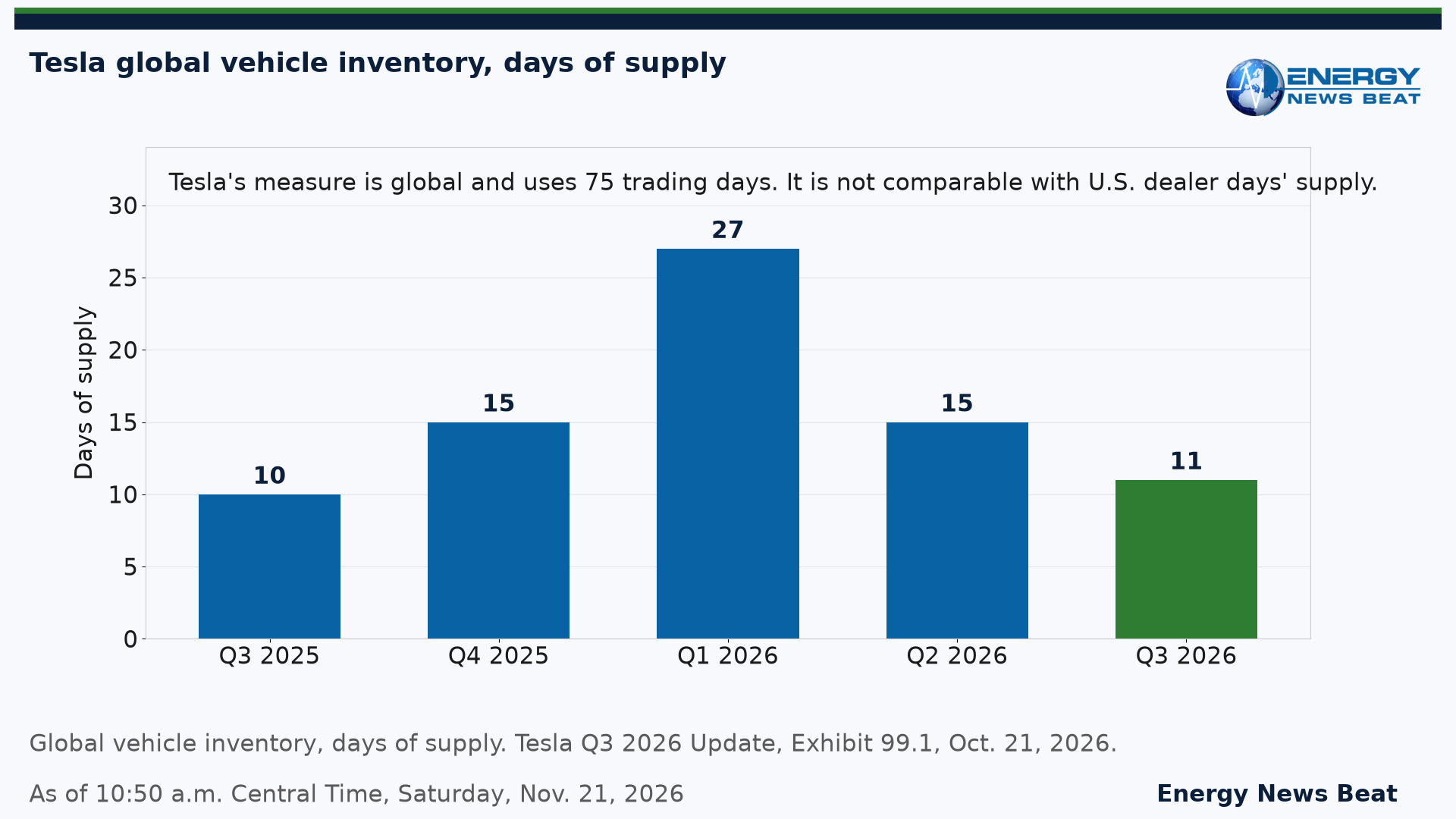
Tesla’s own global inventory, a different measure, was 11 days of supply in the third quarter, down from 27 in the first quarter. Stu Turley argues that thin rival EV lots would favor Tesla as the leading supplier, his view, not a fact. S&P counts that exclude Tesla show thinner rival lots, while Tesla’s own pipeline is already tight.
Consumer and Investor Views
Consumer View. In J.D. Power’s 2026 U.S. Electric Vehicle Experience Ownership Study, released Feb. 18, 2026, as reported by EV.com and CarPro, the Model 3 scored 804, first overall, and the Model Y scored 797, second. YouGov BrandIndex, in a Sept. 29, 2026, note by Shinmin Bali, said Tesla’s U.S. Impression score improved from -20 in September 2025 to -6. Consideration among U.S. adults rose from 5% to 9%.
Investor View. Not investment advice. Tesla’s shares are down 23.1% this year, more than the S&P 500 or the Nasdaq Composite. The third-quarter story is flat revenue, a 2% drop in deliveries, better automotive margins excluding credits, energy margins that include tariff refunds, and a 2026 capex guide cut to about $20 billion, from more than $25 billion.
Timeline
Key dates for Tesla’s North American emissions warranty, the third-quarter report, and the Friday close. Times are America/Chicago where a clock time is given.
April 18, 2024. The U.S. Environmental Protection Agency publishes its final multi-pollutant emissions standards for model years 2027 and later, designating the high-voltage battery and associated electric powertrain components as specified major emission control components with an 8-year or 80,000-mile warranty.
Feb. 18, 2026. EPA’s rescission rule keeps EV batteries on the 8-year/80,000-mile major-component list while removing battery-durability requirements.
Sept. 1, 2026. Tesla’s New Vehicle Limited Warranty, North America, takes effect, including the Emissions Performance Warranty for model year 2027 and later vehicles with a United States or Canada warranty region.
Sept. 3, 2026. Tesla starts providing Robotaxi rides using Cybercabs in Austin, according to the Q3 shareholder update.
Sept. 29, 2026. YouGov publishes updated U.S. BrandIndex figures showing Tesla’s Impression score at -6 and consideration at 9%.
Sept. 30, 2026. Tesla’s third quarter ends.
Oct. 21, 2026. Tesla posts its Q3 2026 Update and holds its Q&A webcast. Tesla stock closes at $386.47.
Oct. 22, 2026. Tesla closes at $374.58. CNBC publishes a roundup of analyst notes on the print.
Nov. 13–20, 2026. For the week, the S&P 500 falls 8.6%, the Nasdaq Composite 10.0% and Tesla 11.4%, measured from the Nov. 13 close through Friday.
Nov. 16, 2026. Cox Automotive publishes its October EV Market Monitor, with new EV days’ supply at 85, compared with 89 days for gasoline and hybrid vehicles.
Nov. 20, 2026. Tesla closes at $345.82, the S&P 500 at 6,910.39, and the Nasdaq Composite at 22,617.73.
Nov. 21, 2026. Drive Tesla Canada reports the new 8-year Emissions Performance Warranty for 2027 Model 3 and Model Y vehicles in Canada and the United States. Kyle Stock’s Bloomberg article, published at 9:00 a.m. Central Time under the headline ‘US Car Dealerships Are Low on EV Models’ (page title: ‘Eager Electric Vehicle Buyers Find US Car Lots Low on Inventory’), reports thinner U.S. EV dealer lots.
What is still in dispute, or still unofficial
Warranty terms come from Tesla’s official PDF and parts list. Webcast quotes are from unofficial transcripts. The 33.1% energy margin is also in the 10-Q. J.D. Power scores are as reported by EV.com and CarPro. Analyst targets are CNBC-reported opinions dated Oct. 22, 2026. U.S. lot figures are from Cox Automotive and, as reported by Bloomberg, from S&P Global for October dealer inventories. Nothing in this article is investment advice.
Stu’s Take
The new warranty is a real, if narrower, extra layer for a 2027 Model 3 or Model Y buyer in Canada. It is not a tailpipe promise, and it does not replace the longer battery coverage or the 70% capacity floor. I own Tesla shares, and SpaceX shares, and I will say plainly that they are about the last two stocks in my personal portfolio in this downturn. Friday’s close was ugly, in a week when the broader market was ugly too. If other automakers keep U.S. electric-vehicle lots thin while buyers are still showing up, that is a good setup for Tesla as the premier EV supplier. That is my view, not a fact. S&P counts that leave Tesla out show thinner rival lots, but Tesla’s own pipeline is already tight, and Cox’s October supply rose as sales slowed. The part I keep watching is whether Full Self-Driving, Robotaxi, and Optimus move from a date on a calendar to something a customer can actually use.
Sources
Primary and contemporaneous sources, with access dates. Accessed Nov. 21, 2026.
- Darryn John, “Tesla adds new 8-year Emissions Performance Warranty for 2027 Model 3 and Model Y – here’s what’s covered,” Drive Tesla Canada, published Nov. 21, 2026, 10:08 a.m. EST. Accessed Nov. 21, 2026. https://driveteslacanada.ca/news/tesla-new-8-year-emissions-performance-warranty-canada/
- Tesla, Inc., New Vehicle Limited Warranty, North America, effective date 2026/09/01, English (Canada) PDF. Accessed Nov. 21, 2026. https://digitalassets.tesla.com/tesla-contents/image/upload/tesla-new-vehicle-limited-warranty-en-ca.pdf
- Tesla, Emissions Performance Warranty Related Parts – Model 3, Model Y, English PDF, effective Sept. 1, 2026. Accessed Nov. 21, 2026. https://service.tesla.com/docs/Public/epw/3Y-Emissions_Performance_Warranty_9-1-2026_en-us.pdf
- Tesla, Emissions Performance Warranty parts index page. Accessed Nov. 21, 2026. https://service.tesla.com/docs/Public/epw/emissions-performance-warranty-parts.html
- Tesla Support Canada, Vehicle Warranty page. Accessed Nov. 21, 2026. https://www.tesla.com/en_ca/support/vehicle-warranty
- U.S. Environmental Protection Agency, “Multi-Pollutant Emissions Standards for Model Years 2027 and Later Light-Duty and Medium-Duty Vehicles,” Federal Register, Vol. 89, No. 76, April 18, 2024, via govinfo. Accessed Nov. 21, 2026. https://www.govinfo.gov/content/pkg/FR-2024-04-18/html/2024-06214.htm
- Federal Register HTML version of the same EPA final rule. Accessed Nov. 21, 2026. https://www.federalregister.gov/documents/2024/04/18/2024-06214/multi-pollutant-emissions-standards-for-model-years-2027-and-later-light-duty-and-medium-duty
- U.S. Department of Energy, Alternative Fuels Data Center, “Battery Durability and Warranty Requirements for Model Years 2027 and Later,” summarizing the EPA warranty designation. Accessed Nov. 21, 2026. https://afdc.energy.gov/laws/14222
- U.S. Environmental Protection Agency, “Greenhouse Gas Endangerment Finding and Motor Vehicle Greenhouse Gas Emission Standards Under the Clean Air Act; Final Rule,” Federal Register, Vol. 91, No. 32, Feb. 18, 2026, 91 FR 7685, via govinfo. Accessed Nov. 21, 2026. https://www.govinfo.gov/content/pkg/FR-2026-02-18/html/2026-03157.htm
- Tesla, Inc., Form 10-Q for the quarter ended June 30, 2026, capital-expenditure outlook “in excess of $25 billion in 2026.” Accessed Nov. 21, 2026. https://www.sec.gov/Archives/edgar/data/1318605/000162828026049270/tsla-20260630.htm
- Kyle Stock, “US Car Dealerships Are Low on EV Models” (page title: “Eager Electric Vehicle Buyers Find US Car Lots Low on Inventory”), Bloomberg, published Nov. 21, 2026, 9:00 a.m. Central Time. Accessed Nov. 21, 2026. https://www.bloomberg.com/news/articles/2026-11-21/eager-electric-vehicle-buyers-find-us-car-lots-low-on-inventory
- Stephanie Valdez Streaty, “EV Market Monitor – October 2026,” Cox Automotive, published Nov. 16, 2026. The report says October sales were “up 3% from a year earlier,” against a revised October 2025 base of 80,843; Cox’s original October 2025 Monitor put that month at 74,835 units, with Tesla at 54.3% share. Accessed Nov. 21, 2026. https://www.coxautoinc.com/insights/ev-market-monitor-october-2026/
- Cox Automotive, “EV Market Monitor – October 2025,” published Nov. 17, 2025. Estimated October 2025 new EV sales 74,835; Tesla share 54.3%; EV days’ supply 79. Accessed Nov. 21, 2026. https://www.coxautoinc.com/insights/ev-market-monitor-october-2025/
- Chris Teague, “Electric Vehicle Market Sent Mixed Signals in October,” Kelley Blue Book, Nov. 17, 2026, 12:29 p.m. Accessed Nov. 21, 2026. https://www.kbb.com/car-news/electric-vehicle-market-sent-mixed-signals-in-october/
- Tesla, Inc., Form 8-K dated Oct. 21, 2026, Exhibit 99.1, Q3 2026 Update. Accessed Nov. 21, 2026. https://www.sec.gov/Archives/edgar/data/1318605/000162828026066738/exhibit9914.htm
- Tesla, Inc., Form 8-K dated Oct. 21, 2026, cover filing. Accessed Nov. 21, 2026. https://www.sec.gov/Archives/edgar/data/1318605/000162828026066738/tsla-20261021.htm
- Tesla, Inc., “Tesla Third Quarter 2026 Production, Deliveries & Deployments,” Exhibit 99.1 to the production-and-deliveries filing. Accessed Nov. 21, 2026. https://www.sec.gov/Archives/edgar/data/1318605/000162828026064366/exhibit991111111.htm
- Tesla, Inc., Form 10-Q for the quarter ended Sept. 30, 2026. Accessed Nov. 21, 2026. https://www.sec.gov/Archives/edgar/data/1318605/000162828026066775/tsla-20260930.htm
- Tesla Investor Relations home page, listing the Oct. 21, 2026, earnings materials. Accessed Nov. 21, 2026. https://ir.tesla.com/
- The Motley Fool, unofficial transcript of Tesla’s Q3 2026 Q&A webcast, published Oct. 22, 2026. Accessed Nov. 21, 2026. https://www.fool.com/earnings/call-transcripts/2026/10/22/tesla-tsla-q3-2026-earnings-call-transcript/
- Stock Analysis, unofficial transcript of Tesla’s Q3 2026 Q&A webcast. Accessed Nov. 21, 2026. https://stockanalysis.com/stocks/tsla/transcripts/712902-q3-2026/
- Stock Analysis, unofficial transcript of General Motors’ Q3 2026 earnings call, Oct. 20, 2026, speaker Paul Jacobson. Accessed Nov. 21, 2026. https://stockanalysis.com/stocks/gm/transcripts/654007-q3-2026/
- Liz Napolitano, “Tesla is falling even after earnings. What analysts are saying,” CNBC, published Oct. 22, 2026, 7:38 a.m. EDT. Accessed Nov. 21, 2026. https://www.cnbc.com/2026/10/22/tesla-q3-2026-earnings-analysts.html
- Shinmin Bali, “Tesla gains ground with U.S. consumers as consideration and perceptions improve,” YouGov, Sept. 29, 2026, BrandIndex 12-week moving average Sept. 23, 2025–Sept. 21, 2026. Accessed Nov. 21, 2026. https://yougov.com/en-us/articles/55641-tesla-gains-ground-with-us-consumers-as-consideration-and-perceptions-improve
- EV.com staff, “Tesla Model 3 and Model Y Top J.D. Power EV Satisfaction Rankings,” Feb. 19, 2026, reporting J.D. Power’s 2026 U.S. Electric Vehicle Experience Ownership Study, released Feb. 18, 2026. Accessed Nov. 21, 2026. https://ev.com/news/tesla-model-3-and-model-y-top-jd-power-ev-satisfaction-rankings
- CarPro, “J.D. Power 2026 EV Satisfaction Study Results,” March 2, 2026, citing the J.D. Power press release. Accessed Nov. 21, 2026. https://www.carpro.com/blog/j.d.-power-electric-vehicle-satisfaction-study-results
- Kevin Williams, InsideEVs, “EV Owner Satisfaction Continues To Grow, With Tesla Leading The Way,” Feb. 18, 2026, on the same J.D. Power study. Accessed Nov. 21, 2026. https://insideevs.com/news/787681/jd-power-ev-study-2026/
- Yahoo Finance, Tesla (TSLA) daily historical quotes, used for the price series, year-to-date and one-year calculations, and 52-week high and low. Accessed Nov. 21, 2026. https://finance.yahoo.com/quote/TSLA/history
- Nasdaq, Tesla (TSLA) official daily close for Nov. 20, 2026, $345.82. Accessed Nov. 21, 2026. https://www.nasdaq.com/market-activity/stocks/tsla/historical
Key Excerpts
Tesla New Vehicle Limited Warranty, North America, effective Sept. 1, 2026, Emissions Performance Warranty. “NOTE: The Emissions Performance Warranty applies only to vehicles of Model Year 2027 and later.” “Tesla provides an Emissions Performance Warranty, which applies to all vehicles with a Warranty Region of the United States and Canada.” For Major Emission Control Components, the emission defect warranty and the emission performance warranty each run “For 8 years or 80,000 miles (128,700 km), whichever comes first.” For components that are not Major Emission Control Components, each period is “2 years or 24,000 miles (38,620 km), whichever comes first.”
Tesla, Emissions Performance Warranty Related Parts – Model 3, Model Y, effective Sept. 1, 2026. Covered systems: High Voltage Battery; Battery Control and Ancillary Bay; Charging System – On Board; Power Conversion System; Drive Unit(s); High Voltage Distribution; Vehicle Control Units; Thermal Management – Powertrain. “Components within these systems that are not needed to charge the high voltage battery, store energy, or transmit power to move the vehicle are not covered.”
Tesla New Vehicle Limited Warranty, Battery and Drive Unit Limited Warranty, Model 3 and Model Y. Standard or Standard Range Plus: “8 years or 100,000 miles (160,000 km), whichever comes first, with minimum 70% retention of Battery capacity.” Long Range or Performance: “8 years or 120,000 miles (192,000 km), whichever comes first, with minimum 70% retention of Battery capacity.”
EPA final rule, Federal Register, April 18, 2024. EPA is “designating the high-voltage battery and associated electric powertrain components as specified major emission control components according to our authority under CAA section 207(i)(2), which assigns a warranty period of 8 years or 80,000 miles for components so designated.”
Tesla Q3 2026 Update, Exhibit 99.1, Revenue. “Total quarterly revenue was roughly flat YoY at $28.0B.”
Tesla Q3 2026 Update, Exhibit 99.1, Highlights and operations. “While battery availability continued to be the limiting factor in increasing auto volumes in the quarter, we have made additional progress in securing future supply, as we work toward our goal of maximum utilization of our factories.” “We started providing Robotaxi rides using Cybercabs on September 3 in Austin. Cumulative unsupervised Robotaxi miles grew eightfold quarter over quarter, driven by sustained double-digit weekly growth.” “We ended the quarter with the largest backlog for our passenger vehicles in four years.”
Tesla Q3 2026 Update, Exhibit 99.1, Manufacturing & Hardware, Robotics. “Optimus production began in Fremont on our high-volume lines. The bots coming off this line are the first production-quality bots that we have manufactured.” “Production has begun for Tesla Semi in Nevada and Optimus in Fremont.”
Tesla Q3 2026 Update, Exhibit 99.1, Outlook, Volume. “We are focused on maximum capacity utilization at our factories. Deliveries and deployments will be impacted by aggregate demand for our products, supply chain readiness and allocation decisions between sale to customers and use for our owned and operated fleet.”
Vaibhav Taneja, CFO, Tesla Q3 2026 Q&A webcast, Oct. 21, 2026, unofficial transcripts. Automotive margins excluding credits “increased sequentially from 16.3% to 18.1%,” driven by “a higher mix of deliveries in APAC,” while “commodity price increases and interest rate changes continue to add to our cost and create further headwinds.” “In Q3, over 75% of deliveries in North America included a sign-up for paid FSD subscription at the time of delivery, which is approximately 20% higher than Q2.” Energy gross margins “improved from 20.4% to 33.1%,” a move he attributed “primarily” to “tariff refunds recognized in the quarter and warranty true-downs.” “We are revising our CapEx guidance to be approximately $20 billion for the current year.”
Elon Musk, Tesla Q3 2026 Q&A webcast, Oct. 21, 2026, unofficial transcripts. Tesla had started “what I’d call early production on our high-volume line in Fremont,” and he would expect it to take “probably at least a year, maybe a little longer, to get to that annualized rate, to get to 20,000 units a week.” Remaining issues should “be solved around the end of next year,” which he called “the time to expect when we’re delivering Optimus to companies outside of Tesla.” He remains “convinced that Optimus will be the biggest product on Earth.”
Ashok Elluswamy, Tesla Q3 2026 Q&A webcast, Oct. 21, 2026, unofficial transcripts. Asked when customer-owned cars could run unsupervised, Elluswamy said: “We suspect somewhere around Q2 next year is when we can turn on some of the first customer vehicles to be part of the Robotaxi fleet.”
EPA rescission rule, Federal Register, Feb. 18, 2026. “Considering the connection to the EPA criteria pollutant program, which is out of scope of this rulemaking, we are not taking final action at this time on the proposal to remove batteries serving as a RESS for electric vehicles and plug-in hybrid electric vehicles from the list of specified major emission control components in 40 CFR 85.2103(d)(1). We may consider revisions in a future criteria pollutant rule.” The article quotes the first sentence only through “components,” and the second sentence in full.
Tesla Form 10-Q, quarter ended June 30, 2026, capital expenditures. “We currently expect our capital expenditures to be in excess of $25 billion in 2026, driven by our AI initiatives…”
Tesla Form 10-Q, quarter ended Sept. 30, 2026, capital expenditures. “we currently expect our capital expenditures to be in excess of $20 billion in 2026”
Tesla Q3 2026 Update, Exhibit 99.1, Global vehicle inventory. “Global vehicle inventory (days of supply)” for the five quarters ended Q3 2026: 10, 15, 27, 15, 11. Footnote: “Days of supply is calculated by dividing new vehicle ending inventory by the relevant quarter’s deliveries and using 75 trading days (aligned with Automotive News definition).”
Cox Automotive, EV Market Monitor – October 2026, Stephanie Valdez Streaty, Nov. 16, 2026. New EV days’ supply “rose to 85 days in October, down 40.4% year over year but up 21% month over month.” Cox’s Nov. 17, 2025, report gave 79 days for October 2025. ICE+ supply “was 89 days.” New EV sales “totaled an estimated 83,262 units in October,” “up 3% from a year earlier,” or “6.2% of total new-vehicle sales,” against a revised October 2025 base of 80,843; Cox’s original October 2025 Monitor put that month at 74,835 units, with Tesla at 54.3% share. New EV ATP “was $56,221 in October, down 2.9% from a year ago.” Tesla “remained the top-selling EV brand with 47,850 units sold” and “share of EV sales increased to 57.5%.” “The October increase was driven primarily by slower sales rather than inventory growth.” “Tesla and Rivian figures reflect only vehicles available through traditional dealerships and exclude vehicles at factory-owned outlets.”
Liz Napolitano, CNBC, Oct. 22, 2026, on the Q3 print versus estimates. Tesla reported “adjusted earnings of 48 cents per share … topping the 43 cents expected by analysts polled by LSEG. Its revenue came in at $28.05 billion … slightly above the Street’s consensus estimate of $27.9 billion.”
YouGov BrandIndex, Shinmin Bali, Sept. 29, 2026. Tesla’s U.S. Impression score “stood at -20 in September 2025” and “has risen by 14 points since then and now stands at -6.” “The score remaining below zero means that negative impressions of Tesla continue to outweigh positive ones.” Consideration among U.S. adults rose “from 5% in September 2025 to 9% in September 2026.”
Goldman Sachs, as quoted by Liz Napolitano, CNBC, Oct. 22, 2026. “Over the near to medium term, we expect profitability and FCF to remain somewhat pressured from higher opex and capex.” “Finally, we see valuation as full.”
Jed Dorsheimer, William Blair, as quoted by CNBC, Oct. 22, 2026. “Elon Musk tempered expectations on the Optimus ramp-up expectations and Robotaxi tangible revenue impacts for a year, weighing on the stock, which traded lower after hours.”
Kyle Stock, Bloomberg, “US Car Dealerships Are Low on EV Models,” Nov. 21, 2026, 9:00 a.m. Central Time. U.S. dealers had about 65,000 EVs on lots in October, “38% fewer than there were a year ago,” per S&P Global. “Tesla Inc., which isn’t captured in the S&P inventory data because it sells directly to consumers, controls 58% of the US EV market, up from 54% a year ago.” Bloomberg reports October U.S. EV sales of 83,300, up 11% from a year earlier; those gains fit Cox’s original October 2025 estimates, since revised. In October, GM dealers had roughly half as many EVs as a year earlier, and about 70% of Ford’s EV inventory had disappeared over 12 months, with no electric pickups on lots after Ford axed the F-150 Lightning in December.
Paul Jacobson, GM CFO, Oct. 20, 2026, earnings call, unofficial transcript. Jacobson cited “rightsizing” EV capacity and said: “We think with these oil prices and these fuel prices, that EV penetration may continue to go up, and we want to make sure we’re ready for that.”
Gil Tal, director, The Electric Vehicle Research Center, UC Davis, as quoted by Kyle Stock, Bloomberg, Nov. 21, 2026. “You cannot measure demand for a new product if you’re not stocking the shelf… In our case, the shelf is empty.”
Data Tables
Figures below are taken from the cited primary documents or, where labeled, from unofficial transcripts or contemporaneous accounts. As of 10:50 a.m. Central Time, Saturday, Nov. 21, 2026
Table A. Tesla and index closes
| Item | Figure | Source and as-of date |
| Tesla close, Friday, Nov. 20, 2026 | $345.82 | Nasdaq official close; Yahoo Finance daily series |
| Tesla close, Dec. 31, 2025 | $449.72 | Yahoo Finance daily series |
| Tesla close, Nov. 20, 2025 | $395.23 | Yahoo Finance daily series |
| Tesla year-to-date | −23.1% | ENB arithmetic from the Dec. 31, 2025, and Nov. 20, 2026, closes |
| Tesla one-year | −12.5% | ENB arithmetic from the Nov. 20, 2025, and Nov. 20, 2026, closes |
| Tesla close, Nov. 12, 2026 | $397.45 | Yahoo Finance; Nasdaq |
| Tesla close, Nov. 13, 2026 | $390.22 | Yahoo Finance daily series |
| Tesla, Nov. 13–20, 2026 (calendar week) | −11.4% | ENB arithmetic from $390.22 and $345.82 |
| Tesla close, Oct. 21, 2026 (earnings day) | $386.47 | Yahoo Finance daily series |
| Tesla close, Oct. 22, 2026 | $374.58 | Yahoo Finance daily series |
| 52-week high (daily high) | $498.83 on Dec. 22, 2025 | Yahoo Finance daily highs |
| 52-week low (daily low) | $297.38 on July 29, 2026 | Yahoo Finance daily lows |
| vs. the 52-week intraday high | −30.7% | ENB arithmetic from the Nov. 20 close of $345.82 and the Dec. 22, 2025, intraday high of $498.83 |
| Highest close in the same 52-week window | $489.88 on Dec. 16, 2025; close is −29.4% below that close | Yahoo Finance daily closes; ENB arithmetic |
| S&P 500 close, Nov. 20, 2026 | 6,910.39 | Yahoo Finance daily series |
| S&P 500 close, Dec. 31, 2025 | 6,845.50 | Yahoo Finance daily series |
| S&P 500 close, Nov. 20, 2025 | 6,538.76 | Yahoo Finance daily series |
| S&P 500 year-to-date / one-year | +0.9% / +5.7% | ENB arithmetic |
| S&P 500 close, Nov. 13, 2026 | 7,561.67 | Yahoo Finance daily series |
| S&P 500, Nov. 13–20, 2026 (calendar week) | −8.6% | ENB arithmetic from 7,561.67 and 6,910.39 |
| Nasdaq Composite close, Nov. 20, 2026 | 22,617.73 | Yahoo Finance daily series |
| Nasdaq Composite close, Dec. 31, 2025 | 23,241.99 | Yahoo Finance daily series |
| Nasdaq Composite close, Nov. 20, 2025 | 22,078.05 | Yahoo Finance daily series |
| Nasdaq Composite year-to-date / one-year | −2.7% / +2.4% | ENB arithmetic |
| Nasdaq Composite close, Nov. 13, 2026 | 25,136.27 | Yahoo Finance daily series |
| Nasdaq Composite, Nov. 13–20, 2026 (calendar week) | −10.0% | ENB arithmetic from 25,136.27 and 22,617.73 |
Regular-session closes. Percentages use unadjusted closes and are rounded to one decimal place. Sources: Yahoo Finance daily chart data as of Nov. 21, 2026; Nasdaq official close for Tesla on Nov. 20, 2026. As of 10:50 a.m. Central Time, Saturday, Nov. 21, 2026
Table B. Tesla Q3 2026 financial and operating figures
| Item | Q3 2026 | Q2 2026 | Q3 2025 | Source |
| Total revenue ($ millions) | 28,046 | 28,236 | 28,095 | Exhibit 99.1, statement of operations |
| Automotive revenue | 20,560 | 20,516 | 21,205 | Same |
| Energy generation and storage revenue | 2,881 | 3,139 | 3,415 | Same |
| Services and other revenue | 4,605 | 4,581 | 3,475 | Same |
| Automotive regulatory credits | 113 | 146 | 417 | Same |
| GAAP net income attributable to common stockholders | 787 | 1,114 | 1,373 | Same |
| GAAP diluted EPS | 0.22 | 0.32 | 0.39 | Same |
| Non-GAAP diluted EPS | 0.48 | 0.33 | 0.50 | Exhibit 99.1, reconciliation |
| Automotive gross margin (GAAP) | 18.5% | 16.9% | 17.0% | Exhibit 99.1, reconciliation |
| Automotive gross margin excl. regulatory credits (non-GAAP) | 18.1% | 16.3% | 15.4% | Same |
| Income from operations | 718 | 398 | 1,624 | Statement of operations |
| Capital expenditures ($ millions) | (4,732) | (5,789) | (2,248) | Financial summary |
| Free cash flow | 1,531 | (1,092) | 3,990 | Same |
| Cash, cash equivalents and short-term investments | 45,447 | 43,524 | 41,647 | Same |
| Vehicle production | 464,391 | 451,758 | 447,450 | Operational summary |
| Vehicle deliveries | 486,532 | 480,126 | 497,099 | Same |
| Storage deployed (GWh) | 13.7 | 13.5 | 12.5 | Same |
| Active FSD subscriptions (millions) | 1.74 | 1.48 | 1.04 | Same |
| Nine-month 2026 capex | $13.01 billion | — | $6.13 billion in the year-earlier nine months | Form 10-Q |
| 2026 capex outlook (filed 10-Q language) | in excess of $20 billion | in excess of $25 billion (Q2 10-Q) | — | Q3 and Q2 Forms 10-Q |
| Energy generation and storage gross margin | 33.1% | 20.4% | 31.4% | Q3 10-Q (Q3 figures); Q2 from Exhibit 99.1 and the call |
| Global vehicle inventory (days of supply) | 11 | 15 | 10 | Exhibit 99.1 operational summary |
Source: Tesla, Inc., Q3 2026 Update, Exhibit 99.1 to the Form 8-K dated Oct. 21, 2026, and the Form 10-Q for the quarter ended Sept. 30, 2026. Dollar figures in millions except where noted. As of 10:50 a.m. Central Time, Saturday, Nov. 21, 2026
Table C. Warranty comparison for Model 3 and Model Y in Canada
| Item | Battery and Drive Unit Limited Warranty | Emissions Performance Warranty (Major Emission Control Components) |
| Eligible vehicles, per Tesla’s current parts list and warranty booklet | Model 3 and Model Y (all model years covered by this booklet) | Model year 2027 and later Model 3 and Model Y; booklet also states it applies to vehicles with a U.S. or Canada warranty region |
| Time limit | 8 years | 8 years |
| Distance limit | 160,000 km (Standard or Standard Range Plus) or 192,000 km (Long Range or Performance) | 128,700 km (80,000 miles) |
| Capacity guarantee | Minimum 70% retention of battery capacity | No separate capacity guarantee in the booklet |
| What it covers | Repair or replacement of a malfunctioning or defective Battery or Drive Unit, subject to listed exclusions | Major Emission Control Components needed to charge the battery, store energy, or transmit power to move the vehicle, as listed on Tesla’s parts list |
| Shorter companion coverage | Not applicable | 2 years or 38,620 km for components that are not Major Emission Control Components |
| Effective date of this booklet | Sept. 1, 2026 | Sept. 1, 2026; coverage itself applies only to model year 2027 and later |
Source: Tesla New Vehicle Limited Warranty, North America, effective Sept. 1, 2026, and the Model 3/Y Emissions Performance Warranty parts list, effective Sept. 1, 2026. As of 10:50 a.m. Central Time, Saturday, Nov. 21, 2026
Table D. Selected analyst views after the Q3 2026 report, as reported by CNBC, Oct. 22, 2026
| Firm / analyst | Rating and target, as reported | Selected point |
| Canaccord Genuity | Buy; target raised to $442 from $410 | Updated model for higher deliveries and higher energy-storage margins |
| Deutsche Bank | Buy, reiterated | Megapack demand and Tesla “almost sold out of Megapacks for 2027” |
| Morgan Stanley | Equal weight; target raised to $410 from $400 | More confident in fleet-size estimates through 2027 |
| Goldman Sachs | Neutral; $360 target | Profitability and FCF “somewhat pressured from higher opex and capex”; “valuation as full” |
| Truist | Hold; $370 target, unchanged | Elevated operating expenses for AI projects will weigh on margins and cash flow |
| JPMorgan | Neutral | 2026 capex guidance lowered to about $20 billion from about $25 billion+ |
| Barclays | Equal Weight | Some bears may frame the capex cut as a slip in the production ramp; Barclays was “less inclined to take this view” |
| William Blair, Jed Dorsheimer | Market Perform | Musk “tempered expectations on the Optimus ramp-up expectations and Robotaxi tangible revenue impacts for a year” |
| HSBC | Reduce; $157 target | Soft reported growth rates; management “keen to suggest an acceleration in growth is on its way” |
Source: Liz Napolitano, CNBC, Oct. 22, 2026, 7:38 a.m. EDT, reporting notes dated that morning. These are the firms’ opinions, not recommendations by Energy News Beat. As of 10:50 a.m. Central Time, Saturday, Nov. 21, 2026
Table E. U.S. EV lots and Tesla global inventory
| Item | Figure | Source and as-of date |
| U.S. new EV days’ supply, October 2026 | 85, down 40.4% year over year, up 21% from September. Cox’s Nov. 17, 2025, report gave 79 days for October 2025. | Cox Automotive EV Market Monitor, published Nov. 16, 2026; Cox October 2025 Monitor, published Nov. 17, 2025 |
| U.S. ICE+ (gasoline and hybrid) days’ supply, October 2026 | 89 | Same Cox report |
| U.S. new EV sales, October 2026 | Bloomberg: 83,300, up 11% year over year; Cox: estimated 83,262, “up 3% from a year earlier,” or 6.2% of new-vehicle sales. Cox’s Nov. 17, 2025, report put October 2025 at 74,835 (now 80,843). | Kyle Stock, Bloomberg, Nov. 21, 2026; Cox Automotive October 2026 and October 2025 Monitors |
| U.S. new EV average transaction price, October 2026 | $56,221, down 2.9% year over year | Cox Automotive; also reported by Kelley Blue Book, Nov. 17, 2026 |
| Tesla U.S. new EV sales and share, October 2026 | Cox: estimated 47,850 units and 57.5% of EV sales; Bloomberg reports Tesla’s U.S. EV-market share at 58%, up from 54% a year ago | Cox Automotive; Kyle Stock, Bloomberg, Nov. 21, 2026 |
| Honda / Volkswagen new EV days’ supply, October 2026 | Honda 38 days, leanest; Volkswagen more than twice the industry average | Cox Automotive |
| Tesla global vehicle inventory, days of supply, Q3 2025–Q3 2026 | 10, 15, 27, 15, 11 | Tesla Q3 2026 Update, Exhibit 99.1 |
| U.S. dealer EV lots, October 2026 | About 65,000, “38% fewer than there were a year ago”; Tesla is not in the S&P count because it sells directly to consumers | S&P Global, as reported by Kyle Stock, Bloomberg, Nov. 21, 2026 |
| GM dealer EV inventory, October 2026 | Roughly half as many EVs as a year earlier | Kyle Stock, Bloomberg, Nov. 21, 2026 |
| Ford EV inventory, past 12 months | About 70% gone; no electric pickups on lots after Ford axed the F-150 Lightning in December; affordable electric pickup planned next year | Kyle Stock, Bloomberg, Nov. 21, 2026 |
| Chevy Blazer EV listings, early in the week of Nov. 16, 2026, per Bloomberg | Salt Lake City 5, Kansas City 3, Nashville 0; a later snapshot, not the October count | GM’s site, as reported by Bloomberg |
Cox days’ supply is a U.S. dealer measure based on the recent daily sales rate. Tesla days of supply is a global figure that divides new-vehicle ending inventory by that quarter’s deliveries and uses 75 trading days, aligned with the Automotive News definition. The two series are not directly comparable. Cox notes that Tesla and Rivian inventory counts cover only traditional dealerships, not factory-owned outlets. As of 10:50 a.m. Central Time, Saturday, Nov. 21, 2026