Mark Levine accurately quoted NYISO’s New York City figures: about 400 MW short in 2032, growing to about 1,850 MW by 2036. The grid operator’s ‘first-ever’ label applies to a statewide resource deficiency that begins in 2033. NYISO has flagged New York City reliability needs before, including a 446 MW summer-2025 warning in 2023.
New York City Comptroller Mark Levine did not invent the warning. On Nov. 19, 2026, a day after the New York Independent System Operator published its 2026 Reliability Needs Assessment, he posted that “NY’s power grid operator just sent up a massive warning flare,” that the city would be “400 MW below need by 2032, and 1,850 MW by 2036,” and that “this is the first time they have ever issued a warning like this.”
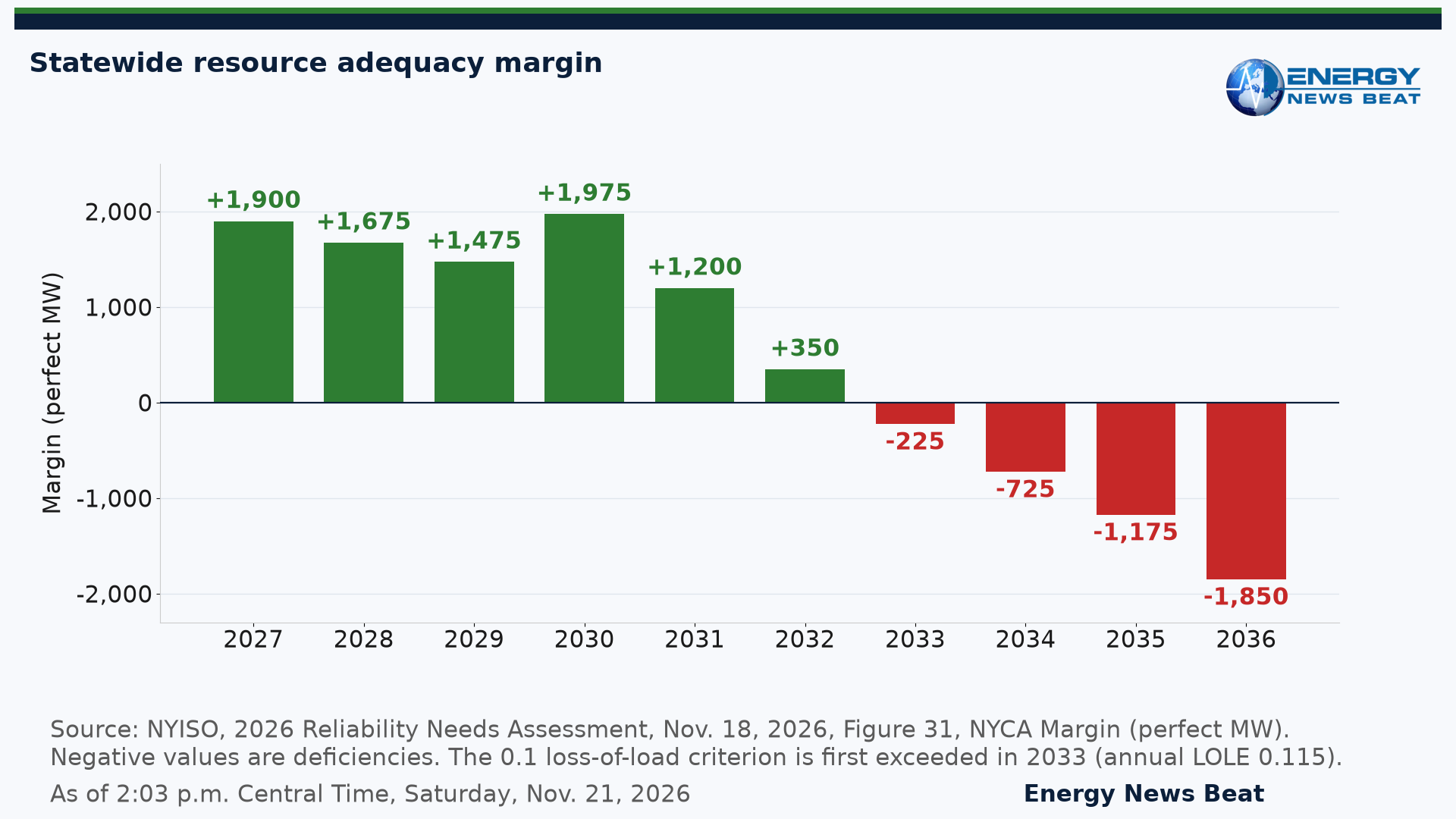
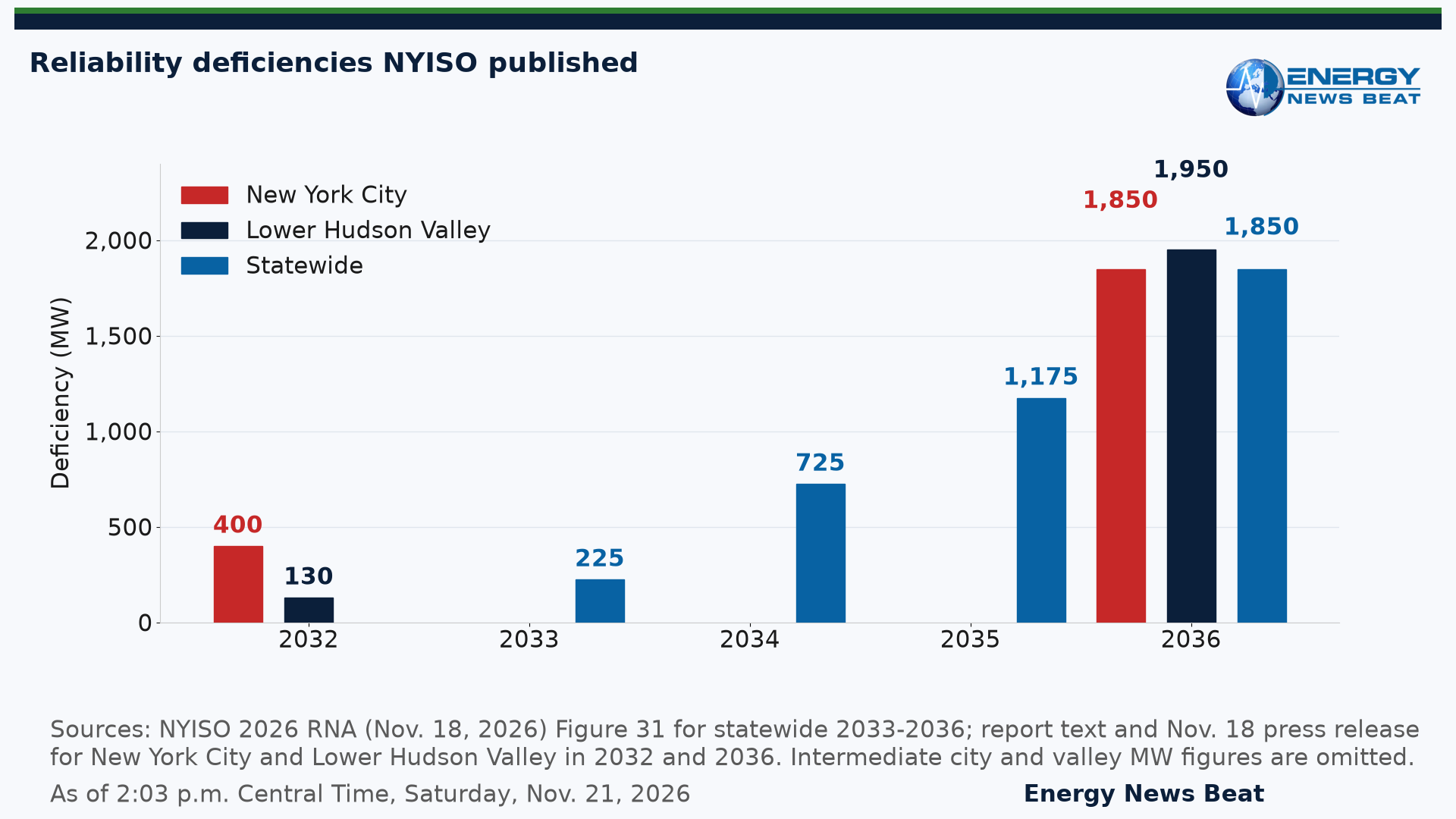
The megawatts check out. NYISO’s Nov. 18 press release and the report behind it project New York City about 400 MW short in summer 2032, growing to about 1,850 MW by 2036. Statewide, the shortfall starts later, at 225 MW in 2033, and reaches 1,850 MW in 2036 in NYISO’s published table.
What does not check out is the “first time” claim as a description of New York City. NYISO reserved “first-ever” for a statewide resource deficiency. The city need, the report itself says, “is a continuation of the deficiencies identified in recent Short-Term Assessments of Reliability.” He got the numbers right. He stretched the history.
What NYISO actually found
The 2026 Reliability Needs Assessment is NYISO’s biennial look at whether New York can keep the lights on through 2036. It finds three needs: a statewide shortage beginning in 2033, a transmission-constrained shortage in New York City beginning in 2032, and a related need in the Lower Hudson Valley the same year.
The statewide need is a resource-adequacy finding: not enough supply, anywhere in the state, to meet the loss-of-load standard. Figure 31, NYISO’s “perfect MW” margin table, is the year-by-year record. The margin stays positive, though thinning, through 2032. In 2033 it turns to -225 MW, then -725 MW in 2034, -1,175 MW in 2035, and -1,850 MW in 2036. By then, winter accounts for about 40 percent of the annual risk. The press release describes 2036 as “more than 1,850 MW”; the table prints -1,850.
The city and valley figures are transmission-security margins: whether enough power can be delivered into a constrained area on a peak day. New York City is about 400 MW short in summer 2032, growing to about 1,850 MW for 15 hours in summer 2036, and 775 MW short in winter 2036. The Lower Hudson Valley is about 130 MW short in summer 2032 and about 1,950 MW short by 2036. Its winter margins stay sufficient.
The report says the state needs “at least 1,850 MW of new generation resources appropriately located with the necessary operating characteristics,” plus transmission to deliver them: “In-state transmission alone will not resolve the statewide need.” Zach Smith, a NYISO senior vice president, said, “New York’s reliability needs are no longer a distant concern.”
What Levine got right, and where he stretched
Levine, elected New York City Comptroller in November 2025, took office Jan. 1, 2026, and quoted the city numbers accurately. He called for “more solar, more wind, upgraded transmission lines, community battery storage, a return to nuclear, greater efficiency.” NYISO called for an “all-of-the-above” mix of new generation, repowered plants, storage, demand reductions, flexible large loads, and more transmission.
NYISO’s headline is “First-Ever Statewide Resource Deficiency.” The report is more careful about the city: that need “is a continuation” of recent short-term assessments. On July 14, 2023, NYISO’s Quarter 2 Short-Term Assessment of Reliability found a New York City deficit “as large as 446 MW” beginning in summer 2025. On Nov. 21, 2024, the 2024 Reliability Needs Assessment identified a city need of 17 MW in summer 2033, rising to 97 MW in summer 2034, and already flagged “increasing statewide concerns.”
Levine is right that the new report is a flare, and he is right about the city megawatts. He is not right if “the first time they have ever issued a warning like this” describes New York City. NYISO calls the statewide finding new. The city’s warning is not.
How New York arrived at a statewide gap
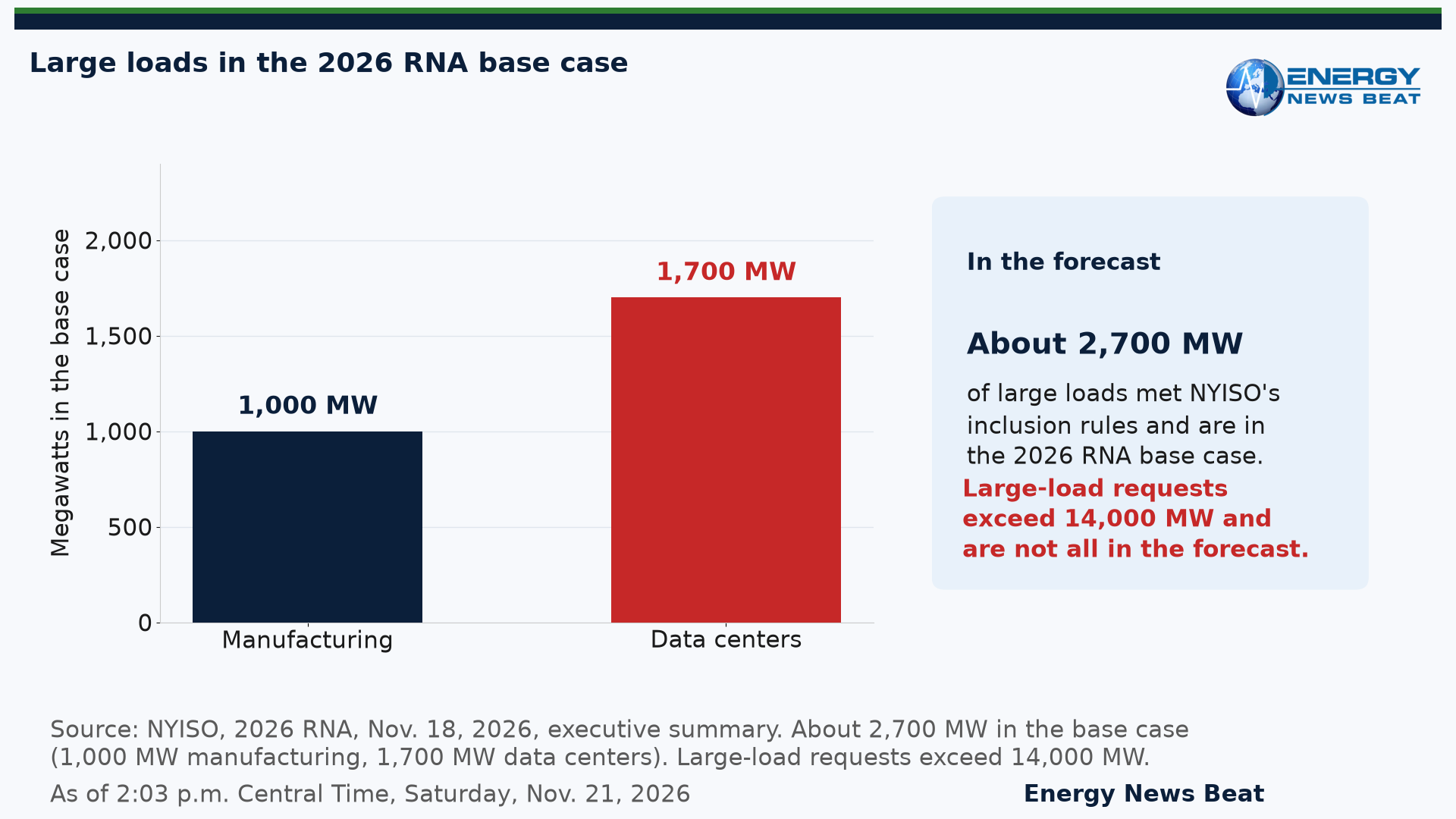
The report describes a pile-up. Demand is growing, especially from large loads. The RNA includes about 2,700 MW of planned large loads that cleared inclusion rules: about 1,000 MW of manufacturing and 1,700 MW of data centers. Large-load requests exceed 14,000 MW statewide; most of that is not in the base case. If new data-center loads, except those already in service, could be curtailed at peak, NYISO says the 2036 statewide need would drop from about 1,850 MW to 850 MW.
Supply is getting older and smaller. New York, NYISO says, has the oldest generation fleet in the country. About 4,600 MW of today’s fossil generation will be more than 70 years old by 2036, and about 2,600 MW is projected as unavailable by then, nearly all in New York City and Long Island. The base case assumes 517 MW of New York Power Authority small gas plants retire at the end of 2030, under a 2023-24 budget law that allows an exception if the plants are needed for reliability. The DEC Peaker Rule tightened ozone-season nitrogen-oxide limits in 2023 and 2025. A 2023 NYISO study put 1,027 MW of affected peakers already offline or limited as of May 1, 2023, with another 590 MW in the city then expected off on May 1, 2025. Some city barges remain through May 1, 2029.
The Climate Leadership and Community Protection Act, S.6599 / A.8429, passed the Senate on June 18, 2019, and the Assembly 111-35. Governor Andrew Cuomo signed it on July 18, 2019, as Chapter 106. Since then, the RNA says, retirements have outpaced new supply by 1.5 GW of nameplate capacity. The base case still includes about 6,200 MW of planned additions, including 1,750 MW of offshore wind — only what met inclusion rules. Two large offshore contracts, Empire Wind 2 and Beacon Wind, were mutually terminated with NYSERDA in late 2023 and January 2024. NYISO’s project list shows Empire Wind 1 for winter 2027.
Indian Point Unit 2 closed in April 2020 and Unit 3, almost 1,040 MW, on April 30, 2021, under a 2017 settlement, the U.S. Energy Information Administration reported. The 2026 RNA does not treat that closure as a new driver of this shortfall. Champlain Hudson Power Express, 1,250 MW, entered service in May 2026 and is assumed available in summer, not winter.
What NYISO says can close the gap
Transmission can help the city and the valley; it cannot, by itself, fix a statewide shortage of megawatts. The greatest benefit, the report says, comes from supply or dependable demand reductions in New York City and the Lower Hudson Valley, because those can serve both needs. Keeping or replacing the NYPA small plants would push those local needs out by a year and shrink the 2036 shortfalls by about 350 MW and 400 MW, respectively. Storage helps, but the city shortfall lasts 15 hours in the detailed summer result, so today’s batteries would need other resources beside them. The reported need is a minimum: real plants are not “perfect MW.”
Reliance on emergency operating procedures is already rising, from about 3.5 days a year in 2027 to about 21 days by 2036, and NYISO says actual 2026 emergency actions have already exceeded that early-year projection. After the RNA is approved, NYISO will take eligible updates. If needs remain, it will solicit market-based solutions and regulated backstops through the 2027-2036 Comprehensive Reliability Plan.
Consumer and Investor Views
Consumer View. Tight New York City summer margins show up in capacity prices and, over time, on the supply portion of a Con Edison bill. Delivery rates are already rising under a plan the Public Service Commission adopted on Jan. 22, 2026, in Case 25-E-0072: for a typical residential customer using 280 kilowatt-hours a month, the approved delivery increase is $4.00 a month in the first rate year, then $3.55 and $3.58, on top of commodity and capacity charges. If the state is short of firm power later in the 2030s, the bill risk includes new plants, emergency measures, retained peakers, and delayed hookups. Not investment advice.
Investor View. The RNA is a map of where new dispatchable or long-duration resources, and the wires to deliver them, would be most valuable: New York City and the Lower Hudson Valley, plus a statewide need that in-state transmission cannot close alone. If the needs survive the update window, NYISO will solicit market-based solutions, with regulated backstops behind them. More than 4,700 MW of nameplate has finished interconnection studies but has not yet met base-case milestones. Not investment advice.
Timeline
Key dates for the 2026 Reliability Needs Assessment, earlier New York City reliability warnings, and the policy decisions that set today’s retirement calendar. Times are America/Chicago where a clock time is given.
- NYISO’s first Reliability Needs Assessment, as described in the 2005 Comprehensive Reliability Plan, finds the baseline bulk-power system does not meet reliability criteria for the full five-year period, with additional resources needed by 2008 (NYCA loss-of-load expectation 0.309 that year after NYISO corrected a modeling error; first reported as 0.395).
March 16, 2007. The 2007 Reliability Needs Assessment finds the forecasted system exceeds the 0.1 days-per-year criterion starting in 2011. The 2011 need is largely from transmission constraints; beyond 2011, NYISO said the need is from an overall statewide (NYCA) resource deficiency as well as transmission constraints.
January 2017. Entergy and New York officials announce a settlement to close Indian Point Unit 2 by April 2020 and Unit 3 by April 2021.
June 18, 2019. The New York Senate passes the Climate Leadership and Community Protection Act, S.6599.
June 19–20, 2019. The Assembly passes the same bill 111-35. The official floor-vote record is dated June 20; the bill actions list records passage on June 19.
July 18, 2019. Governor Andrew Cuomo signs the act as Chapter 106.
April 2020 and April 30, 2021. Indian Point Unit 2, then Unit 3 (almost 1,040 MW), permanently retire, the U.S. Energy Information Administration later reported.
May 1, 2023, and May 1, 2025. Phased Peaker Rule compliance dates used in NYISO’s 2023 short-term study; 1,027 MW had already deactivated or limited operations as of the first date, with another 590 MW in the city then expected to become unavailable on the second.
July 14, 2023. NYISO’s Quarter 2 STAR finds a New York City reliability need as large as 446 MW beginning in summer 2025.
2023-24 enacted state budget. Directs NYPA to deactivate its small New York City and Long Island gas plants by the end of 2030, with reliability and air-quality exceptions. The plants total 517 MW.
December 2023 and January 2024. NYSERDA and the developers mutually terminate the Empire Wind 2 and Beacon Wind offshore contracts.
Nov. 21, 2024. The 2024 Reliability Needs Assessment identifies a New York City need of 17 MW in summer 2033 and 97 MW in summer 2034, and flags increasing statewide concerns.
April 15, 2026. NYISO writes DEC that the Gowanus 2 and 3 and Narrows 1 and 2 generators are needed for reliability until May 1, 2029.
May 2026. Champlain Hudson Power Express, 1,250 MW, enters service, the 2026 RNA says, and is assumed available in summer but not in winter.
Nov. 18, 2026. NYISO publishes the 2026 Reliability Needs Assessment and the “first-ever statewide resource deficiency” press release.
Nov. 19, 2026, 3:10 p.m. Central Time. Comptroller Levine posts the city figures and the “first time” claim.
Next in NYISO’s process. Eligible updates, then, if needs remain, solicitations for market-based and regulated solutions in the 2027-2036 Comprehensive Reliability Plan.
Caveats and Criticism
NYISO will take updates before it solicits solutions. The 2,700 MW of large loads is only the slice that cleared inclusion rules. NYISO’s fact sheet printed a 200 MW statewide shortfall in 2033, while the report table and press release use 225 MW; this article follows the report table. Levine attached an image of NYISO’s release, headlined “First-Ever Statewide Resource Deficiency”; his text, though, names only city numbers, so his “first time” reads as applied to a city warning NYISO has issued before. NYISO’s 2005 and 2007 assessments found statewide violations, partly transmission-driven; this one is “not primarily driven by internal transmission constraints.” This is not a prediction of blackouts, and it is not investment advice.
Stu’s Take
New York does not have a shortage of plans. It has a shortage of firm power that can run when the city is hot, when the wind is calm, or when a neighbor cannot spare a megawatt. NYISO just said the statewide gap starts in 2033 and that transmission alone cannot close it. That is the sentence to sit with. Comptroller Levine got the New York City numbers right, and he is right that nuclear belongs in the mix. What he stretched is the idea that this is the first city warning of its kind. The grid operator has been waving a flag over the city since at least 2023. Energy security starts at home. That means building and keeping dispatchable generation, including a real return to nuclear, on a timetable that matches the retirement calendar Albany already wrote. Wires, storage, and efficiency help. They do not replace the plants that keep the lights on.
Sources
Primary and contemporaneous sources used for this article, with access dates. The 2026 Reliability Needs Assessment final PDF and NYISO’s Nov. 18, 2026, press release are the controlling sources for the deficiency figures. Accessed Nov. 21, 2026.
- Mark D. Levine, post on X, Nov. 19, 2026, 3:10 p.m. Central Time (21:10:48 UTC), including the full note text and an image of the NYISO press release headlined “NYISO Report Identifies First-Ever Statewide Resource Deficiency”. Author bio on X: “Comptroller of New York City.” Accessed Nov. 21, 2026. https://x.com/MarkLevineNYC/status/2123524415187001785
- Office of the New York City Comptroller, “About Mark Levine,” stating he was elected in November 2025 and assumed office on Jan. 1, 2026. Accessed Nov. 21, 2026. https://comptroller.nyc.gov/about/about-mark-levine/
- NYISO press release, “NYISO Report Identifies First-Ever Statewide Resource Deficiency,” Nov. 18, 2026. Accessed Nov. 21, 2026. https://www.nyiso.com/-/press-release-nyiso-report-identifies-first-ever-statewide-resource-deficiency
- NYISO, 2026 Reliability Needs Assessment, final report PDF, dated in the file metadata Nov. 18, 2026, 96 pages. Controlling source for Figure 31 and the report text. Accessed Nov. 21, 2026. https://www.nyiso.com/documents/20142/2248793/2026RNA-Report-Final.pdf
- NYISO, 2026 RNA Fact Sheet, “First-Ever Statewide Resource Deficiency,” PDF dated Nov. 18, 2026. Prints a 200 MW statewide shortfall in 2033, which conflicts with the report table and press release (225 MW). Accessed Nov. 21, 2026. https://www.nyiso.com/documents/d/guest/2026-rna-fact-sheet-final
- NYISO press release, “NYISO Study Finds ‘Reliability Need’ in 2025 for New York City Region,” July 14, 2023. Accessed Nov. 21, 2026. https://www.nyiso.com/-/press-release-%7C-nyiso-study-finds-reliability-need-in-2025-for-new-york-city-region
- NYISO, Short-Term Assessment of Reliability: 2023 Quarter 2, final report. New York City deficiency as large as 446 MW for summer 2025. Accessed Nov. 21, 2026. https://www.nyiso.com/documents/20142/39103148/2023-Q2-STAR-Report-Final.pdf
- NYISO press release, “NYISO Report on Grid Reliability Finds Future NYC Deficiency, Increasing Statewide Concerns,” Nov. 21, 2024, on the 2024 Reliability Needs Assessment. Accessed Nov. 21, 2026. https://www.nyiso.com/-/press-release-nyiso-report-on-grid-reliability-finds-future-nyc-deficiency-increasing-statewide-concerns
- NYISO, 2007 Reliability Needs Assessment, March 16, 2007. Finds the forecasted system exceeds the 0.1 days-per-year criterion starting in 2011; beyond 2011, the need is from an overall NYCA resource deficiency as well as transmission constraints. Accessed Nov. 21, 2026. https://www.nyiso.com/documents/20142/3657944/2007_RNA.pdf/a07f64da-da12-02b5-6ef2-c2b47c670823
- NYISO, The Comprehensive Reliability Plan 2005, third draft for discussion, July 12, 2006. Describes the first RNA: the baseline bulk-power system does not meet reliability criteria for the full five-year period, with additional resources needed by 2008 (NYCA LOLE 0.309 for 2008 after a modeling correction; 0.395 as first reported). Accessed Nov. 21, 2026. https://www.nyiso.com/documents/20142/1391612/crp_2005_clean_version_071206.pdf/79a447a6-0e23-2d48-6fae-d39facca4fd6
- New York State Assembly, bill S06599 / A08429, 2019–2020 session, actions and floor votes. Assembly floor-vote record dated June 20, 2019, YEA/NAY 111/35; actions list records “passed assembly” on June 19, 2019, and “SIGNED CHAP.106” on July 18, 2019. Accessed Nov. 21, 2026. https://nyassembly.gov/leg/?default_fld=&leg_video=&bn=S06599&term=2019&Summary=Y&Actions=Y&Floor%26nbspVotes=Y
- New York State Assembly, A08429 summary and actions, confirming the Senate passed S.6599 on June 18, 2019, and the governor signed Chapter 106 on July 18, 2019. Accessed Nov. 21, 2026. https://nyassembly.gov/leg/?Actions=Y&Summary=Y&Text=&bn=A08429&default_fld=&leg_video=&term=2019
- New York State Senate, S.6599 bill page. This article does not cite a Senate roll-call tally. Accessed Nov. 21, 2026. https://www.nysenate.gov/legislation/bills/2019/S6599
- U.S. Energy Information Administration, “New York’s Indian Point nuclear power plant closes after 59 years of operation,” April 30, 2021. Accessed Nov. 21, 2026. https://www.eia.gov/todayinenergy/detail.php?id=47776
- Entergy, “Entergy, NY Officials Agree on Indian Point Closure in 2020-2021.” 2017 settlement announcement. Accessed Nov. 21, 2026. https://www.entergy.com/news/entergy-ny-officials-agree-indian-point-closure-2020-2021
- New York Power Authority, Small Natural Gas Power Plants page, describing the 2023-24 enacted state budget directive and the reliability and air-quality exceptions. Accessed Nov. 21, 2026. https://nypa.gov/small-natural-gas-power-plants
- New York State Public Service Commission, Consolidated Edison Electric Rate Case Summary, Case 25-E-0072, plan adopted Jan. 22, 2026. Accessed Nov. 21, 2026. https://dps.ny.gov/system/files/documents/2026/01/con-edison-electric-rate-case-summary.pdf
- NYSERDA and Empire Offshore Wind LLC, mutual termination of the Empire Wind 2 contract, fully executed letter dated Dec. 29, 2023, in the file name. Accessed Nov. 21, 2026. https://www.nyserda.ny.gov/-/media/Project/Nyserda/Files/Programs/Offshore-Wind/EW2_-_Mutual_Termination_V_2_12-29-2023_fully-executed.pdf
- NYSERDA and Beacon Wind LLC, mutual termination letter, Jan. 22, 2024. Accessed Nov. 21, 2026. https://www.nyserda.ny.gov/-/media/Project/Nyserda/Files/Programs/Offshore-Wind/BWMutualTermination01222024FE-2.pdf
- New York State Department of Environmental Conservation, SIP revision incorporating 6 NYCRR Subpart 227-3 (Peaker Rule). Used as a rule identifier; compliance-step figures in the article are from NYISO’s 2023 Q2 STAR. Accessed Nov. 21, 2026. https://extapps.dec.ny.gov/docs/air_pdf/siprevision2273.pdf
Key Excerpts
Mark Levine, X post (full note text), Nov. 19, 2026, 3:10 p.m. Central Time. “NY’s power grid operator just sent up a massive warning flare. Amid rapidly rising energy demand, they project NYC’s electricity supply will be 400 MW below need by 2032, and 1,850 MW by 2036. This is the first time they have ever issued a warning like this. We need to move on all fronts to head off an era of rising outages and soaring electricity costs: more solar, more wind, upgraded transmission lines, community battery storage, a return to nuclear, greater efficiency etc etc. No time to waste.”
NYISO press release, Nov. 18, 2026. “The RNA finds the statewide deficiency begins at approximately 225 megawatts (MW) in 2033 and grows to more than 1,850 MW by 2036.” “New York City is projected to be deficient by approximately 400 MW in 2032, growing to approximately 1,850 MW by 2036. The Lower Hudson Valley deficiency grows from approximately 130 MW in 2032 to approximately 1,950 MW in 2036.” “While transmission investments can help address local reliability needs in New York City and the Lower Hudson Valley, they cannot resolve the statewide resource shortfall.”
Zach Smith, NYISO senior vice president of System and Resource Planning, Nov. 18, 2026, press release. “New York’s reliability needs are no longer a distant concern. Electricity demand is growing as the availability of reliable power is increasingly uncertain. New generation and transmission resources take years to plan, permit, and build, so the reliability needs identified in this report must be addressed today.”
NYISO, 2026 RNA, executive summary, statewide need. “Beginning in 2033, the planned statewide resources are insufficient to reliably serve forecasted demand, based on the resource adequacy loss-of-load-expectation criterion. The deficiency in 2033 is initially 225 MW and rapidly gets worse through 2036 with a deficiency greater than 1,850 MW.” “Unlike many previously identified reliability needs, this deficiency is not primarily driven by internal transmission constraints and cannot be addressed with transmission solutions.”
NYISO, 2026 RNA, executive summary, p. 6, what resolves the statewide need. “…maintaining a reliable grid will require at least 1,850 MW of new generation resources appropriately located with the necessary operating characteristics and coupled with transmission capability necessary to deliver those resources. In-state transmission alone will not resolve the statewide need.”
NYISO, 2007 Reliability Needs Assessment, March 16, 2007, §§5.1 and 5.2.4. “the forecasted system exceeds the 0.1 days per year reliability criteria starting in the year 2011.” “the need for 2011 results largely from transmission constraints and not an overall resource deficiency in NYCA. Beyond 2011, the need results from an overall resource deficiency in the NYCA as well as transmission constraints.”
NYISO, Comprehensive Reliability Plan 2005 (third draft, July 12, 2006), on the first RNA. “the New York State bulk power baseline system does not meet reliability criteria for the full five-year period, and in order to maintain reliability, additional resources would be needed by 2008.” The plan’s NYCA loss-of-load-expectation table shows 0.395 for 2008. It adds that after a modeling error was corrected, “the 2008 LOLE dropped to 0.309 days per year from 0.395 days per year”.
NYISO, 2026 RNA, p. 11, New York City need as a continuation. “This transmission security Reliability Need is a continuation of the deficiencies identified in recent Short-Term Assessments of Reliability. Those deficiencies are mitigated in the near-term horizon through the temporary retention of the Gowanus and Narrows barges and the addition of the Champlain Hudson Power Express line.”
NYISO, 2026 RNA, Figure 31, study year 2033 and 2036. Y2033 annual LOLE 0.115, NYCA margin −225 perfect MW. Y2036 annual LOLE 0.596, NYCA margin −1,850 perfect MW. The 0.1 criterion is first exceeded in 2033.
NYISO, July 14, 2023, press release on the 2023 Q2 STAR. “The deficit is as large as 446 MW, driven primarily by the combination of a forecasted increase in peak demand and the unavailability of certain generators.” The NYISO “first identified rapidly declining reliability margins in its 2021 Comprehensive Reliability Plan and restated those concerns in its 2022 Reliability Needs Assessment.”
NYISO, Nov. 21, 2024, press release on the 2024 RNA. “According to the findings of the RNA, the identified New York City reliability need is 17 MW in summer 2033 and increases to 97 MW in summer 2034.” The release also said state legislation enacted in 2023 requires NYPA to deactivate its small natural gas plants, a loss of 517 MW, and “authorizes NYPA to confer with the NYISO to determine if the plants are necessary for electric system reliability.”
NYISO, 2026 RNA, on large loads and a flexibility sensitivity. “The growing demand is especially driven by approximately 2,700 MW of planned large loads, including 1,000 MW of industrial facilities and 1,700 MW of computational data centers across the state. Although requests for large load development exceed 14,000 MW statewide, the RNA reflects only those projects that have progressed sufficiently to be incorporated into the demand forecast.” “If all new planned data center large loads (excluding those currently in service) are flexible and curtailed during peak demand periods, the statewide resource need in 2036 would reduce from approximately 1,850 MW to 850 MW.”
NYPA, Small Natural Gas Power Plants page, accessed Nov. 21, 2026. “The 2023-24 Enacted State Budget calls for NYPA to deactivate its small plants in New York City and Long Island by the end of 2030 if emissions from replacement resources will not cause more than a minimal increase in air pollution in disadvantaged communities and if they are not needed to maintain reliable electric service.”
Data Tables
Figures below are taken from the cited primary documents. Approximations and conflicts between NYISO documents are labeled. As of 2:03 p.m. Central Time, Saturday, Nov. 21, 2026
Table A. NYISO 2026 RNA, Figure 31, statewide resource adequacy
| Study year | Annual LOLE (event-days/year) | NYCA margin (perfect MW) |
| 2027 | 0.025 | 1,900 |
| 2028 | 0.032 | 1,675 |
| 2029 | 0.034 | 1,475 |
| 2030 | 0.019 | 1,975 |
| 2031 | 0.036 | 1,200 |
| 2032 | 0.074 | 350 |
| 2033 | 0.115 | −225 |
| 2034 | 0.182 | −725 |
| 2035 | 0.290 | −1,175 |
| 2036 | 0.596 | −1,850 |
Source: NYISO, 2026 Reliability Needs Assessment, Nov. 18, 2026, Figure 31, p. 54. There is no summer or winter LOLE criterion; seasonal columns in the source table are informational. The 0.1 annual criterion is first exceeded in 2033. The press release describes 2036 as “more than 1,850 MW”; the table prints −1,850. The fact sheet prints a 200 MW shortfall in 2033; this table follows the report. As of 2:03 p.m. Central Time, Saturday, Nov. 21, 2026
Table B. Local transmission-security deficiencies NYISO published in text
| Locality | 2032 | 2036 | Other published figures |
| New York City (summer) | About 400 MW for 7 hours | About 1,850 MW for 15 hours | Winter 2036: 775 MW in the detailed results; executive summary says approximately 800 MW. If batteries cannot discharge, 130 MW short for 3 hours in 2031. |
| Lower Hudson Valley (summer) | About 130 MW for 2 hours | About 1,950 MW for 7 hours | Winter margins sufficient in all planning years. |
| Statewide (resource adequacy) | Still a positive 350 MW margin (Figure 31) | 1,850 MW deficiency (Figure 31) | Deficiency begins in 2033 at 225 MW. |
Sources: NYISO 2026 RNA, pp. 11–12 and 61–63, and the Nov. 18, 2026, press release. Intermediate city and valley MW values for 2033–2035 were not published in the report text and are not invented here. As of 2:03 p.m. Central Time, Saturday, Nov. 21, 2026
Table C. Earlier New York City reliability warnings
| Date | Finding | Source |
| July 14, 2023 | New York City reliability need beginning summer 2025, deficit as large as 446 MW | NYISO press release and 2023 Q2 STAR |
| 2023 Q2 STAR detail | 446 MW over 9 hours under the higher-bound expected-weather case; 306 MW over 7 hours under the baseline coincident-peak case | 2023 Q2 STAR executive summary |
| Nov. 21, 2024 | New York City reliability need of 17 MW in summer 2033, rising to 97 MW in summer 2034; “increasing statewide concerns” | NYISO press release on the 2024 RNA |
| 2021 CRP / 2022 RNA | Rapidly declining reliability margins, as later described in the July 14, 2023, press release | Cited in the 2023 STAR press release |
| 2026 RNA, p. 11 | The New York City transmission-security need “is a continuation of the deficiencies identified in recent Short-Term Assessments of Reliability.” | 2026 RNA |
These precedents are why Levine’s “first time” wording, applied to a New York City warning, is treated as a stretch. “First-ever” is the wording of NYISO’s Nov. 18, 2026, press release and fact sheet, not of the 2026 RNA report. NYISO’s 2005 and 2007 assessments already found statewide criterion violations. As of 2:03 p.m. Central Time, Saturday, Nov. 21, 2026
Table D. Selected policy and plant dates
| Item | Date or figure | Source |
| CLCPA, S.6599, passed the Senate | June 18, 2019 | New York State Assembly actions list for S.6599 / A.8429 |
| CLCPA, Assembly floor vote | 111–35; official floor-vote record dated June 20, 2019 (actions list records passage on June 19) | Assembly floor-vote record for S.6599 |
| CLCPA signed, Chapter 106 | July 18, 2019, by Governor Andrew Cuomo | Assembly actions list |
| Indian Point Unit 2 retired | April 2020 | EIA, April 30, 2021 |
| Indian Point Unit 3 retired | April 30, 2021; almost 1,040 MW | EIA, April 30, 2021 |
| NYPA small plants, 517 MW | Assumed retired at end of 2030 in the 2026 RNA base case; 2023-24 budget law has a reliability exception | 2026 RNA; NYPA; 2024 RNA press release |
| Peaker Rule compliance steps in the 2023 STAR | 1,027 MW deactivated or limited as of May 1, 2023; 590 MW in the city then expected unavailable May 1, 2025 | 2023 Q2 STAR |
| Gowanus 2 and 3 and Narrows 1 and 2 | NYISO letter to DEC, April 15, 2026, designating the units as needed until May 1, 2029 | 2026 RNA, footnote 6, p. 45 |
| CHPE, 1,250 MW, entered service | May 2026; assumed available in summer, not winter, in the 2026 RNA | 2026 RNA, p. 47 |
| Empire Wind 2 and Beacon Wind contracts | Mutually terminated with NYSERDA, late 2023 and January 2024 | NYSERDA termination letters |
| Empire Wind 1 in NYISO’s project list | 816 MW, winter 2027 | 2026 RNA, Figure 11, p. 34 |
Sources: as listed. This article does not cite a Senate roll-call tally. As of 2:03 p.m. Central Time, Saturday, Nov. 21, 2026
Table E. Con Edison delivery-rate plan, Case 25-E-0072
| Item | Rate year 1 | Rate year 2 | Rate year 3 |
| Annual electric revenue increase | $234 million | $409.7 million | $421.1 million |
| Delivery-revenue increase | 4.4% | 4.4% | 4.3% |
| Typical residential 280 kWh/month, delivery $ | $4.00 (5.3%) | $3.55 (4.5%) | $3.58 (4.3%) |
| Same customer, total bill $ | $4.00 (3.9%) | $3.55 (3.3%) | $3.58 (3.2%) |
| Approved ROE | 9.4% | — | — |
Source: New York State Public Service Commission, Consolidated Edison Electric Rate Case Summary. The PSC adopted the joint proposal on Jan. 22, 2026. These are delivery and total-bill increases from that plan, not a forecast of later capacity-market effects. As of 2:03 p.m. Central Time, Saturday, Nov. 21, 2026
Background
NYISO is the not-for-profit operator of New York’s bulk electric system and wholesale markets, and the author of the biennial Reliability Needs Assessment. A statewide resource-adequacy need is a finding that the system does not meet the loss-of-load-expectation criterion; a local transmission-security need is a finding that a constrained area cannot be served securely on a peak day. Mark D. Levine is the Comptroller of the City of New York. He was elected in November 2025 and took office on Jan. 1, 2026. NYISO’s 2005 and 2007 assessments found statewide (NYCA) criterion violations, in those years partly driven by transmission constraints. The 2026 RNA says the current statewide deficiency is “not primarily driven by internal transmission constraints.” “First-ever” is the wording of NYISO’s Nov. 18, 2026, press release and fact sheet; the 2026 RNA report does not use that phrase. Nothing in this article is a prediction of blackouts, and nothing in it is investment advice.