The federal government has proposed a new national survey of data-center electricity use, Form EIA-872. We read the notice, the draft form and the draft instructions. Here is what it collects, why, and how to weigh in.
How much electricity do America’s data centers use? EIA says no source “comprehensively” measures it. On Nov. 27 the agency published a proposal to fix that: the Data Center Energy Consumption Survey, Form EIA-872. It would collect yearly, facility-level data from every U.S. data center with a design capacity of at least 1 megawatt (MW). Anyone can comment by Jan. 26, 2027, and the steps are below.
Why should a household care? Utilities cite data centers when explaining higher bills, and who pays for the wires depends on knowing who drives the load.
What the Survey Would Collect
- Who reports: By the draft instructions, the company that holds or manages the facility’s electric utility contract. A colocation provider reports for the whole building, tenants’ equipment included. Planned facilities count, and a campus is measured against 1 MW as a whole.
- Which facilities: Enterprise, colocation, hyperscale and edge data centers, “super intelligence” data centers, carrier hotels, network gateways and cryptocurrency mines.
- How often: Annually, for the previous year. EIA estimates 1,400 respondents and 1,400 responses.
- What it asks: The draft form has 25 items, including IT design capacity, contracted load now and at full build-out, average peak load, year first operating, cooling methods, IT electricity use and purchased electricity, both in megawatt-hours, and whether on-site generation is backup or continuous.
- Burden: EIA estimates 12,200 hours a year, about 8.7 hours per response, costing $1,158,268 at $94.94 an hour.
- Confidentiality: Responses are “confidential by law” under the 2018 statistical-confidentiality act and published only in aggregate. The draft says that means national, Census region and division, and state totals, never an individual facility or company.
- Authority: The notice cites 15 U.S.C. 772(b) and 42 U.S.C. 7101 et seq. It does not use the word “mandatory.” EIA’s survey page and draft instructions do, and the draft lists civil penalties of up to $13,273 per day per facility.
Why EIA Says It Needs It
EIA says data centers “exhibit high power densities” compared with the commercial buildings its building survey covers. That survey last collected data from 2018. In its words, “A new survey is required because there are currently no sources that comprehensively measure end-use energy consumption of data centers.”
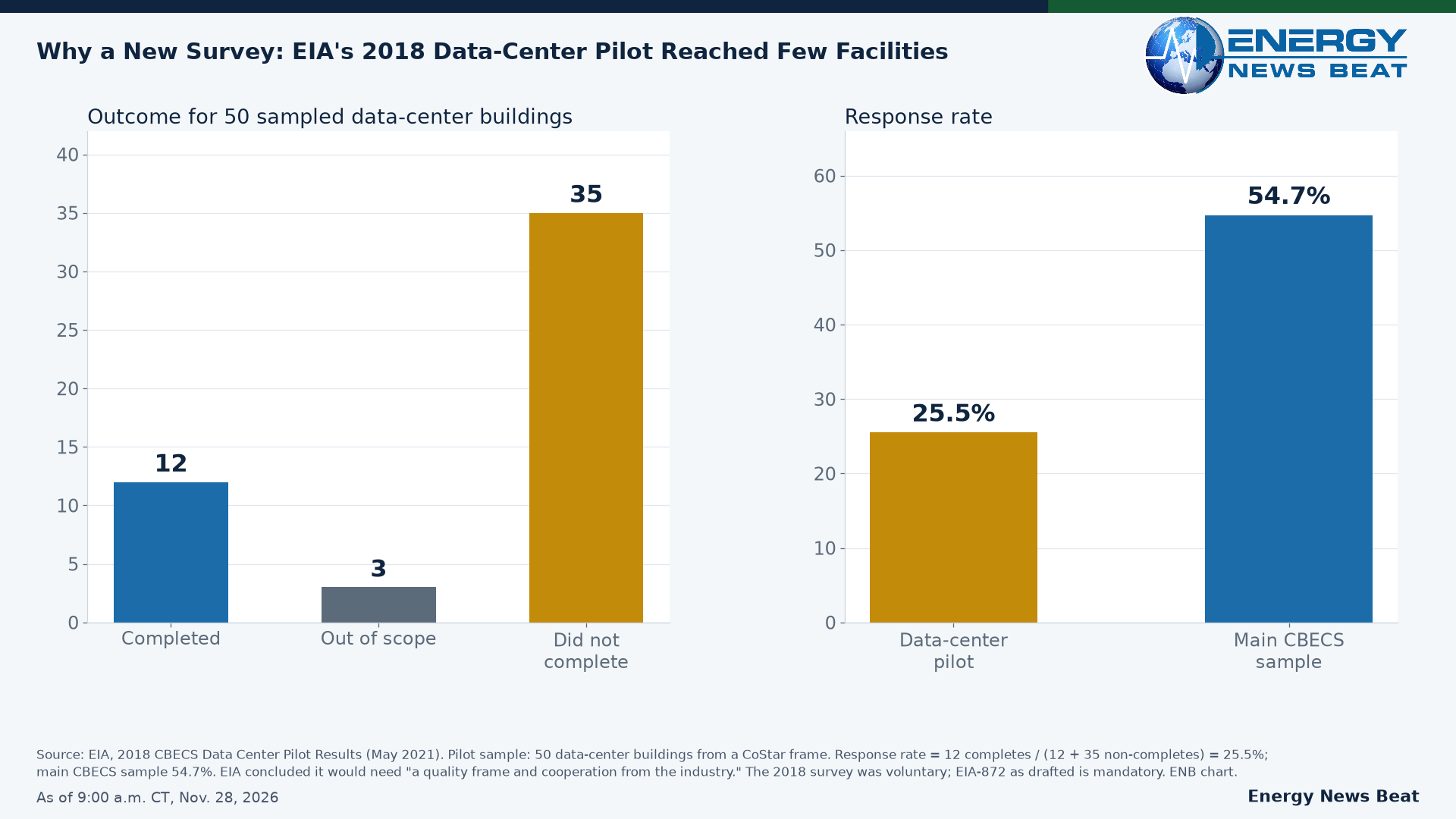
EIA tried before. A 2018 pilot sampled 50 data-center buildings, and 12 completed it, a 25.5% response rate against 54.7% for the main survey. EIA concluded it would need “a quality frame and cooperation from the industry.”
What We Have Now
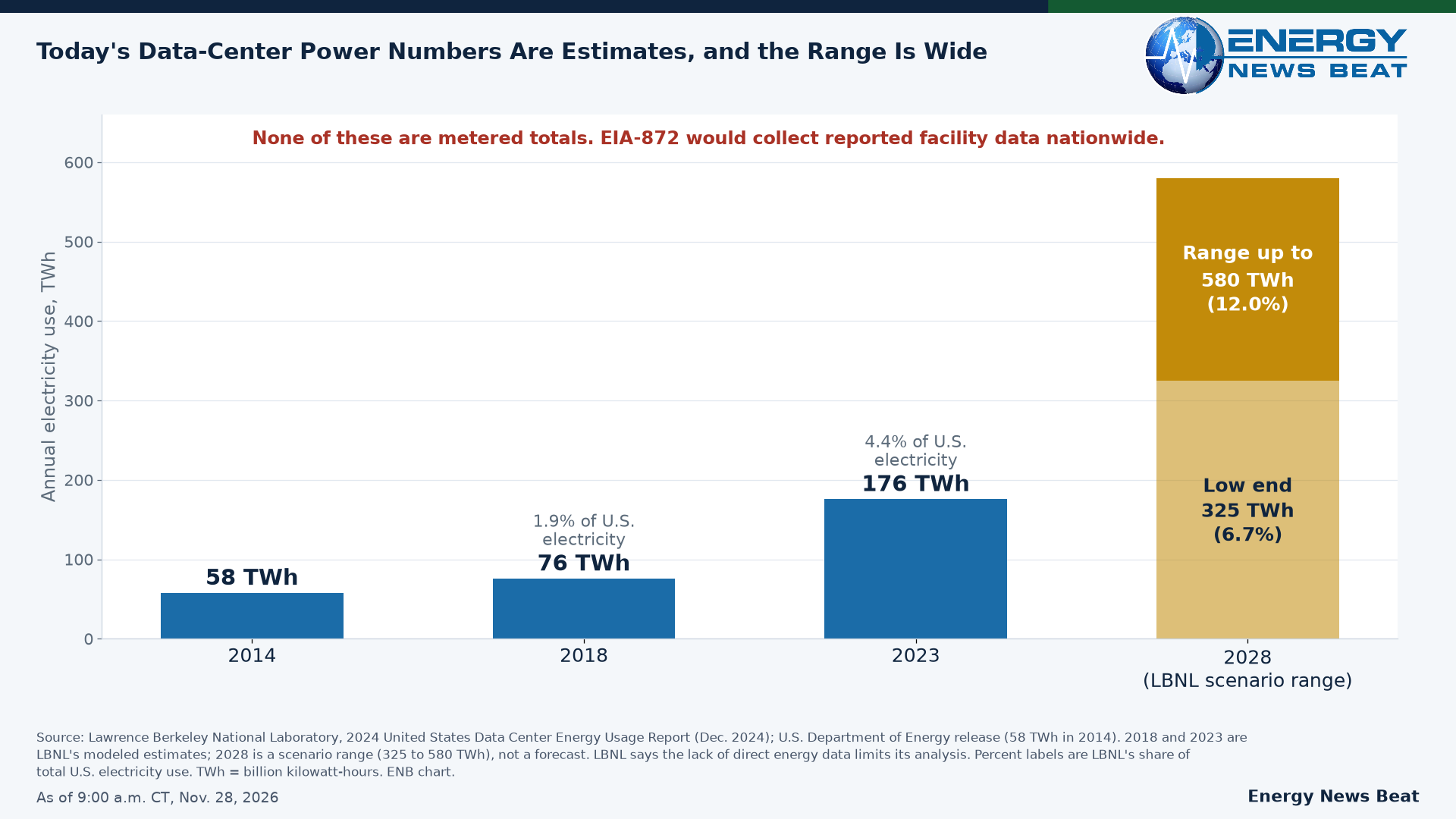
The best public number is a model. Berkeley Lab estimated data centers used 58 terawatt-hours in 2014, 76 in 2018 (1.9% of U.S. electricity) and 176 in 2023 (4.4%). For 2028 it gives a scenario range of 325 to 580 terawatt-hours, 6.7% to 12.0%. Berkeley Lab says the lack of direct energy data limits its analysis, and “Very few companies report actual data center electricity use”.
Timeline
- 25, 2026: EIA launches three voluntary pilots covering 196 companies in Texas, Washington state and the Northern Virginia and D.C. area.
- 9: EIA’s Administrator tells Sen. Elizabeth Warren it plans a mandatory survey after the pilots.
- 27: The 60-day notice is published. Comments are due Jan. 26, 2027.
- Next: Federal rules call for a 30-day OMB notice and an OMB decision within 60 days. The notice gives no date for either.
- 2027: EIA says it will conduct the survey. The draft workbook’s reporting year is 2026, and the draft instructions leave the due date blank.
- How to Comment (Step by Step)
1. Deadline: EIA must receive comments by Jan. 26, 2027. If you may miss it, contact the person in step 4 as soon as possible. 2. Email: Send comments to EIA-FRNcomments@eia.gov, “identified by EIA-872: Data Center Energy Consumption Survey”.
3. Subject line: The notice says to include the OMB control number. It lists the OMB number as “New,” so none exists yet. ENB suggestion: write “EIA-872: Data Center Energy Consumption Survey (OMB No.: New),” and ask the contact below if unsure.
4. Contact: Maura Bardos Chihil, EIA Clearance Officer, (202) 586-7865, Maura.BardosChihil@eia.gov.
5. Read the draft: The forms and instructions are at www.eia.gov/survey/.
6. Answer EIA’s five questions. Is the survey necessary and useful? Is the burden estimate accurate? Can EIA improve the quality, utility and clarity of the data? Can it minimize burden, such as with automation? Is its definition of a data center facility comprehensive and accurate?
7. Be specific. ENB tip, not from the notice: cite item numbers, give your own hours or data limits, and suggest a fix.
The notice gives no docket number or mailing address, and email is the only route it names. Federalregister.gov’s page also offers a comment form, and regulations.gov lists the notice (EIA_FRDOC_0001-0306) as open for comment through Jan. 26. Comments filed there are posted publicly.
Consumer View
Better data could help decide who pays. Duquesne Light will raise its default supply rate Dec. 1 from 14.14 to 14.56 cents per kilowatt-hour for most residential customers, about $2.49 a month on a 600 kWh bill, and says the biggest driver over the past two years has been higher energy demand from data centers. It adds: “Aging power generation plants are also retiring faster than replacements can be built, further contributing to a supply-and-demand imbalance and rising prices.” That is the company’s claim. An executive at the Pittsburgh Technology Council told TribLive, as PennLive reported, that the reduction of the state’s power grid was more responsible for rate hikes than easy targets like data centers. “When you reduce supply, but you don’t reduce demand, prices go up,” he said. EIA says no source comprehensively measures data-center energy use, so neither explanation can be fully tested.
Berkeley Lab warned that if grid investments are made and expected load “fails to show up, ratepayers could be unduly burdened by cost recovery.” The draft form asks for contracted load, planned build-out and actual peak load, so state totals could show how plans compare with reality. That is our reading, not EIA’s claim.
What it will not do. The draft form has no item for which utility serves a facility or what rate it pays, and EIA will publish no facility-level data. It will not say who pays. It could make the argument checkable.
We have followed this question in Who Pays for the Wires? Data Centers, Distant Power and the Transmission Bill on Your Meter and in Microsoft’s Mecklenburg data centers. In Data Centers Done Right? SpaceX Drafted the Code in Arizona, the numbers came from the company’s own post.
Investor View (information, not investment advice)
Who is covered: Operators of enterprise, colocation, hyperscale and edge sites, and crypto miners, if they hold the utility contract for a facility with at least 1 MW of IT design capacity. EIA’s estimated cost is $1,158,268 a year in total, about $827 per respondent by ENB math. No company-specific financial effect is documented.
What is public so far: EIA does not describe industry reaction in the notice. Questions commenters may raise, not claims: whether 8.7 hours fits large campuses, whether colocation providers can report tenants’ equipment, how “functionally integrated” campuses are drawn, and how EIA protects state totals where few facilities exist. Berkeley Lab notes that IT details such as workload types “are often considered proprietary.”
Caveats
The notice is a proposal. The form and instructions are drafts: OMB number and due dates are placeholders. Mandatory status and penalties come from EIA’s survey page and draft instructions, not the notice. The reporting year, 2026, comes from the draft workbook. Regulations.gov lists the notice (EIA_FRDOC_0001-0306) as open for comment, closing at 11:59 p.m. Eastern on Jan. 26, 2027. The 30-day OMB notice has no stated date. We found no published results from the 2026 pilots. Berkeley Lab’s figures are modeled scenarios. Duquesne’s cause is its own claim, and we found no sourced estimate of what data centers add to any household bill.
Stu’s Take
We like facts, and today’s data-center power numbers are models, forecasts and company press releases. EIA wants real reported numbers, and the comment window is open until Jan. 26. If you run a data center or pay an electric bill, read the draft form and tell EIA what it gets right and wrong. Counting the load will not settle who pays for the wires. But utilities and data centers should pay their own way, not households, and that is hard to enforce when no one can say how much power the load uses. We will be watching as we do not trust politicians or the mainstream media to define “Affordability”. With their performance, they have lost the right to be trusted. Secretary Chris Wright is still the greatest Secretary of Energy the United States has ever had and we are grateful for his leadership. My hope is that this report will help define affordability so that either political party will be held to a higher standard.
-
Sources
- Federal Register, “Agency Information Collection Proposed New Survey” (EIA, Form EIA-872, Data Center Energy Consumption Survey), Doc. 2026-24077, 91 FR 76760-76761, signed Nov. 23, published Nov. 27, 2026: https://www.federalregister.gov/documents/2026/11/27/2026-24077/agency-information-collection-proposed-new-survey (PDF: https://www.govinfo.gov/content/pkg/FR-2026-11-27/pdf/2026-24077.pdf)
- EIA, Survey Forms page, entry for EIA-872 (annual; 1,400 respondents; “Mandatory”; legal citation Public Law 93-275 Sec. 13(b), 5(a), 5(b), 52; links to the Federal Register notice, form and instructions): https://www.eia.gov/survey/#eia-872
- EIA, Form EIA-872 draft Respondent Instructions (OMB No. 1905-XXXX; burden 8.7 hours; Sections 1, 2, 3, 4, 5, 6, 7, 8, 9, 10 and Appendix A): https://www.eia.gov/survey/form/eia_872/proposed/instructions.pdf
- EIA, Form EIA-872 draft workbook (labelled “PROTOTYPE,” reporting year 2026): https://www.eia.gov/survey/form/eia_872/proposed/form.xlsx
- EIA press release, “EIA launches pilot survey on energy use at data centers,” Mar. 25, 2026: https://www.eia.gov/pressroom/releases/press585.php
- EIA Administrator Tristan Abbey, letter to Sen. Elizabeth Warren, Apr. 9, 2026 (posted by Sen. Warren): https://www.warren.senate.gov/wp-content/uploads/media/doc/sen_elizabeth_warren_-_eia.pdf
- EIA, “2018 CBECS Data Center Pilot Results,” May 2021: https://www.eia.gov/consumption/commercial/data/2018/pdf/2018_CBECS_Data_Center_Pilot_Results.pdf
- Lawrence Berkeley National Laboratory, “2024 United States Data Center Energy Usage Report,” Dec. 2024 (Executive Summary and the future-research section): https://escholarship.org/uc/item/32d6m0d1
- U.S. Department of Energy, “DOE Releases New Report Evaluating Increase in Electricity Demand from Data Centers” (58 TWh in 2014; 176 TWh in 2023): https://www.energy.gov/articles/doe-releases-new-report-evaluating-increase-electricity-demand-data-centers
- EIA Today in Energy, “Data center server energy use grows across the commercial building stock,” May 19, 2026: https://www.eia.gov/TodayinEnergy/detail.php?id=67704
- EIA Today in Energy, “Commercial electricity sales have soared in Virginia, driven by data centers,” May 5, 2026: https://www.eia.gov/TODAYINENERGY/detail.php?id=67664
- EIA, Short-Term Energy Outlook, Nov. 10, 2026, Table 7a: https://www.eia.gov/outlooks/steo/tables/pdf/7atab.pdf
- 5 CFR 1320.8(d) (60-day notice and the four questions) and 1320.10(a), (b), (d) (30-day OMB notice, OMB decision, control number): https://www.law.cornell.edu/cfr/text/5/1320.8 ; https://www.law.cornell.edu/cfr/text/5/1320.10
- Duquesne Light Company newsroom, “Why Supply Rates Are Rising Dec. 1 and How to Save,” Nov. 20, 2026 (updated Nov. 23): https://newsroom.duquesnelight.com/why-supply-rates-are-rising-dec-1-and-how-to-save
- PennLive, “Pa. electric company blames data centers for upcoming rate hike,” Nov. 28, 2026: https://www.pennlive.com/news/2026/11/pa-electric-company-blames-data-centers-for-upcoming-rate-hike.html
- Energy News Beat, “Who Pays for the Wires? Data Centers, Distant Power and the Transmission Bill on Your Meter,” Oct. 25, 2026: https://theenergynewsbeat.substack.com/p/who-pays-for-the-wires-data-centers
- Energy News Beat, “Who Pays for the Wires? Microsoft’s Mecklenburg Data Centers and Your Power Bill,” Nov. 24, 2026: https://theenergynewsbeat.substack.com/p/who-pays-for-the-wires-microsofts
- Energy News Beat, “Data Centers Done Right? SpaceX Drafted the Code in Arizona,” Nov. 26, 2026: https://theenergynewsbeat.substack.com/p/data-centers-done-right-spacex-drafted
- Regulations.gov, “Agency Information Collection Activities; Proposals, Submissions, and Approvals,” EIA_FRDOC_0001-0306 (Federal Register Doc. 2026-24077; comments through Jan. 26, 2027): https://www.regulations.gov/document/EIA_FRDOC_0001-0306
Appendix A: Key Numbers
Measure Value Source Comments due to EIA Jan. 26, 2027 (60 days after Nov. 27, 2026) 1, 19 Notice 91 FR 76760-76761, signed Nov. 23, published Nov. 27, 2026 1 Threshold IT design capacity of 1 MW or more (campus total for a campus) 1, 3 Respondents / responses a year 1,400 / 1,400 1, 2 Burden hours a year 12,200 (about 8.7 per response) 1, 3 Cost of burden $1,158,268 ($94.94 an hour) 1 Draft form items 25 (Company 1-2; Facilities 3-25; Campuses subset) 3 Civil penalty in draft instructions Up to $13,273 per day per facility 3 2018 pilot 50 buildings; 12 completed; 3 out of scope; 35 did not; 25.5% vs 54.7% 7 2026 pilots 3 voluntary studies; 196 companies 5 LBNL data-center electricity 58 TWh (2014); 76 (2018, 1.9%); 176 (2023, 4.4%) 8, 9 LBNL 2028 scenarios 325 to 580 TWh (6.7% to 12.0%); 74 to 132 GW at 50% utilization 8 EIA server share of commercial use About 7% in 2025 (estimate) 10 EIA commercial sales forecast 1,503 BkWh (2025); 1,557 (2026); 1,600 (2027) 12 Duquesne supply rate 14.14 to 14.56 cents per kWh on Dec. 1 for most residential customers; about $2.49 a month at 600 kWh 14 Appendix B: What the Draft Form Asks
Items are numbered 1 to 25 in the draft. The Campuses tab asks a subset (Items 6, 9, 11, 12, 14, 23, 24, 25) for each campus as a whole.
- Company (Items 1-2): legal name and headquarters address of the utility-contract holder; primary, secondary and supervisory contacts.
- Facility identity (Items 3-6): name and street address; scope (standalone building, shared building, or building on campus); operational status (operational, planned, or not utility contract holder) as of Dec. 31; campus site name.
- Other company (Item 7): the other company holding the contract, if not you.
- Capacity and load (Items 8-13): IT design capacity; nameplate capacity of on-site generation; planned year of operation; total contracted facility load now and at maximum planned capacity; final IT design capacity.
- Actual load (Items 14-15): actual average peak load and average IT peak load for the year (average of monthly peaks).
- Facility profile (Items 16-20): colocation or not; year and month first operational; IT cabinets; building square footage.
- Cooling (Item 21, a to k): a checklist of cooling methods, from air-cooled and chilled-water systems to immersion cooling, evaporative cooling, free cooling and district cooling.
- Energy (Items 22-24): IT equipment electricity (MWh); on-site generation type (emergency or standby, continuous or primary, or none); purchased electricity (MWh).
- Comments (Item 25): optional context.
Status and capacity items describe the facility on Dec. 31. Annual items are totals or averages for the calendar year. Respondents file through EIA’s secure upload; EIA does not accept email, fax or mailed forms for responses (Section 4).
Appendix C: Comment Routes, as Documented
Route Where documented Status Email EIA-FRNcomments@eia.gov; “identified by EIA-872: Data Center Energy Consumption Survey” Notice, ADDRESSES (1) The route the notice names. OMB control number in the subject line Notice, ADDRESSES (1) Notice lists OMB No. as “New.” Under 5 CFR 1320.10(b), OMB assigns the number on approval, so none should exist yet (13). Contact: Maura Bardos Chihil, EIA Clearance Officer, (202) 586-7865, Maura.BardosChihil@eia.gov Notice, FOR FURTHER INFORMATION CONTACT (1) Also the person to contact if a deadline is at risk. Federal Register comment form and regulations.gov link EIA_FRDOC_0001-0306 federalregister.gov page and regulations.gov (19) Not in the notice text. Regulations.gov lists the document as open for comment through Jan. 26, 2027. No docket number appears in the notice. Mail: EIA Office of Statistical Methods and Research, EI-21, 1000 Independence Ave. SW, Washington, DC 20585 Draft instructions, Section 9 burden statement (3) Form boilerplate for burden comments, with a copy to OIRA, OMB, Washington, DC 20503. Not the notice’s comment route. For respondents’ questions about the form itself (not comments), the draft lists EIA Survey Support at eia4usa@eia.gov and 1-855-342-4872, Monday through Friday, 8 a.m. to 6 p.m. Eastern (3).
Appendix D: ENB Math
- 12,200 burden hours / 1,400 responses = 8.71 hours, matching the draft’s 8.7.
- 12,200 hours x $94.94 = $1,158,268, matching the notice.
- $1,158,268 / 1,400 respondents = about $827 per respondent.
- 27, 2026 + 60 days = Jan. 26, 2027.
- 176 TWh / 76 TWh = about 2.3 times 2018 (LBNL). 325 to 580 TWh is about 1.8 to 3.3 times 176 TWh.
- Duquesne: 14.56 minus 14.14 = 0.42 cents per kWh; the company’s own bill figure is about $2.49 a month at 600 kWh, so we use the company’s figure.
Appendix E: Existing Estimates and Where They Come From
- Berkeley Lab (Dec. 2024): a “bottom-up” model built from an installed base of equipment, “limited publicly available data, proprietary market analyst data, and review by industry representatives and stakeholders.” The 2028 range depends on GPU shipments, server utilization and cooling efficiency. It recommends more frequent reports and a data repository. It also says, “If investments are made on the grid side but the expected load fails to show up, ratepayers could be unduly burdened by cost recovery.”
- EIA (May 19, 2026): Annual Energy Outlook 2026 projects data-center server electricity use of 446 to 818 billion kWh by 2050, and estimates servers at about 7% of commercial-sector electricity use in 2025, rising to 22% to 33% by 2050 across its cases. These are model projections.
- EIA (May 5, 2026): Virginia commercial electricity sales rose by nearly 30 million MWh from 2019 to 2025. EIA says the growth is “largely driven by a concentration of data centers, as well as electric vehicle adoption and building electrification.” It does not split the shares.
- EIA Short-Term Energy Outlook (Nov. 2026): commercial sales of 1,557 BkWh in 2026 against residential 1,546. Table 7a has no data-center line.
Appendix F: How the Process Works
- 60-day notice (5 CFR 1320.8(d)): before sending a collection to OMB, an agency publishes a notice asking whether the collection is necessary, whether the burden estimate is accurate, how to improve quality, utility and clarity, and how to minimize burden. This is the notice now open.
- 30-day OMB notice (5 CFR 1320.10(a)): when the agency submits to OMB, it publishes another notice asking that comments go to OMB’s Office of Information and Regulatory Affairs within 30 days.
- OMB decision (1320.10(b)): within 60 days after receipt or publication of that notice, whichever is later. OMB assigns the control number on approval, for up to three years.
- Control number (1320.10(d)): an agency may not conduct a collection, and no one is required to respond, unless it displays a currently valid OMB control number.
- What the notice adds: EIA’s fifth question, on the definition of a data center facility, goes beyond the four in the regulation.