

The United States continues to assert its position as a global energy powerhouse, with Gulf Coast refineries driving record exports of refined petroleum products. Demand for downstream fuels — particularly diesel (distillate fuel oil), jet fuel, and gasoline — has surged internationally, fueled by economic recovery in Latin America, Europe’s energy security needs, and rising aviation activity worldwide. Gulf Coast refineries (PADD 3), home to some of the world’s most complex and efficient facilities, are the epicenter of this export boom, supplying markets from Mexico to Brazil and beyond. However, this success comes with growing challenges. Export volumes have climbed steadily over the past five years, but infrastructure vulnerabilities — most notably severe water shortages in Corpus Christi, a critical refining hub — threaten to constrain output.
What does this mean for U.S. consumers facing potential price volatility, investors eyeing refining and export infrastructure, and America’s broader energy dominance?
Last Five Years: Strong Export Growth from Gulf Coast Refineries
Gulf Coast refineries dominate U.S. petroleum product exports, accounting for the vast majority of distillate, jet fuel, and gasoline shipments overseas. Annual average exports (thousand barrels per day) from PADD 3 show clear upward trends:
Motor Gasoline: Rose from 661 kb/d in 2020 to a peak of 823 kb/d in 2022, settling at 772 kb/d in 2025.
Kerosene-Type Jet Fuel: More than doubled, climbing from 76 kb/d in 2020 to 190 kb/d in 2025.
Distillate Fuel Oil (Diesel): Remained robust, fluctuating but averaging over 1 million kb/d, reaching 1,137 kb/d in 2025.
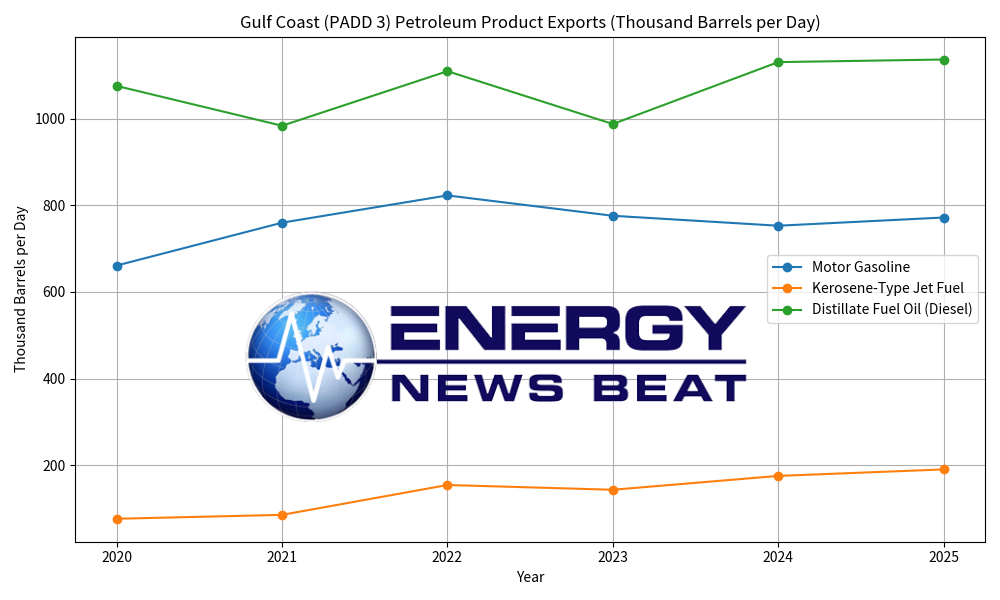
Overall, finished petroleum product exports from the Gulf Coast have grown approximately 32% since 2020, mirroring national records. In 2024, total U.S. petroleum product exports hit an all-time high of 6.6 million b/d, with distillate at ~1.30 million b/d, motor gasoline at 877 kb/d, and jet fuel at 209 kb/d.
Preliminary 2025 data show continued strength, with jet fuel and gasoline exports edging higher while distillate held near record levels.
These volumes reflect Gulf Coast refiners’ ability to process abundant domestic crude and export surplus products that align poorly with U.S. domestic demand profiles (e.g., more diesel-oriented output than U.S. gasoline-heavy needs).
Projections: Continued Growth Expected
EIA forecasts point to sustained or modestly increasing U.S. petroleum product exports in the near term. Global demand for clean products like low-sulfur diesel and jet fuel remains robust, particularly in Europe (displaced Russian supply) and Latin America. U.S. net exports of crude oil and petroleum products are projected to widen through 2027, supporting energy independence. Longer-term outlooks (Annual Energy Outlook) see the U.S. remaining a net exporter of petroleum products well into the 2050s. Refinery utilization on the Gulf Coast has stayed high (often above 90%), and new export terminals and infrastructure expansions are enhancing capacity. However, any acceleration in global demand — or domestic supply constraints — could push exports even higher, tightening inventories and supporting margins.
Potential Problems: Water Crisis in Corpus Christi
A major headwind is emerging in Corpus Christi, Texas — a vital refining and export hub producing roughly 5% of the nation’s refined products, including significant gasoline and jet fuel volumes for Texas and beyond. A prolonged multi-year drought has depleted key reservoirs (Lake Corpus Christi and others) to critically low levels. As of early 2026, the city faces a potential water emergency within months, with full depletion possible by late 2026 if conditions worsen.
Refineries operated by companies like Valero, Citgo, and Flint Hills Resources, along with petrochemical plants and LNG facilities, consume massive volumes of water for cooling, steam generation, and processing. Industrial users account for 50-70% of local water demand. Abrupt curtailments pose safety risks (e.g., overheating equipment) and could force production cuts, reducing output of gasoline, jet fuel, and diesel.
Refiners are responding with efficiency gains (some have already cut water use per barrel by nearly 30% since 2010), wastewater recycling, desalination plans, and alternative sourcing. A new seawater desalination plant is targeted for 2028, but short-term risks remain. Experts warn that serious shortages could elevate fuel prices regionally and nationally while threatening ~115,000 regional jobs.
This highlights a broader vulnerability: climate-driven water scarcity intersecting with energy infrastructure in key hubs.
What This Means for Consumers, Investors, and U.S. Energy Dominance
Consumers: Increased exports generally support lower domestic prices by incentivizing high refinery runs and absorbing surplus output. However, sustained high exports can contribute to tighter domestic inventories and price volatility — especially if global prices rise or domestic disruptions (like Corpus Christi water issues) occur. Jet fuel and diesel shortages would ripple into airfares, freight costs, and consumer goods prices.
Recent EIA data already show transportation fuel demand recovering, but it is still sensitive to supply shocks. Investors: The export boom presents clear opportunities. Gulf Coast refining margins benefit from strong distillate and jet cracks, while midstream/export terminal operators gain from rising volumes.
Companies investing in water resilience, efficiency, or diversified export infrastructure stand to benefit. Risks include regulatory hurdles, weather/climate events, and potential policy shifts affecting trade or permitting. Overall, the sector’s role in U.S. energy exports supports long-term capital deployment. United States Energy Dominance: This export surge cements America’s status as the world’s top petroleum liquids producer and a net exporter since 2020.
Gulf Coast refineries turn domestic shale abundance into global market influence, enhancing energy security for allies, generating economic value (jobs, tax revenue, trade balance), and providing geopolitical leverage. Maintaining dominance requires addressing bottlenecks like water infrastructure to ensure reliable supply chains.
Without proactive investment, vulnerabilities could erode the competitive edge. In summary, rising U.S. downstream exports underscore the strength of American refining and its pivotal role in global energy markets.
Yet the “at what cost?” question looms large — particularly as water constraints in places like Corpus Christi test the industry’s resilience. Balancing export growth with domestic reliability and infrastructure upgrades will determine whether the U.S. not only leads but sustains its energy dominance for decades to come.
Appendix: Links and Sources
- EIA Gulf Coast (PADD 3) Exports of Crude Oil and Petroleum Products: https://www.eia.gov/dnav/pet/pet_move_exp_dc_r30-z00_mbblpd_a.htm (and subseries for distillate, jet fuel, gasoline).
eia.gov
- EIA Today in Energy — U.S. Exports of Major Transportation Fuels (2025 data): https://www.eia.gov/todayinenergy/detail.php?id=67304.
eia.gov
- EIA Record U.S. Petroleum Product Exports (2024): Related summaries via EIA Petroleum Supply Monthly.
- AP News / Texas Tribune on Corpus Christi Water Crisis (2026): https://apnews.com/article/corpus-christi-texas-water-shortage-oil-gas-1d9577698f394e83335f1ed5c16cef6d and https://www.texastribune.org/2026/03/20/texas-corpus-christi-water-shortage-oil-gas-refineries/.
- apnews.com +1
- EIA Short-Term Energy Outlook (projections context): https://www.eia.gov/outlooks/steo/.
eia.gov
Data current as of April 2026 releases. All figures are annual averages in thousands of barrels per day unless noted otherwise.