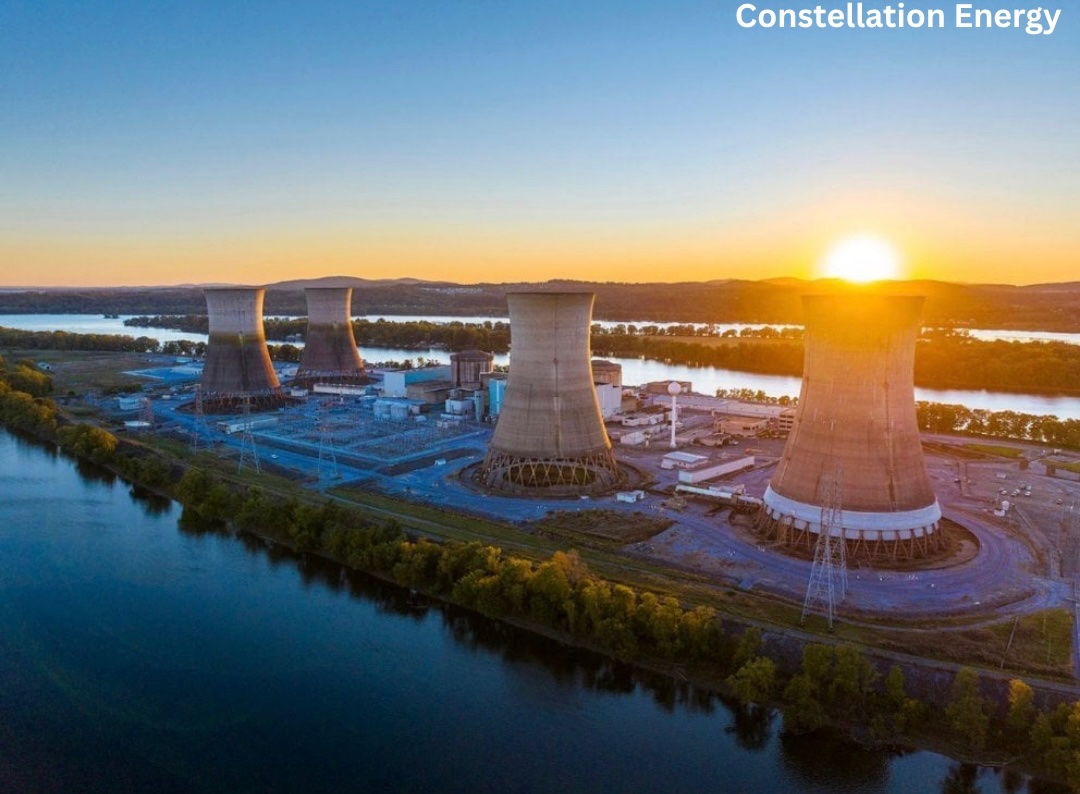
In a landmark move signaling a nuclear renaissance driven by surging artificial intelligence and data center energy needs, Constellation Energy is preparing to restart Three Mile Island Unit 1—now rebranded as the Crane Clean Energy Center—in Pennsylvania. The plant, which has been offline since 2019 for economic reasons, will once again deliver reliable, carbon-free baseload power to the grid under a groundbreaking 20-year power purchase agreement (PPA) with Microsoft. Backed by a $1 billion federal loan from the U.S. Department of Energy, the $1.6 billion revival project highlights how tech giants’ insatiable demand for clean electricity is reshaping America’s energy landscape.
Three Mile Island (TMI) holds a unique place in U.S. nuclear history. Located on the Susquehanna River near Middletown, Pennsylvania, the station consists of two pressurized water reactors. Unit 2 suffered the worst commercial nuclear accident in U.S. history—a partial meltdown in March 1979—though it caused no fatalities and negligible off-site radiation exposure according to official assessments. Unit 1, a separate 835-megawatt reactor that began commercial operation in 1974, operated safely and at high reliability for decades before shutting down in September 2019 due to low wholesale power prices and lack of sufficient state subsidies. Decommissioning plans were underway until Constellation Energy announced the restart in September 2024, citing renewed demand for firm, 24/7 carbon-free power.
The restart will restore approximately 835 MW of carbon-free capacity—enough to power roughly 800,000 average homes—directly to Microsoft’s data centers in the PJM Interconnection region. Microsoft will purchase the plant’s entire output for 20 years as part of its commitment to match data center consumption with carbon-free energy and achieve carbon-negative status. Constellation expects the unit to return to service in the second half of 2027 (accelerated from an initial 2028 target), following upgrades to turbines, generators, transformers, cooling systems, and controls, plus comprehensive NRC safety reviews and license renewal to extend operations potentially into the 2050s. The project has already hired over 200 workers, with plans to create approximately 3,400 direct and indirect jobs and generate more than $3 billion in state and federal taxes while adding $16 billion to Pennsylvania’s GDP over the plant’s life.
This deal is more than a single-plant revival; it underscores the explosive growth in electricity demand from AI and hyperscale data centers. Tech companies like Microsoft, Amazon, Google, and Meta are racing to secure gigawatts of clean power, often turning to nuclear for its reliability and zero-emissions profile amid retiring coal and gas plants.
What This Means for Investors and Consumers
For investors, the TMI restart is a bullish signal for the nuclear sector. Constellation Energy (Nasdaq: CEG) stands to benefit directly from the long-term, high-margin PPA and federal financing support, which reduces capital costs and de-risks the project. Broader implications include heightened investor interest in nuclear operators, uranium producers, and advanced reactor developers as AI-driven demand reshapes power markets. Nuclear stocks have already seen momentum from similar announcements, and policy tailwinds—such as the Trump administration’s push for expanded nuclear capacity—could accelerate licensing and financing for future projects.
For consumers and the broader economy, the restart bolsters grid reliability in a high-demand era. Nuclear power provides dispatchable, around-the-clock electricity without the intermittency of renewables or the emissions of fossil fuels. By adding clean capacity, it helps mitigate potential rate hikes or reliability issues from data center load growth (projected to consume 8% or more of U.S. electricity by 2030 in some forecasts). Pennsylvania residents will see economic gains through jobs and tax revenue, while the national grid benefits from a diversified, resilient supply. Environmental advocates note the climate upside: nuclear already supplies about half of U.S. carbon-free electricity.
The Broader U.S. Nuclear Fleet: Aging but Resilient
The United States operates the world’s largest nuclear fleet. As of March 2026, there are 96 operating commercial reactors at 57 plants across 28 states, with a combined net summer capacity of approximately 98.4 GW. The average age of these reactors is about 44 years, making the fleet one of the oldest globally. Despite this, U.S. nuclear plants achieve industry-leading performance, with capacity factors routinely exceeding 90% (around 91-93% in recent years).
Nuclear power currently accounts for roughly 18-19% of total U.S. electricity generation (e.g., 816 TWh in 2024, or about 18% of output). It remains the largest source of carbon-free electricity in the country.
Recent additions include Vogtle Units 3 and 4 in Georgia, which entered service in 2023 and 2024—the first new large reactors in decades. However, new large-scale construction has been limited due to high costs and regulatory timelines.
New Reactors and Future Outlook
In the near term, growth will come primarily from restarts and uprates rather than greenfield builds. TMI Unit 1 and Holtec’s Palisades plant in Michigan (targeted for restart in early 2026, with some delays reported) represent historic comebacks of recently retired units. The Department of Energy’s UPRISE initiative aims for +2.5 GW by 2027 and +5 GW by 2029 through uprates, restarts, and efficiency gains.
Looking further ahead, the Nuclear Energy Institute’s 2025 survey shows industry planning for an additional 23.4 GWe of new nuclear generation through 2039—more than 50% higher than prior years. Small modular reactors (SMRs) and advanced designs from companies like NuScale, X-energy, and Oklo are targeted for late-2020s or early-2030s deployment, often paired with data centers. Westinghouse has announced plans for 10 new AP1000 reactors, with construction potentially starting by 2030. Ambitious policy goals under the current administration target quadrupling U.S. nuclear capacity to 400 GW by 2050.
EIA’s Annual Energy Outlook 2026 projects nuclear capacity remaining relatively flat in baseline scenarios, with generation share declining modestly from ~17% in 2025 to 12-15% by 2050 as overall demand surges. However, higher natural gas prices or stronger policy support could drive meaningful increases, and real-world momentum from AI demand and restarts suggests upside to these projections.
The TMI restart is a powerful case study in how market forces, corporate offtake agreements, and federal support can revive nuclear assets. As America confronts unprecedented electricity demand growth, the nuclear fleet—old but proven—stands poised for a new era of expansion.
Appendix: Sources and Links
- Constellation Energy Press Release (Sept 20, 2024): https://www.constellationenergy.com/news/2024/Constellation-to-Launch-Crane-Clean-Energy-Center-Restoring-Jobs-and-Carbon-Free-Power-to-The-Grid.html
- World Nuclear News: https://www.world-nuclear-news.org/articles/constellation-to-restart-three-mile-island-unit-powering-microsoft
- CNBC: https://www.cnbc.com/2024/09/20/constellation-energy-to-restart-three-mile-island-and-sell-the-power-to-microsoft.html
- AP News (DOE loan): https://apnews.com/article/three-mile-island-nuclear-power-constellation-microsoft-energy-b36d8ce1b68891e18d165063f57e4c5b
- U.S. EIA – Nuclear Industry: https://www.eia.gov/energyexplained/nuclear/us-nuclear-industry.php
- U.S. EIA – Nuclear Generation: https://www.eia.gov/nuclear/generation/
- Wikipedia (TMI history): https://en.wikipedia.org/wiki/Three_Mile_Island_Nuclear_Generating_Station
- Fox News / Additional coverage: Various reports from 2024-2025 on restart and loan.
- Nuclear Energy Institute and World Nuclear Association reports on fleet statistics and plans.
- Reuters, NucNet, and industry updates on Palisades and broader projections (2025-2026).
All data current as of May 2026 based on publicly available reports from EIA, NRC, companies, and reputable news outlets.