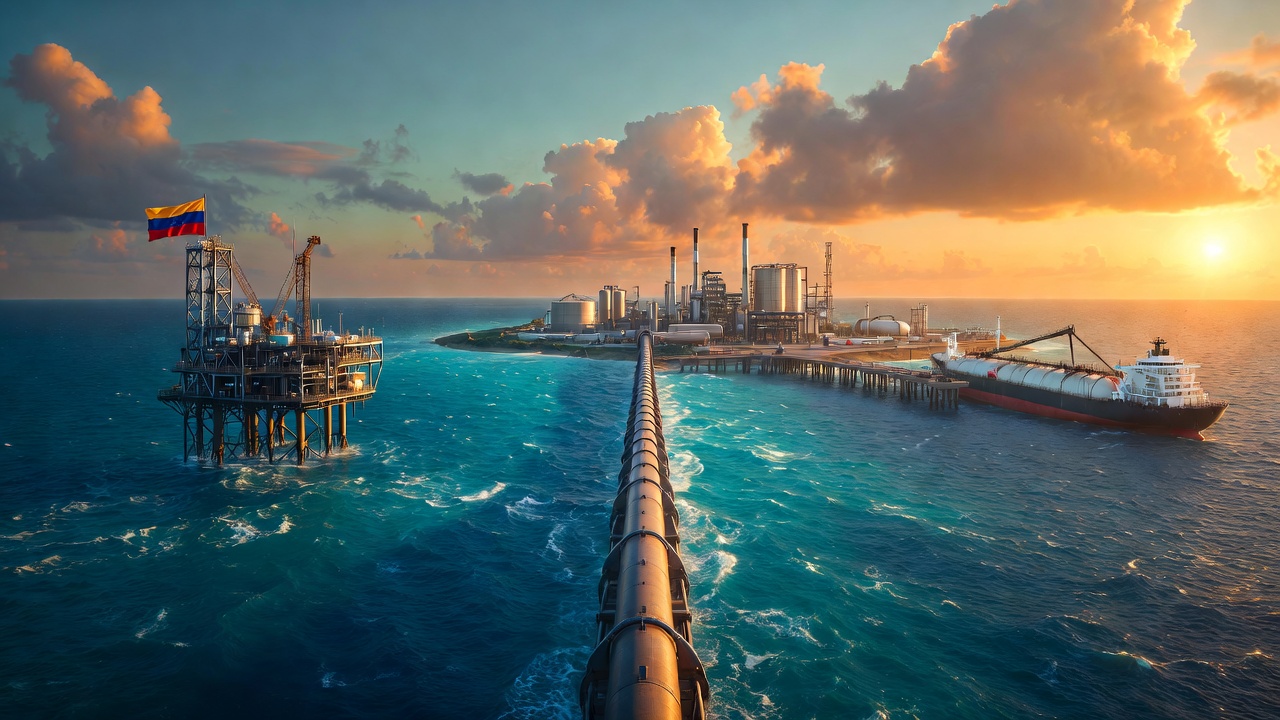
Shell is actively exploring the development of Venezuela’s offshore natural gas resources, with plans to route production through Trinidad and Tobago’s existing infrastructure for export as LNG.
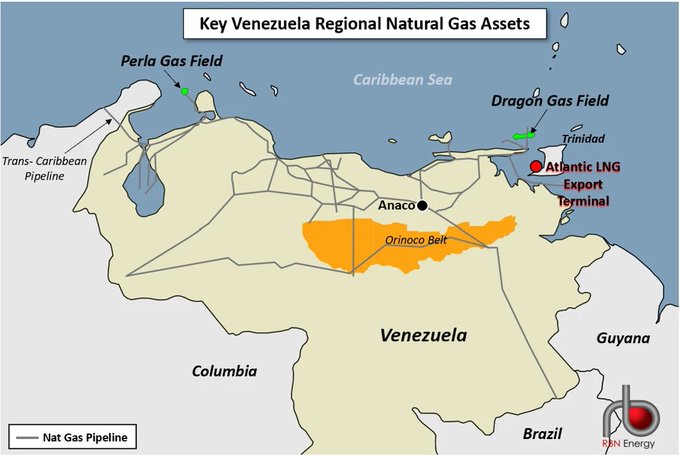
In a February 2026 earnings call and subsequent Bloomberg TV interview, Shell CEO Wael Sawan confirmed ongoing talks with Venezuela’s government to advance offshore gas projects, specifically targeting the Dragon field. The strategy leverages Trinidad’s Atlantic LNG facility, which already has the terminals, offtake contracts, and export capabilities in place—avoiding the need for costly new greenfield LNG infrastructure in Venezuela.
The Dragon field, holding approximately 4.2–4.5 trillion cubic feet of gas in Venezuelan waters just miles from Trinidad’s Hibiscus platform, represents one of the most accessible “stranded” resources in the region. A proposed ~22 km subsea pipeline would connect the field directly to existing infrastructure. Preliminary geophysical and geotechnical surveys were conducted years ago, and the project has a 30-year license framework involving Shell and Trinidad’s National Gas Company (NGC). Trinidad and Tobago has eyed a late-2027 production start, though some sources indicate Shell is targeting first gas as early as 2026–2027 if final investment decision (FID) hurdles are cleared.
Political and Sanctions Context: A Post-Maduro Opening
Progress on the Dragon project has long been hostage to U.S. sanctions on Venezuela’s government and state oil company PDVSA. Licenses were granted, revoked, and reissued multiple times between 2023 and 2025 amid shifting U.S. policy toward the Maduro regime. Venezuela even suspended energy cooperation with Trinidad in late 2025. The landscape changed dramatically in January 2026 following the capture of Nicolás Maduro and the establishment of an interim government. The Trump administration moved quickly to ease sanctions through a series of OFAC general licenses (GLs) that explicitly authorize activities in Venezuela’s oil, gas, petrochemical, electricity, and—later expanded—critical minerals and mining sectors.
Shell and partners are now awaiting additional specific OFAC authorizations to move from negotiations to full development and production. Sawan has indicated that, with the right licenses, FID could come relatively quickly, with first gas potentially flowing within about three years.
How Financing Will Be Handled: Same Controls as Oil (and Now Mining)
A key question raised in market discussions—including replies to commodity analyst Jack Prandelli’s May 9, 2026 X post on the Shell talks—is how any payments or revenues from Venezuelan gas will be handled under the new sanctions-relief framework. The answer appears clear: natural gas has been folded into the same U.S.-controlled financial architecture established for oil sales.
Under an early 2026 Executive Order and related OFAC guidance, proceeds from Venezuelan natural resource sales (initially focused on oil) are directed into U.S.-controlled accounts—initially including a dedicated account in Qatar for neutral, seizure-resistant movement, later shifted to U.S. Treasury-managed accounts. These “Foreign Government Deposit Funds” ensure revenues are used for the benefit of the Venezuelan people and U.S. interests rather than flowing directly to blocked entities. OFAC licenses for cross-border gas projects, including those involving Trinidad and Tobago, explicitly require that any payment of oil or gas taxes or royalties to the Government of Venezuela, PDVSA, or PDVSA entities must be paid into these designated U.S.-controlled accounts.
This mirrors the approach taken for critical minerals and mining. OFAC first broadened authorizations for oil/gas/petrochemicals (e.g., GL 46B, 48A, 52 and related updates), then issued parallel licenses (GL 51A, 54, 55) extending the same structured framework—U.S. law contracts, reporting obligations, and controlled payment mechanisms—to gold and other minerals. The administration has consistently applied a unified, transparent revenue-control model across energy and strategic minerals to prevent corruption, creditor seizures, and misuse while enabling investment.
No public statements from the administration single out “natural gas” as a separate carve-out; instead, the GLs and project-specific licenses treat it as part of the integrated energy sector under the same oversight as oil. Energy Secretary Chris Wright and other officials have emphasized that this controlled-revenue model provides the leverage needed to stabilize Venezuela’s economy and rebuild its infrastructure responsibly.
Outlook and Strategic Wins
For Venezuela, monetizing Dragon gas would unlock stranded resources without requiring massive domestic LNG investment. For Trinidad and Tobago, it provides vital throughput to keep Atlantic LNG running at higher utilization amid declining domestic reserves. Shell gains access to new gas reserves cost-effectively. The project could deliver roughly 1.5 billion cubic meters per year once online, offering a pragmatic early win in Venezuela’s post-Maduro energy reopening.
Challenges remain—technical integration, final OFAC approvals, and political stability in the interim government—but the trajectory is positive. As one analyst noted in response to the Shell news: the gating factor is now Washington’s posture on sanctions relief, and that posture has clearly shifted toward enabling structured, transparent development.
As long as the LNG is traded in the US Dollar, it might get approved faster.
Appendix: Sources and Links
- Jack Prandelli X post (May 9, 2026): https://x.com/jackprandelli/status/2053061646797402283
- Reuters: “Shell weighing Venezuela offshore investments” (Feb 5, 2026) – https://www.reuters.com/business/energy/shell-weighing-venezuela-offshore-investments-worth-billions-dollars-ceo-tells-2026-02-05/
- Argus Media: “Trinidad eyes late 2027 start for Venezuelan gas field” (Jan 28, 2026)
- Congressional Research Service: “Venezuela’s Natural Gas: Opportunity Knocks?” (Feb 19, 2026) – https://www.congress.gov/crs_external_products/IF/PDF/IF12448/IF12448.4.pdf
- OFAC General Licenses and FAQs (various 2026 updates on oil/gas/minerals) – https://ofac.treasury.gov/sanctions-programs-and-country-information/venezuela-related-sanctions
- The Hill / Reuters / Semafor reports on U.S.-controlled oil revenue accounts and Qatar mechanism (Jan–Feb 2026)
- Caribbean Today / Trinidad government statements on OFAC licenses for gas projects (Feb 2026)
- Additional background: NYT, EnergiesNet, Global Energy Monitor, and Paul Hastings / Hogan Lovells client alerts on OFAC GL expansions (March–May 2026)
Energy News Beat will continue monitoring OFAC updates, FID announcements, and project timelines for further developments.