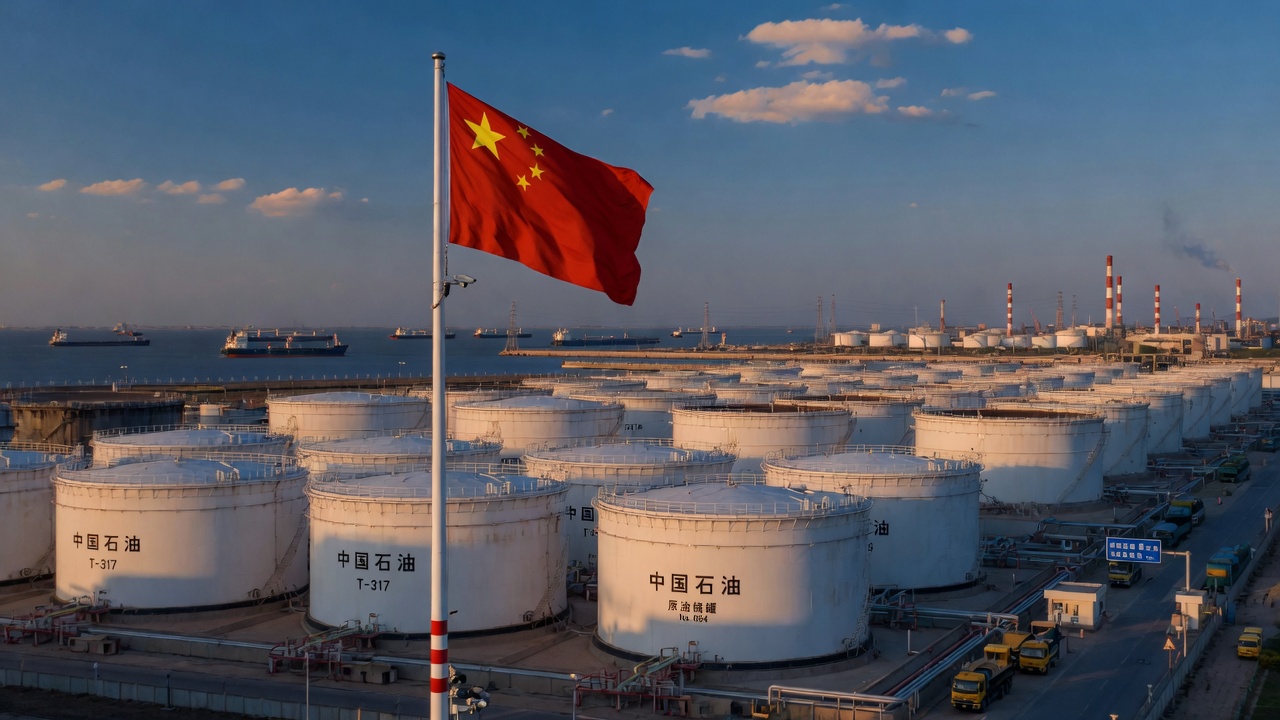
While global oil markets grapple with the fallout from the Strait of Hormuz disruptions and seek a path toward price recovery, one player is quietly rewriting the rules: China. Through years of deliberate, long-range planning, Beijing has transformed its strategic petroleum reserves into a powerful tool for energy security—and, unintentionally or not, a distorting force on global price signals and market recovery.
The foundation of this strategy was laid well before the current crisis. China aggressively stockpiled crude oil during periods of lower prices, vacuuming up discounted barrels from Russia, Iran, and opportunistic Middle Eastern suppliers. In early 2026, as geopolitical tensions around Iran escalated, Chinese crude imports surged approximately 16% year-on-year in January and February, reaching nearly 12 million barrels per day. This buying spree allowed Beijing to build what analysts estimate is now the world’s largest national oil inventory—between 1.2 and 1.4 billion barrels of combined strategic and commercial crude reserves.
By the U.S. Energy Information Administration’s (EIA) estimates, China added an average of 1.1 million barrels per day to its strategic inventories throughout 2025 alone, pushing totals to nearly 1.4 billion barrels by December 2025 (with roughly 360 million barrels government-held and the rest commercial). Preliminary data showed continued builds into early 2026, giving China a buffer equivalent to over 100 days of import coverage—far exceeding the International Energy Agency’s 90-day benchmark.
Fast-forward to April 2026: As prices spiked amid the Hormuz crisis (which has disrupted roughly 1 billion barrels of supply potential), China abruptly reversed course. Crude imports collapsed by around 20% year-on-year, with seaborne volumes dropping to about 8 million barrels per day—the lowest level since 2022. Rather than chasing spot market barrels, Beijing released inventory into its domestic refining system and sharply curtailed exports of refined products like gasoline, diesel, and jet fuel to shield its own economy.
This “buy low, pause high” playbook—enabled by opacity around exact reserve levels and buying behavior—has turned China into what analyst Cyril Widdershoven aptly calls the “invisible central banker” of oil markets. By stockpiling during weakness and withdrawing demand visibility during strength, Beijing absorbs shocks for its domestic market while exporting volatility elsewhere. The result? Traditional supply-and-demand signals are scrambled. Markets interpret reduced Chinese imports as “weak global demand,” softening prices and bearish positioning—even as physical tightness builds in non-Chinese inventories and refined product markets.
How China’s Strategy Is Distorting the Recovery
The current oil market “recovery”—understood here as the effort to rebalance after recent supply shocks, OPEC+ adjustments, and post-2025 glut fears—is being artificially damped. Despite the Hormuz-related tightness that might otherwise have driven Brent crude well above $130–150 per barrel, prices have remained relatively contained (hovering around $105–110/bbl in mid-May). China’s massive reserves act as a shock absorber, masking scarcity and preventing the full price signal that would typically spur new investment, production ramps, or demand destruction elsewhere.
This distortion is particularly acute in refined products. By constraining exports of diesel, jet fuel, and gasoline, China has removed balancing barrels from Asian and European spot markets precisely when summer peak demand hits. The outcome could be bidding wars and a sudden fuel crunch for nations without China’s inventory buffer—Japan, South Korea, Southeast Asia, and beyond. Pricing power is shifting away from OPEC+ toward a U.S.-China dynamic, where Beijing controls not just physical supply but the perception of demand.
Scenario Analysis: If China Manipulates, Releases, or Stops Purchasing
What happens to the recovery if China doubles down on its long-range playbook?
Continued or Accelerated Manipulation of Releases/Drawdowns
China could increase draws from its commercial and strategic stocks, ramping up domestic refining while still limiting product exports. This would flood internal supply but keep global crude and product markets tighter than headline import data suggest. Short-term effect: Prices remain capped, delaying recovery for U.S. shale producers, OPEC members, and other exporters who rely on higher revenues for budgets and investment. Long-term: When China eventually exhausts or reallocates stocks, a violent repricing could occur—potentially one of the most dangerous mismatches since the 1970s—as the world realizes “weak demand” was an illusion. Summer 2026 product markets would face a heightened risk of spikes.
Full Stop on Net Purchasing (or Even Strategic Selling)
If Beijing halts new imports entirely or begins net draws/releases into the global market (via refined products or rare crude re-exports), the distortion intensifies. Markets would price in an even deeper “glut,” further softening crude benchmarks and stalling upstream investment worldwide. Non-OECD Asia and Europe—lacking China’s buffers—would compete fiercely for the remaining supply, driving regional price premia and inflation. Geopolitically, this gives China leverage: It could time releases to stabilize allies or pressure rivals. The recovery would be slower, more uneven, and prone to sudden reversals once China re-enters as a buyer or stocks run low.
In both cases, China’s opacity and domestic-first priority mean the timing and scale of any shift remain hidden. This “commodity mercantilism” exports volatility globally while protecting Beijing’s economy, but it risks miscalculation by traders, producers, and policymakers who underestimate the physical tightness building outside China’s borders.
The Bottom Line
China’s long-range oil planning—rooted in energy security, geopolitical hedging, and opportunistic buying—has given it unprecedented leverage. While it stabilizes Beijing’s outlook amid crises, it distorts the very recovery the rest of the world needs for balanced investment, energy transition funding, and economic stability. As Widdershoven warns, “The world no longer knows what ‘real’ demand actually is.”
For U.S. energy producers, OPEC+, and global traders, the message is clear: Watch China’s invisible hand. True market recovery may depend less on traditional fundamentals and more on when—and how—Beijing decides to loosen its grip on the throttle.
- Cyril Widdershoven, “China’s Invisible Hand Is Distorting Global Oil Markets,” OilPrice.com, May 13, 2026. https://oilprice.com/Energy/Crude-Oil/Chinas-Invisible-Hand-Is-Distorting-Global-Oil-Markets.html
oilprice.com
- U.S. Energy Information Administration (EIA), “China, the United States, and Japan hold most strategic oil inventories in 2025,” Today in Energy, April 20, 2026. https://www.eia.gov/todayinenergy/detail.php?id=67504
eia.gov
- Reuters reports on China’s January-February 2026 import surge and April import collapse (various dates, March–April 2026).
- Additional supporting analysis from Kpler, Vortexa, Oxford Institute for Energy Studies, and Goldman Sachs on stockpiling trends (2025–2026).
All data and quotes drawn directly from publicly available reporting as of May 14, 2026. Market conditions can shift rapidly; this is for informational purposes only.