Power prices on the largest electric grid in the United States — PJM Interconnection, which serves 13 states and the District of Columbia — jumped a staggering 76% in the first quarter of 2026. Wholesale power averaged $136.53 per megawatt-hour (MWh), up from $77.78/MWh in the same period of 2025, according to the grid’s independent market monitor, Monitoring Analytics.
The culprit? Rampant demand from data centers powering the AI boom. Hyperscale facilities for artificial intelligence training and inference are reshaping the PJM region’s energy landscape, adding billions in costs that are landing squarely on the backs of everyday consumers and businesses.
But here’s the uncomfortable truth the headlines often gloss over: AI and data centers aren’t the only reason for higher prices. A big chunk of the pain comes from how these facilities are being built — far from existing power sources, in locations chosen for cheap land, abundant water for cooling, fiber-optic latency, tax incentives, and proximity to major population centers like Northern Virginia. That siting strategy forces massive new transmission line construction, with the costs socialized across all ratepayers under outdated rules. If data centers were co-located next to power plants, many of these extra fees simply wouldn’t exist.
The Numbers Don’t Lie: Data Centers Are Driving the Surge
PJM’s Q1 2026 price spike wasn’t subtle. Independent analysts at Monitoring Analytics attribute much of the increase to data center load growth. In recent capacity auctions, data centers accounted for roughly 63% of the price jump in one key auction, translating to an estimated $9.3 billion in extra costs passed to customers across the 13-state grid over the next year.
These aren’t small loads. Individual data centers now demand 100–1,000 MW or more — the equivalent of entire cities. PJM forecasts show data centers driving peak demand growth to over 222 GW by 2036 and potentially 250 GW by 2046.
Consumers are already feeling it. Capacity charges — which make up about a quarter of many bills — have skyrocketed. In places like western Maryland and Ohio, residential bills could rise by $16–$18 per month just from capacity market effects. Businesses face even steeper hikes, with some commercial customers seeing 29%+ increases starting in 2025–2026.
iTransmission Line Fees: The Hidden Consumer Tax
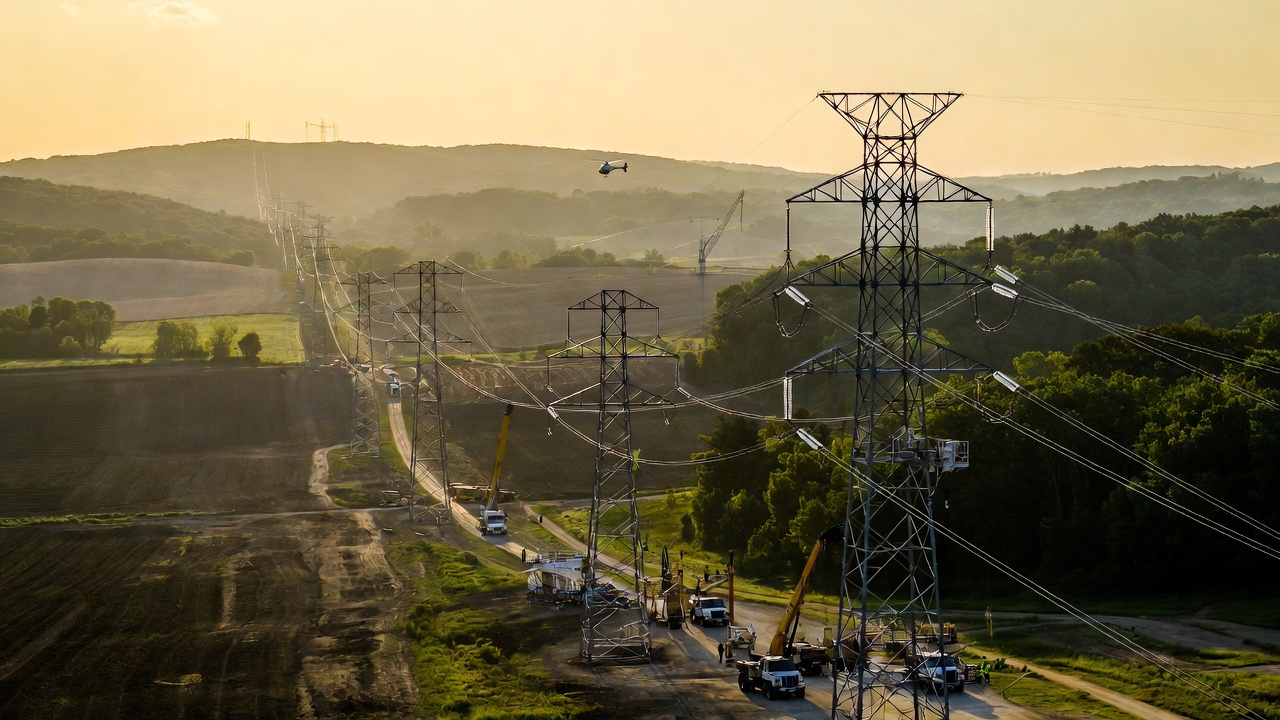
Here’s where the story gets worse for ratepayers. Beyond wholesale power prices, data centers are triggering billions in transmission upgrades that utilities are passing directly to everyone else.A September 2025 analysis by the Union of Concerned Scientists (UCS) found that in 2024 alone, utilities in seven PJM states (Illinois, Maryland, New Jersey, Ohio, Pennsylvania, Virginia, and West Virginia) approved $4.356 billion in local transmission projects — new substations, high-voltage lines, and upgrades — needed solely to connect data centers to the grid. Over 95% of these costs were socialized across all utility customers rather than assigned to the data centers causing them. From 2022–2024, the total hit exceeded $5 billion, with billions more coming.
Virginia led the pack with nearly $2 billion in projects (60 of them). Ohio followed at $1.3 billion. In Maryland, the Office of People’s Counsel has complained to FERC that ratepayers could shoulder $1.6 billion over the next decade for data-center-driven transmission — much of it serving out-of-state facilities.
Why? Historical transmission rules were designed for small, incremental loads (under 10 MW) connecting at low voltage. Data centers plug directly into the high-voltage transmission system. Utilities roll these costs into their rate base, which gets approved by state regulators and spread regionally via PJM’s cost-allocation methods. The result: a classic case of “cost causation” failure. Residential and small-business customers subsidize Big Tech’s infrastructure.
Data center developers choose sites for water (cooling towers guzzle it), cheap land, low latency to users, and incentives — not proximity to generation. Northern Virginia’s “Data Center Alley” is a prime example: fiber-rich, but often distant from the cheapest or cleanest power plants. Building long transmission lines to serve them inflates costs and delays everything.
What If Data Centers Were Built Next to Power Sources?
Imagine the alternative: co-location. Data centers sited (or retrofitted) directly next to existing or new power plants — natural gas, nuclear restarts/uprates, small modular reactors (SMRs), or even dedicated renewables-plus-storage. Power flows “behind the meter,” bypassing much of the transmission buildout. No massive new lines. No socializing costs to grandma’s bill in Ohio or Pennsylvania.FERC recognized this in December 2025, directing PJM to create transparent rules for co-located generation and large loads. PJM has since proposed new transmission service options, revised behind-the-meter generation rules, and clarified interconnection procedures. The goal: let data centers “bring their own generation,” pay their fair share, and speed up deployment while protecting reliability and consumers.
Co-location isn’t perfect — it requires capital for on-site power and space — but it aligns incentives: the data center operator bears the incremental cost, not the broader public.
US Policy Perspective: Time for Cost Causation, Co-Location, and Common Sense
The AI buildout is real and strategically vital for US competitiveness, but the current model is inefficient and unfair to ratepayers. From a national policy standpoint, the United States needs urgent reforms to:
Enforce Cost Causation: FERC should mandate direct assignment of transmission interconnection costs for large single loads (>20–50 MW) to the data center customers, just like new generators pay. Create a dedicated “large load” customer class in transmission rates. States should require utilities to track and allocate these costs transparently in rate cases.
Accelerate and Incentivize Co-Location: Build on FERC’s PJM order. Expand similar rules nationwide. Offer streamlined permitting, tax credits, or financing for co-located projects (e.g., nuclear SMRs or gas with carbon capture next to data centers). Executive orders accelerating federal permitting for data center energy infrastructure (generation, transmission, pipelines) are a good start — but they must prioritize beneficiary-pays models.
Reform Grid Planning and Large-Load Tariffs:
PJM and other RTOs should integrate load and generation planning more tightly. More states should adopt (or strengthen) large-load tariffs that require data centers to self-procure power or pay full incremental costs. Demand transparency: data centers should report usage and forecasts publicly.
All-of-the-Above Power Buildout: Policy must clear the way for new dispatchable generation — nuclear restarts (like Three Mile Island), gas, geothermal, and advanced nuclear. Don’t let ideology slow the energy supply needed for AI dominance.
Federal-State Coordination: Congress could tie incentives (e.g., via infrastructure bills or tax policy) to co-location or cost-responsible siting. Avoid blanket subsidies that socialize costs further.
Without these changes, ratepayers will keep subsidizing AI infrastructure while reliability risks grow. Smarter policy can deliver the power AI needs without punishing families and small businesses.
The 76% price jump is a wake-up call. AI is transformative — but only if the grid can support it affordably and fairly. Location matters. Cost allocation matters. America’s energy policy must catch up.
Appendix: Sources and Links
- Bloomberg Article (May 14, 2026): https://www.bloomberg.com/news/articles/2026-05-14/data-centers-drive-76-rise-in-power-bills-on-largest-us-grid
- Monitoring Analytics PJM State of the Market Report Q1 2026: https://www.monitoringanalytics.com/reports/PJM_State_of_the_Market/2026/2026q1-som-pjm.pdf
- Union of Concerned Scientists (UCS) PJM Data Center Issue Brief (Sep 2025): https://www.ucs.org/sites/default/files/2025-09/PJM%20Data%20Center%20Issue%20Brief%20-%20Sep%202025.pdf
- E&E News: Data centers drive 76% surge in PJM power prices (2026)
- IEEFA and other analyses on capacity auction impacts and $9.3B data center costs
- Maryland Office of People’s Counsel FERC complaint (May 2026)
- FERC Order on PJM Co-Location (Dec 18, 2025) and related filings
- Additional reporting from Utility Dive, NYT, and state PUC documents on transmission cost socialization
Energy News Beat Channel delivers independent, no-nonsense coverage of America’s energy realities. Follow for more on power markets, policy, and the AI-energy intersection.