

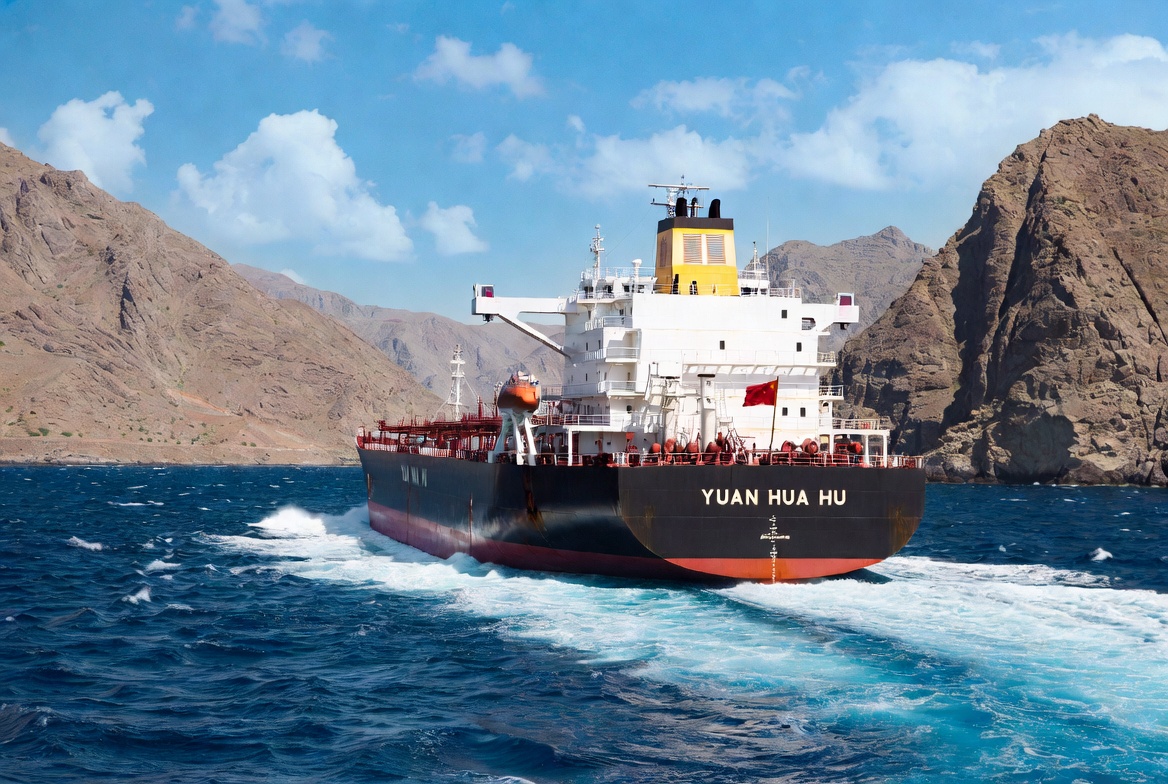
In a notable development for global energy markets amid the ongoing Strait of Hormuz crisis, the Chinese-owned VLCC supertanker Yuan Hua Hu has successfully transited the vital chokepoint and is now en route to China. The passage comes on the heels of high-stakes meetings between U.S. President Donald Trump and Chinese President Xi Jinping in Beijing, where discussions reportedly included trade cooperation, the situation in the Strait of Hormuz, and expanding U.S. energy exports to China.
The Yuan Hua Hu (IMO 9723588), a very large crude carrier (VLCC) capable of carrying over 2 million barrels, departed from Iraq’s Al Basrah Port laden with Iraqi crude oil—specifically Basrah Medium grade—and is heading to China’s Zhoushan terminal (ETA approximately June 1, 2026). Ship-tracking data from MarineTraffic confirms the vessel is currently in the Gulf of Oman/Arabian Sea, sailing at around 11-13 knots under the Chinese flag.
Ownership verification shows the tanker is registered to and operated by COSCO Shipping Energy Transportation (with management under COSCO SHIPPING ENERGY HAINAN), a major Chinese state-linked shipping entity. It had been stranded in the Persian Gulf for more than two months due to the broader Iran-related disruptions and U.S. naval blockade, which specifically targets Iranian ports and vessels but permits non-Iranian traffic to transit freely.
The successful transit—occurring around May 13-14, 2026—aligns closely with the Trump-Xi summit. The White House described the talks as “good,” noting agreement that the Strait of Hormuz must remain open for the free flow of energy. President Xi reportedly expressed opposition to any militarization of the waterway or imposition of tolls and signaled interest in purchasing more American oil to reduce China’s heavy reliance on Persian Gulf supplies (China sources over 40% of its oil from the region under normal conditions).
Broader Traffic Through the Strait of Hormuz Today
While the Yuan Hua Hu’s passage marks a positive step, overall tanker traffic through the Strait remains severely constrained. Maritime data and reports indicate that normal daily transits (typically around 60 vessels) have dropped dramatically, with some estimates showing throughput at just 5-20% of pre-crisis levels due to the ongoing U.S.-Iran tensions and blockades.
In the last 24 hours (as of May 15, 2026), Iran’s Persian Gulf Strait Authority has permitted a limited number of vessels—primarily China-linked—through a designated “safe corridor” under strict protocols, including advance notice and route restrictions. Reports confirm at least 4-6 China-linked ships, including the Yuan Hua Hu, and claims of up to 30 such vessels transiting under Iranian supervision since late Wednesday. However, these are selective and do not represent a full reopening; many vessels are still anchoring outside the strait, and non-compliant traffic faces risks.
U.S. Central Command (CENTCOM) continues to enforce the blockade on Iranian-linked activity, while Iran has used the IRGC Navy for vetting, escorts, and enforcement.
Can Markets Get Hopeful, or Is It Too Soon?
Oil prices have shown some positive reaction, hovering around $100-$106 per barrel (WTI near $101, Brent near $105-106) with modest gains tied to diplomatic progress and Trump’s comments on potential increased Chinese purchases of U.S. crude. The U.S. Strategic Petroleum Reserve has been drawn down significantly to help stabilize Asian markets, underscoring America’s leverage through energy abundance.
Analysts view the tanker’s safe passage and summit agreements as a potential “olive branch” that could ease short-term supply fears and open doors for diversified U.S. exports. However, caution is warranted. The IRGC’s historical and recent tactics—swarm boat attacks, seizures of non-compliant vessels, mining, and selective “toll booth” enforcement dating back to the 1980s Tanker War and continuing into the 2026 crisis—demonstrate that progress can be reversed quickly. Recent incidents include vessel seizures and firings near the strait, and the current “safe corridor” remains under Iranian oversight rather than guaranteed international norms.
In short, while today’s developments offer grounds for measured optimism—particularly for global oil flows and U.S.-China energy ties—it remains too soon for full market confidence. Sustained, unrestricted traffic and verifiable de-escalation will be needed to ease the crisis’s grip on energy security.
Appendix: Links and Sources
- Original X post by@EnergyAbsurdity (May 15, 2026): https://x.com/EnergyAbsurdity/status/2055249032218321400
- Daily Caller full story (May 14, 2026): https://dailycaller.com/2026/05/14/chinese-supertanker-hormuz-blockade-china-talks/
- Bloomberg: Chinese Oil Supertanker in Hormuz (May 13, 2026)
- Reuters/MarineTraffic ship data: Yuan Hua Hu position and ownership (live tracking)
- White House readout of Trump-Xi meeting via multiple outlets (e.g., CNBC, NYT)
- Anadolu Agency on China-linked vessels (May 13-15, 2026)
- Historical IRGC/Tanker War context: Wikipedia and U.S. Naval History sources
- Oil price updates: CNBC and Globe and Mail (May 14-15, 2026)
This article was prepared for Energy News Beat Channel. All facts cross-verified from public maritime tracking, official statements, and reputable news sources as of May 15, 2026.