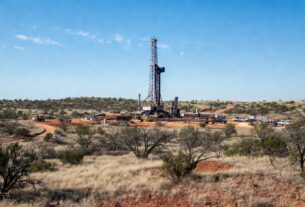
As artificial intelligence drives explosive demand for reliable, always-on electricity, data center operators are scrambling for carbon-free power that doesn’t require sprawling new transmission lines or prime farmland. One unlikely hero is emerging from America’s oil patch: hundreds of thousands — potentially millions — of abandoned oil and gas wells that can be repurposed for next-generation geothermal energy.
A new analysis highlights how these legacy wells, once environmental liabilities, could become the backbone of a geothermal renaissance perfectly suited to power the AI revolution.
Turning Liabilities into 24/7 Clean Power
Traditional geothermal plants have been limited to a handful of Western hot spots. But advanced closed-loop systems and enhanced geothermal techniques — many leveraging the same horizontal drilling and fracking know-how developed in the oil and gas industry — now make it possible to tap Earth’s heat almost anywhere there’s a deep borehole.
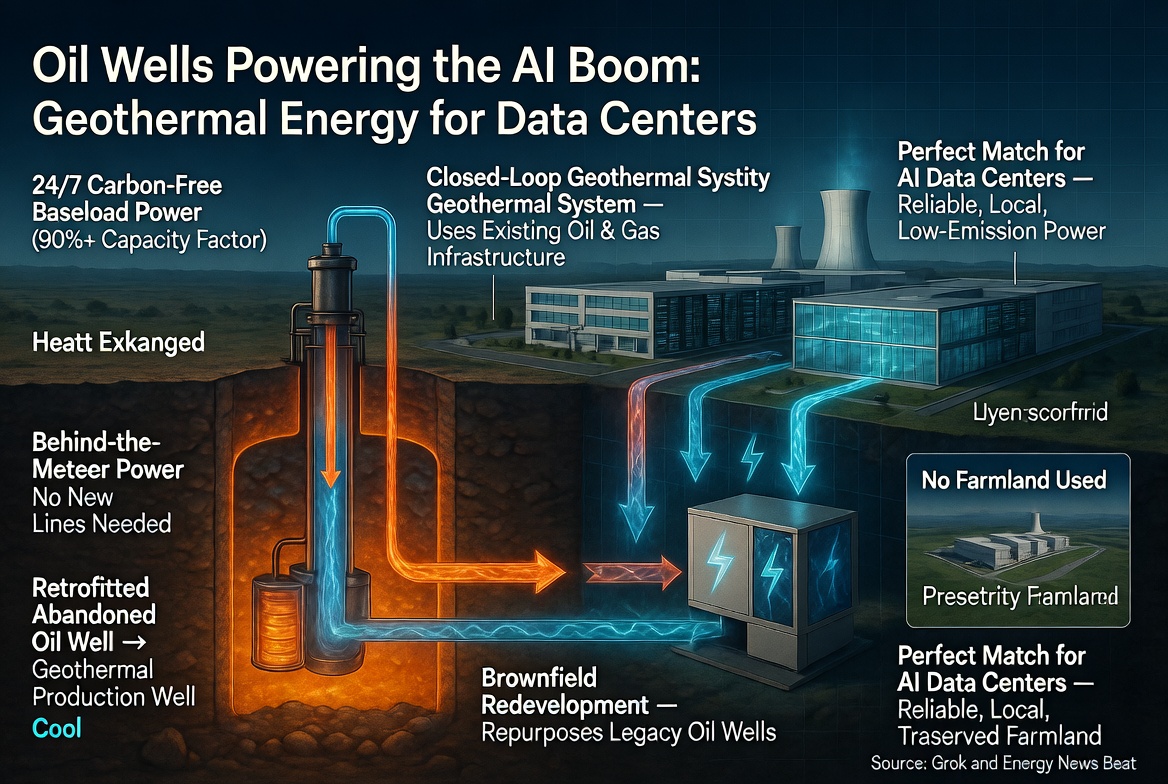
Repurposing abandoned wells slashes the biggest cost and risk in geothermal development: drilling. Existing holes already reach thousands of feet into hot rock formations. Operators install downhole heat exchangers or circulate fluid in a closed loop to bring heat to the surface, where it drives turbines or provides direct-use applications. Binary-cycle technology works even at moderate temperatures common in many oil basins.
The U.S. Department of Energy’s Wells of Opportunity (WOO) initiative has already funded pilot projects to prove the concept, retrofitting idle wells for both electricity generation and direct heating.
Nationwide Potential — From the Permian to Appalachia
Unlike conventional geothermal, which clusters in the West, repurposed oil wells are scattered across America’s historic oil and gas regions:
Oklahoma — Over 20,000 identified wells; lawmakers passed the Well Repurposing Act to let companies buy and convert them for geothermal or storage.
New Mexico, Alabama, North Dakota, Colorado — Similar legislation or active studies underway.
Texas and the Permian Basin — Dense concentrations of wells with known temperature profiles.
Appalachia, Gulf Coast, and Midwest — Additional basins where thousands of idle wells sit ready for conversion.
California: Stu Turley has spoken with Mike Umbro, and they can provide data center demand, but they cannot obtain a permit.
Estimates put the total number of abandoned U.S. oil and gas wells between 3 and 4 million, with tens to hundreds of thousands of “orphaned” wells lacking responsible owners.
A USGS study analyzed bottom-hole temperatures from over 1.4 million well logs and found many fall into moderate (90–150°C) or high (>150°C) geothermal potential categories — more than enough for commercial power or heat.
While exact nationwide gigawatt figures for repurposed wells are still being refined through ongoing R&D, early modeling shows individual wells can produce hundreds of kilowatts to low megawatts each. Scale that across even a modest fraction of suitable wells, and the cumulative impact reaches multiple gigawatts of firm, dispatchable power — exactly what hyperscale data centers need.
Perfect Match for AI Data Centers: No Transmission Lines, No Farmland Lost
Data centers are power-hungry beasts. AI training and inference can demand hundreds of megawatts per campus, and operators want 24/7 carbon-free baseload that geothermal delivers with 90%+ capacity factors.
Placing data centers directly adjacent to repurposed well sites offers game-changing advantages:
Behind-the-meter power — Minimal or zero new high-voltage transmission lines needed. Electricity flows straight from wellhead generators to server halls.
Brownfield development — Oil fields are already industrialized land. No conversion of prime agricultural acreage.
Co-location synergies — Waste heat from geothermal (or data centers themselves) can support direct-use applications, while closed-loop systems avoid water issues common in some regions.
Workforce and community benefits — Oil and gas communities gain new revenue streams and jobs, transitioning drilling expertise to geothermal operations.
States with legacy oil infrastructure are already eyeing these synergies. Companies like Gradient Energy are funding studies to turn orphaned wells into community assets that deliver reliable low-emission power.
From Environmental Headache to Economic Opportunity
Abandoned wells currently leak methane, contaminate groundwater, and cost taxpayers and states hundreds of millions to plug. Repurposing flips the script: operators sell wells instead of paying plugging fees, governments reduce long-term liabilities, and communities gain clean energy revenue.
Benjamin Burke, CEO of Gradient Energy, captured the promise: “Repurposing existing infrastructure for geothermal energy can reduce methane emissions, create local jobs, and deliver reliable, low-emission power to Colorado communities.”
The Road Ahead
Technical hurdles remain — not every well has ideal temperature, depth, or integrity — and significant R&D is still required. But state legislatures in red and blue states alike are clearing regulatory pathways, and federal support through the DOE continues.
With AI electricity demand projected to surge dramatically in the coming years, America’s vast network of idle oil wells offers a uniquely American solution: using the infrastructure of the old energy economy to fuel the next technological boom — cleanly, locally, and at scale.
- Felicity Bradstock, “America’s Abandoned Oil Wells Could Power the Next Geothermal Boom,” OilPrice.com, May 21, 2026. https://oilprice.com/Alternative-Energy/Geothermal-Energy/Americas-Abandoned-Oil-Wells-Could-Power-the-Next-Geothermal-Boom.html
oilprice.com
- U.S. Department of Energy, Wells of Opportunity Initiative. https://www.energy.gov/hgeo/geothermal/wells-opportunity
energy.gov
- R. Gardner et al., “Geothermal potential of orphan oil and gas wells,” USGS, 2025. https://pubs.usgs.gov/publication/70273727
pubs.usgs.gov
- Additional studies and reporting: Canary Media (May 2026), Rhodium Group research on geothermal for data centers, and peer-reviewed analyses of well conversion economics.
Energy News Beat will continue tracking this rapidly evolving opportunity as pilots advance and more states join the geothermal repurposing movement.