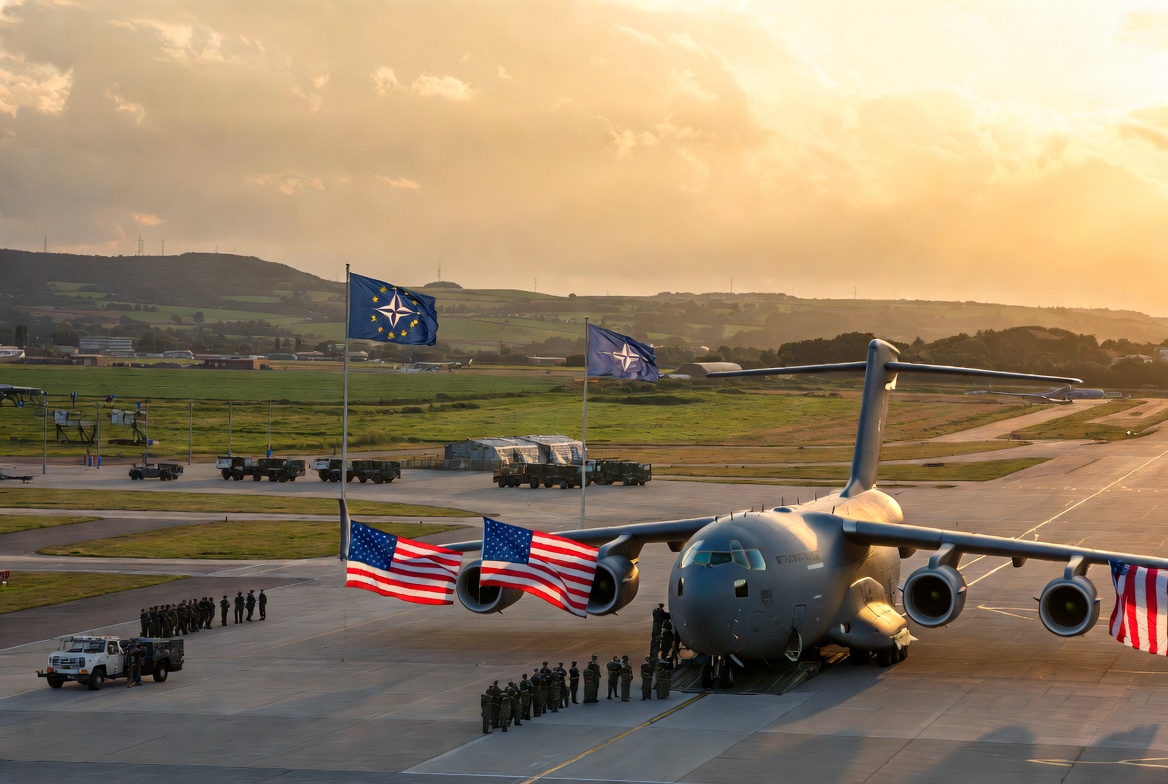
The possibility of a full or partial US withdrawal from NATO has resurfaced in political debates, particularly amid shifting US priorities and rhetoric about burden-sharing. The United States provides the backbone of NATO’s conventional capabilities, command structures, intelligence, strategic enablers (air refueling, lift, ISR), and a significant portion of high-end equipment and munitions. A complete US exit would force European NATO members (including the UK) to rapidly scale up their own forces, procurement, and industrial base to fill critical gaps.
This article examines the current US military footprint in key European host nations, available data on local economic contributions, and the hypothetical costs, timelines, and broader economic strains of replacement. All figures are approximate and drawn from open sources as of late 2025/early 2026; actual numbers fluctuate with rotations and policy changes. A full US withdrawal remains hypothetical and would unfold over years amid complex negotiations.
Current US Military Footprint in Europe
As of late 2025, the US maintained roughly 80,000–100,000 personnel in Europe (including rotations and exercises), with a permanent active-duty presence of around 68,000–80,000. The bulk is concentrated in a handful of countries. Germany hosts by far the largest share.
Summary of Major Host Countries (approximate active-duty US troops, late 2025 data):Germany: 35,000–36,400 (largest concentration)
Italy: 12,500–12,700
United Kingdom: 10,000–10,200 (predominantly Air Force)
Spain: 3,700–3,800
Others (Turkey, Belgium, Poland, rotational/permanent small numbers, etc.): Several thousand combined
Total US bases/installations across Europe exceed 40 major sites, with heavy concentration in Germany, Italy, and the UK.
Breakdown by Key Country
Germany
Germany hosts the largest US presence, centered on Ramstein Air Base (major logistics, air operations, and drone/C2 hub for Europe, Africa, and the Middle East), Kaiserslautern Military Community (KMC — one of the largest US overseas communities), Spangdahlem Air Base, Stuttgart (EUCOM and AFRICOM headquarters), Grafenwöhr/Hohenfels training areas, Ansbach, Wiesbaden, and others.
Troops: ~36,000 active-duty.
Local Economic Impact: Significant and well-documented regionally. The Ramstein/Kaiserslautern area sees over $2 billion in annual economic contribution from wages, rents, contracts with local firms, and spending by US personnel and families (who number in the tens of thousands in the broader community). The US Army presence in Bavaria has historically contributed nearly $1 billion annually. These figures support thousands of local jobs in retail, services, construction, and hospitality. Germany itself spends relatively modestly on direct host-nation support compared to the economic injection from US activity.
Hypothetical Impact of US Withdrawal: Loss of this localized spending would hit specific regions hard (e.g., Rhineland-Palatinate and Bavaria), causing job losses and reduced demand. Nationally, Germany (already increasing defense spending via its special fund and targeting higher GDP shares) would absorb a larger share of collective European replacement efforts.
Italy
Key sites include Aviano Air Base (fighter operations), Vicenza (Army garrison), Naval Support Activity Naples (6th Fleet/AFRICOM naval HQ elements), and Sigonella in Sicily (maritime patrol, logistics).Troops: ~12,500–12,700.
Local Economic Impact: More limited public granular data exists than for Germany. The US presence provides jobs and spending in host communities, while Italy covers certain indirect/host-nation support costs (estimated in the hundreds of millions of euros in older analyses). The bases support Mediterranean and African operations.
Hypothetical Impact:
Southern Italian economies tied to bases (e.g., around Aviano or Naples) would face localized contraction. Italy would need to invest more in its own air and naval capabilities.
United Kingdom
Primary sites: RAF Lakenheath (US fighter wing) and RAF Mildenhall (historically refueling and special operations support; subject to transitions).
Troops: ~10,000–10,200 (heavily USAF).
Local Economic Impact: Close US-UK defense integration includes cost-sharing arrangements where the UK provides land and facilities (often rent-free or with tax waivers). US personnel spending supports local economies around East Anglia bases. The relationship is deeply bilateral beyond NATO.
Hypothetical Impact: The UK, already a high defense spender (~2.3%+ GDP), would likely accelerate its own programs and deepen European cooperation (or face capability gaps in air power). Economic hit would be more contained than in Germany but still notable in base communities.
Spain
Key facilities: Naval Station Rota (strategic naval and logistics hub near Strait of Gibraltar) and Morón Air Base.Troops: ~3,700–3,800 (Navy and Air Force heavy).
Local Economic Impact: Supports Andalusian economies through personnel spending and base operations. Spain provides host support; the location is valuable for transatlantic and Mediterranean logistics.
Hypothetical Impact: Loss would affect southern Spanish communities and reduce US operational flexibility in the region.
Poland and the Emerging Eastern Flank
Permanent US presence is smaller (~hundreds), but rotational forces and new infrastructure (e.g., Powidz) have grown significantly since 2022. Poland has invested hundreds of millions of dollars (with plans for ongoing annual support) in base upgrades and has become a major purchaser of US equipment.
Impact: Poland would likely increase its already high defense spending (among Europe’s highest % of GDP) and push for even stronger eastern flank posture. It stands to gain industrial opportunities but faces the highest direct security exposure.
Cost to Replace Equipment, Troops, and Capabilities
Replacing the full spectrum of US contributions — not just boots on the ground but enablers, high-end platforms, munitions depth, and command/integration — would be enormously expensive.
According to the International Institute for Strategic Studies (IISS) May 2025 report Defending Europe Without the United States, directly replacing key US conventional capabilities assigned to the Euro-Atlantic theater would require European NATO members to invest significantly beyond existing buildup plans. One-off procurement costs for major shortfalls (e.g., hundreds of additional combat aircraft, destroyers, surface-to-air missile systems, and other platforms) run into the hundreds of billions of dollars. Including a 25-year lifecycle, the total reaches approximately USD 1 trillion.
Key Gaps and Rough Scale (drawn from IISS and related analyses):
Air domain (combat aircraft, tankers, munitions) has among the highest costs.
Naval assets (destroyers, submarines).
Land-based enablers and long-range strike.
Broader shortfalls in ISR, strategic lift, and integrated command.
Timeline: Partial mitigation (ramping existing European programs, more joint procurement): 5–10 years with aggressive political and industrial mobilization.
Substantial replacement of high-end conventional capabilities: 10–20+ years.
Full credible independent deterrence posture (including industrial surge capacity, training pipelines, and munitions stockpiles): Likely 15–25 years or longer. European defense industries (fragmented across nations) would need massive coordinated expansion. Current reliance on US systems (e.g., F-35) and supply chains adds friction.
These are capability-focused estimates; they do not include the full cost of sustaining larger standing forces or the nuclear dimension (where the US provides the extended deterrent).Economic Strain on the EU and UKFiscal Pressure: European NATO members would need sustained higher defense spending — potentially moving well beyond the 2% GDP target toward 3–4%+ collectively in the medium term to fund both procurement and operations. This equates to hundreds of billions of euros/pounds in additional annual outlays. Opportunity costs would include slower progress on green energy transitions, infrastructure, healthcare, or debt reduction. Deficits or taxes could rise in fiscally constrained nations.
Localized vs. Broader Effects: Base closures would create painful regional unemployment and economic contraction (especially in Germany). However, a European rearmament drive could generate manufacturing and high-tech jobs if procurement is directed domestically or intra-European. Input-output analyses show defense spending has positive multipliers but generally lower employment impact per euro than equivalent spending on education, health, or environment.
UK Specifics: As a major spender and close US partner, the UK would face capability gaps but also opportunities to lead in certain domains or deepen ties with European partners. Its economy could absorb costs better than some peers but would still feel budget trade-offs.
Broader Geopolitical and Energy Dimensions: The deterrence value of the US presence is difficult to quantify economically but has underpinned decades of stability. Reduced deterrence could raise risk premiums, affect investment, and complicate energy security (e.g., protection of infrastructure, LNG terminals, and routes). Conversely, a more capable and autonomous Europe might strengthen long-term energy resilience by reducing vulnerability to coercion. Higher military budgets compete directly with climate and energy transition investments.
Feasibility and Offsets: Europe has already significantly increased spending and industrial output since 2022. Coordinated EU-level mechanisms, joint procurement, and industrial policy could mitigate some costs and fragmentation. Still, closing the full capability gap without the US scale, technology edge, and logistics would be a generational project.
Conclusion
A US pullout from NATO would impose substantial short- and long-term economic costs on European host nations and the broader EU/UK — from localized base-economy shocks to trillions in cumulative capability replacement and higher ongoing defense burdens. Germany would feel the most immediate localized pain, while the collective challenge spans air, naval, and enabler gaps that take a decade or more to credibly address.
Europe possesses the economic weight and industrial potential to adapt, and recent trends show accelerating progress. However, the transition would involve difficult trade-offs, political coordination hurdles, and opportunity costs. The “peace dividend” of the post-Cold War era would fully reverse, with defense competing more intensely for resources.
Energy security and geopolitical stability are intertwined with these military realities. A stronger, more self-reliant Europe could ultimately enhance resilience, but the path would be costly and lengthy. As the President weighs the advantages and disadvantages of pulling out of NATO, they are an ungrateful group of people who should pick up the slack to defend their own country, starting with closing their borders. As an American taxpayer, I for one am tired of defending the world, only to have them undermine our elections and take advantage of our protection.
We realize there is a lot more to the calculations, as the weapons sales to NATO countries would be lost, but those lost sales can be made up in other countries that want to work with the United States.
- Statista / DMDC data via multiple reports (Germany ~35–36k, Italy ~12.5k, UK ~10k, Spain ~3.7k as of late 2025).
- CFR: “Where Are U.S. Military Forces Deployed in Europe?” (April 2025 update).
- Wikipedia “United States military deployments” and Visual Capitalist mappings.
- Reuters and US Army/Air Force public data on specific garrisons.
Economic Impact / Local Spending:
- Stars and Stripes (2021, with historical context): US contributions in Germany (Ramstein/KMC ~$1–2B+ regional impact; Bavaria ~$1B).
- Older University of Trier study and base economic reports (Kaiserslautern Military Community impacts).
- Hudson Institute analyses on host-nation support and cost-sharing (Italy, UK, Poland examples).
- General: Personnel spending, contracts, and regional multipliers are the primary mechanisms.
Replacement Costs and Broader Analysis:
- IISS Research Paper: Defending Europe Without the United States: Costs and Consequences (May 2025) — key source for ~$1 trillion lifecycle estimate and capability gaps.
- Related commentary in Reuters Breakingviews, Bruegel, and CSIS on fiscal implications and equipment shortfalls.
- SIPRI military expenditure data for European trends.
Additional Context:
- DoD European Deterrence Initiative (EDI) budget documents (recent requests ~$2.9–3B range for specific posture enhancements).
- NATO and national defense reports on spending trends (many allies now at/above 2% GDP).
Data evolves with policy decisions (e.g., announced or planned US adjustments in Germany and eastern Europe). For the most current figures, consult official DoD/EUCOM posture statements, IISS Military Balance, or SIPRI. This analysis is for informational purposes and does not constitute policy advice.