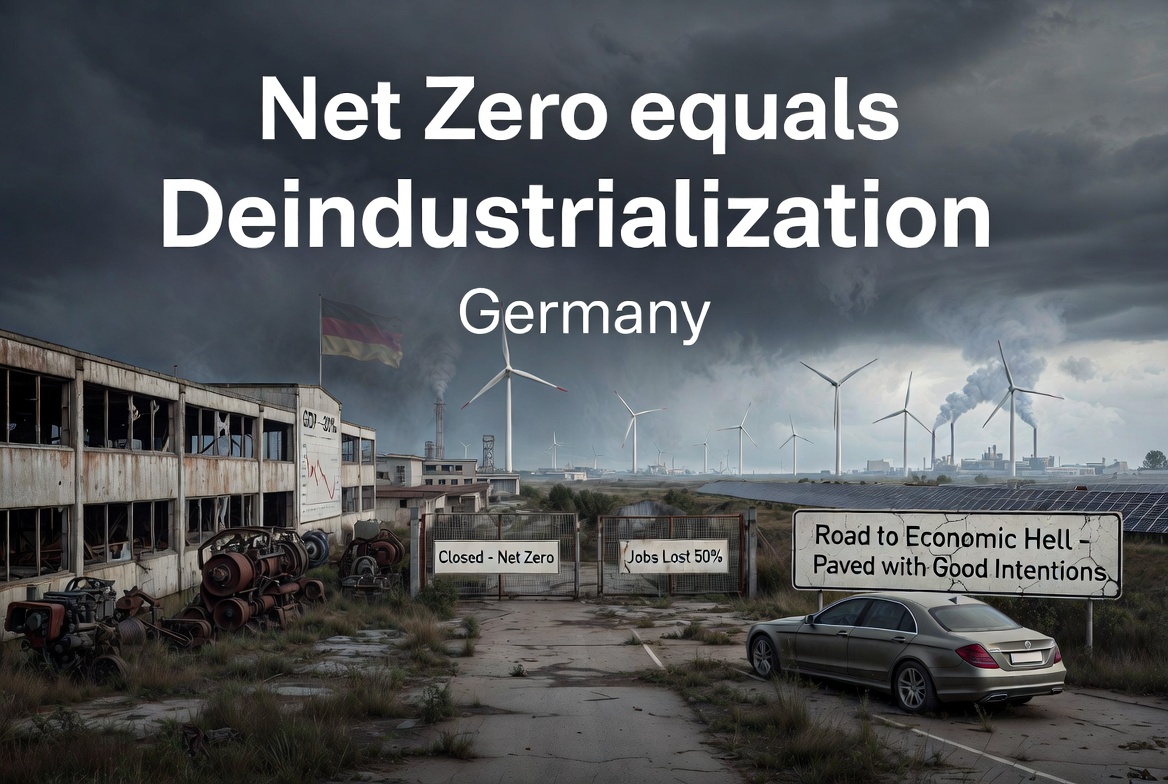
The Wall Street Journal recently captured Germany’s predicament with brutal clarity in pieces like “Germany’s Slow Industrial Suicide.” A LinkedIn post by Doug Sheridan amplified the editorial, highlighting how green mandates, Net Zero zeal, and the Energiewende have delivered deindustrialization instead of the promised green nirvana.
The ironic title nails it: Good intentions around climate policy have paved a road to economic pain, and the iconic German auto industry — once the pride of Mittelstand engineering and export power — is struggling to stay on it.
The Policy Choices: Nuclear “Blow-Up,” Coal Phase-Out, and Lignite Mine “Flooding”
Germany completed its nuclear phase-out in April 2023, shuttering the last three reactors. This was framed as a climate and safety win. In reality, it removed reliable, low-carbon baseload power. Multiple analyses show this led to greater short-term reliance on coal and gas, higher electricity prices, and additional CO₂ emissions — estimates range from tens to over 200+ million tonnes of extra CO₂ equivalent compared to keeping nuclear online alongside renewables.
Coal and lignite phase-out plans (target 2038, with earlier ambitions in some regions) compound the issue. Germany remains Europe’s largest lignite producer and user. While mining continues in key opencast sites (Hambach, Garzweiler in the Rhineland; various in Lusatia), post-mining remediation involves flooding exhausted pits to create massive artificial lakes. These “flooding” plans — for example, turning Hambach into one of Europe’s largest artificial lakes (hundreds of meters deep, billions of cubic meters of water diverted, often from the Rhine over decades) — are part of structural change. They create future recreational assets but bring serious challenges: acid mine drainage, sulfate pollution in rivers like the Spree, groundwater disruptions, and enormous long-term water management costs.
The net result for the economy? Skyrocketing industrial electricity prices (often double U.S. levels), grid instability risks, and lost competitiveness. Renewables reached strong shares — around 59% clean electricity in 2025 (wind ~27%, solar ~18%) with fossils at ~41% — but the transition has been expensive and bumpy.
Deindustrialization in Numbers: Companies Leaving, Shrinking, or Dying
High energy costs, bureaucracy, taxes, and regulatory burden have hammered energy-intensive industries (chemicals, steel, autos, glass, fertilizers). Surveys tell the story:The DIHK Chambers of Industry and Commerce found 37% of industrial companies considering cutting production or relocating abroad (higher — ~45% — for energy-intensive firms). This was up from prior years.
Specific examples of pain (2020–2025 period):BASF: Cut thousands of jobs (hundreds in Ludwigshafen alone), shut energy-intensive lines (e.g., ammonia/fertilizer), and shifted investments/production toward the U.S., Asia, and Belgium, explicitly citing energy and regulatory costs.
Volkswagen: For the first time in its 87-year history, seriously considering or planning to close at least three German plants, with tens of thousands of layoffs (35,000+ cuts discussed) and pay reductions. Competition from China EVs + high German costs are key drivers.
Other hits: ArcelorMittal idled blast furnaces; Bosch planning ~22,000 German job cuts by 2030; numerous auto suppliers and Mittelstand firms scaling back or eyeing moves. Northvolt scaled back European battery plans in favor of U.S. opportunities.
Corporate bankruptcies/insolvencies have surged to decade highs: roughly 22,000–23,900 cases annually in 2024–2025, with sharp year-over-year increases (20%+ in some periods), the worst since the financial crisis era.
Auto sector alone: ~100,000 jobs lost since 2019 (VDA data), with another 125,000 (one in six current jobs) projected gone by 2035 amid EV mandates and broader uncompetitiveness.
GDP and Broader Economic Fallout
Germany — Europe’s former manufacturing engine — has endured its longest period of stagnation since WWII. Real GDP contracted ~0.3% in 2023 and ~0.2% in 2024, with anemic +0.2% growth in 2025. Output remains below mid-2022 levels; industrial production has fallen sharply (roughly 10 percentage points in key measures since recent peaks).
Manufacturing’s share of value added has slipped toward 20%. The “sick man of Europe” label has returned with force. High energy prices, weak exports (China competition), and domestic cost pressures are the primary culprits — not just global factors.
Environmental Impact: Wins on Paper, Leakage in Reality
Germany has made progress on power-sector emissions and renewable deployment. Electricity is cleaner than a decade ago.
However:
The nuclear shutdown increased fossil generation in the transition, raising emissions versus a nuclear + renewables counterfactual.
Deindustrialization drives carbon leakage: Production (and emissions) shifts to places like China with dirtier grids and fewer regulations. Global CO₂ may not fall proportionally — or at all — while German jobs and tax base erode.
Lignite mining and remediation carry local ecological costs (water pollution, habitat disruption) even as lakes are created.
Overall, GHG reductions have occurred, but at enormous economic sacrifice. Germany still ranks among higher per-capita emitters in Europe due to its industrial base and residual coal use.
The “good intentions” delivered lower domestic power emissions in some metrics but exported industrial activity and failed to deliver a clear global climate dividend.
The Bottom Line
The WSJ and analysts like those cited in Sheridan’s post are right: Europe’s (and especially Germany’s) bet on rapid, unilateral Net Zero via renewables-plus-phase-outs while China and others build coal, gas, and nuclear has been a terrible wager on competitiveness. It has accelerated deindustrialization, hammered the auto heartland, spiked bankruptcies, and delivered GDP stagnation — all while environmental gains are partial and leakage undermines the global case.
German cars may still roll off lines, but the industrial ecosystem that built them is under severe strain. Voters and politicians are noticing; recent shifts in European sentiment show growing realism about costs.
Good intentions don’t pay energy bills or keep factories open. Physics, economics, and reliable baseload power still matter.
- LinkedIn post by Doug Sheridan summarizing WSJ (key reference for this piece): https://www.linkedin.com/posts/sheridandoug_fossilfuels-europe-energy-share-7463003168701079552-LI8S/
- WSJ: “Germany’s Slow Industrial Suicide” (and related pieces on Europe/Net Zero cooling): https://www.wsj.com/opinion/german-autos-climate-mandates-regulations-abdc041d (and https://www.wsj.com/opinion/europe-has-been-going-cold-on-net-zero-5d0ab184)
- DIHK survey on company relocation considerations: Reuters coverage https://www.reuters.com/business/energy/more-german-companies-mull-relocation-due-high-energy-prices-survey-2024-08-01/
- BASF job cuts and shifts: Clean Energy Wire https://www.cleanenergywire.org/news/chemicals-producer-basf-axe-jobs-energy-intensive-production-sites-germany
- VW plant closure considerations: Reuters https://www.reuters.com/business/autos-transportation/volkswagen-plans-major-layoffs-shut-least-three-german-plants-works-council-head-2024-10-28/
- Bankruptcy/insolvency data (Creditreform, etc.): Reuters https://www.reuters.com/business/german-corporate-bankruptcies-surge-decade-high-2025-2025-12-08/
- GDP and stagnation data: Multiple (e.g., Michael Roberts analysis, EC forecasts, Wikipedia synthesis of official stats)
- Nuclear phase-out emissions impact: Studies via Foro Nuclear/PwC references and academic estimates (e.g., ~230 Mt extra CO₂ in one quantification)
- Lignite post-mining/flooding plans (Hambach, Garzweiler, Lusatia): Energy Transition.org and Springer scientific reviews
- Electricity mix 2025 (Ember): https://ember-energy.org/countries-and-regions/germany/
- Broader context: Forbes, Clean Energy Wire, IEA, and Destatis/ifo economic reports
All data drawn from public sources as of late 2025/early 2026 reporting. Economic situations evolve; check latest official statistics for updates.