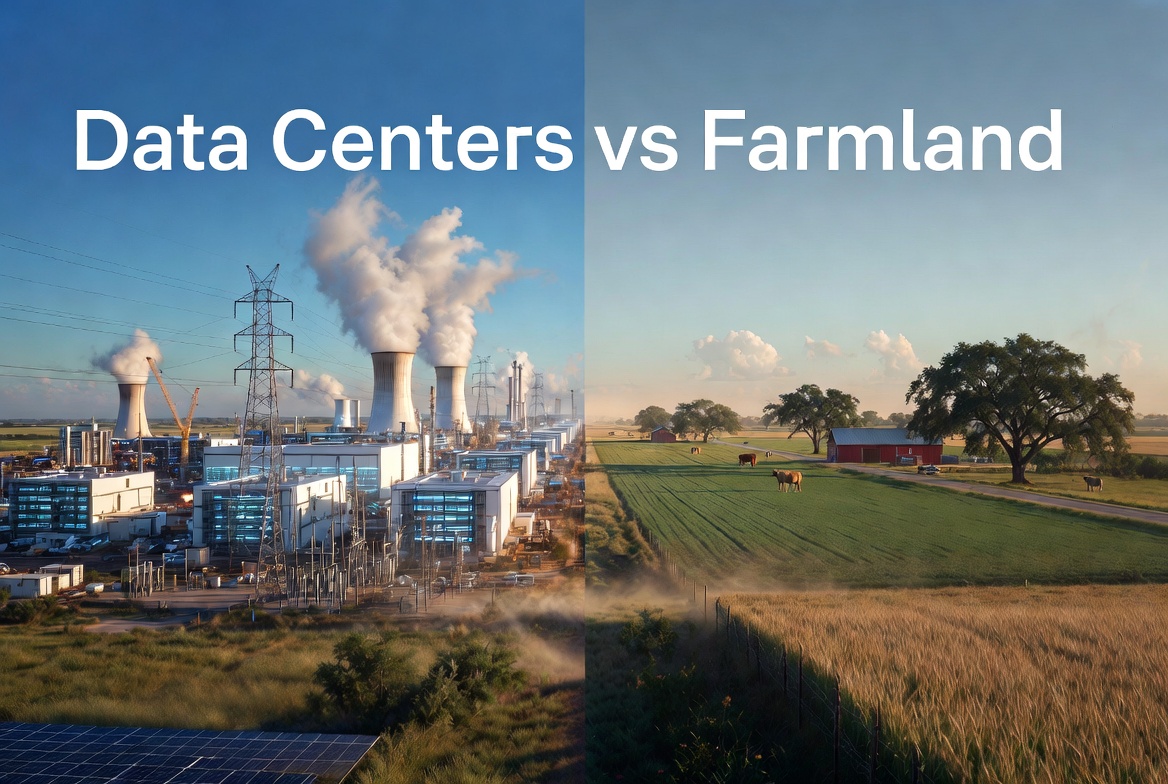
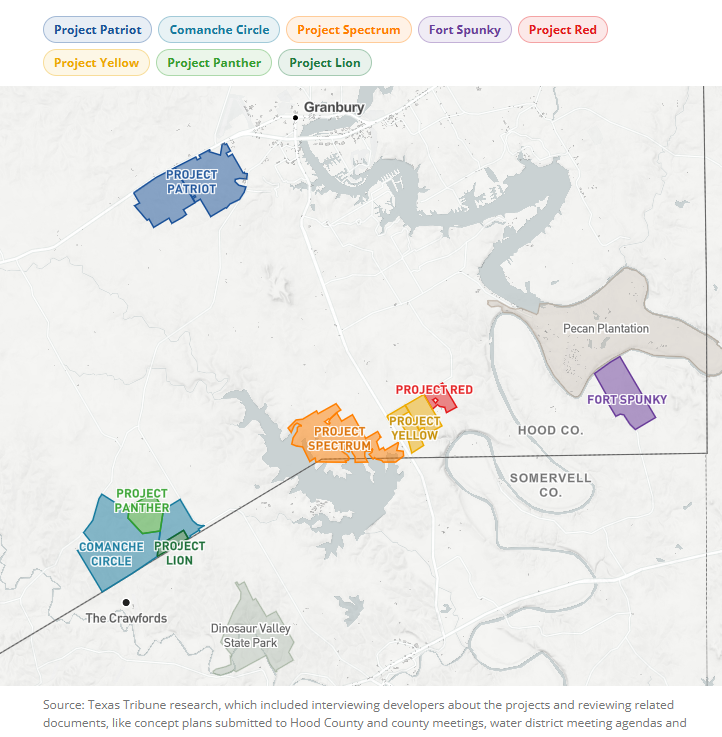
In rural Texas, a quiet but transformative shift is underway. Developers are increasingly siting massive data centers in unincorporated areas—where county governments have far less regulatory authority than cities—bypassing the kind of local zoning, public hearings, and citizen pushback that could slow or stop projects in more populated zones. This strategy is playing out dramatically in Hood County, just an hour southwest of Fort Worth, where eight proposed data centers could reshape more than 7,600 acres (about 12 square miles) of scenic rural land along the Paluxy River Valley and Brazos River.
The Texas Tribune’s June 2, 2026, investigation details how residents like Brian and Laura Crawford—whose 118-acre property with live oaks, gardens, livestock, and river views sits just 600 yards from the massive Comanche Circle project—are organizing through their nonprofit Protect the Paluxy Valley. They and neighbors in areas like Pecan Plantation fear noise, traffic, aquifer strain, and the loss of their small-town, agricultural lifestyle. County officials have described their own limited powers under Texas law, which grants cities broad zoning authority but leaves counties with far fewer tools—often likened to “rural toddlers that can’t be trusted with full powers.” Two attempts at moratoriums on industrial development failed in early 2026 due to lawsuit risks, though the county later tightened disclosure rules for large projects.
This isn’t isolated to Hood County.
A Texas Tribune analysis of statewide trends shows Texas already has 335 existing data centers, with at least 248 more planned. Nearly half of those planned facilities (roughly 124) are targeting unincorporated rural areas—up sharply from just 12% of existing ones. Developers cite cheap land, available power infrastructure, fiber lines, and minimal business restrictions as key advantages. Hood County ranks sixth in planned data centers among Texas counties and third per square mile.
Scale of the Boom: Under Construction, Planned, Approved, and ERCOT Power Applications
Texas leads the U.S. data center surge, driven largely by AI and hyperscale demand from companies like Amazon, Google, Microsoft, and OpenAI. While exact breakdowns of “under construction” vs. “planned” or “approved” vary by source and evolve rapidly (no single state agency publishes a comprehensive official tally), recent data paints a clear picture of explosive growth: Statewide totals: Approximately 335–466 operating or existing facilities (sources differ by scope, including traditional vs. AI-focused). Another 170–248 planned or in development, with hundreds more proposed nationally that could flow into Texas. Texas leads or ranks near the top in projects under construction (one estimate: 140 in Texas alone).
Hood County example: Eight specific projects proposed (including Comanche Circle on 2,100 acres, Fort Spunky on 862 acres—whose approval was later revoked over water issues—and others totaling over 7,600 acres). Some have received conditional approvals or are delayed amid lawsuits and new county rules; others remain in concept/permitting stages.
On the power side, the Electric Reliability Council of Texas (ERCOT) is grappling with an unprecedented queue. As of March–April 2026, ERCOT is tracking approximately 410 GW of large-load interconnection requests, with ~87% from data centers (earlier figures showed 205–439 GW in late 2025/early 2026, with data centers and crypto dominating 70–89%). For context, ERCOT’s all-time peak demand was about 85.5 GW. Not all requests will materialize—ERCOT is implementing stricter “Batch Zero” evaluation processes and new rules (approved in early June 2026) to prioritize serious projects and weed out speculative ones—but the queue underscores the strain on the grid. Individual projects like Comanche Circle alone seek up to 3 GW (enough for ~3 million homes).
ERCOT’s preliminary long-term load forecast (released April 2026) projects massive growth through 2032, with data centers as a primary driver. Some facilities plan on-site generation (e.g., gas plants), but most will draw from the grid.
What This Means for Citizens Living in Unincorporated Townships
Residents in unincorporated areas—often rural townships or county land outside city limits—face unique challenges. Without city-level zoning, public input is more limited, and county commissioners frequently cite legal constraints and lawsuit fears when trying to intervene.
In Hood County, packed town halls, Facebook groups, and rallies in Austin highlighted fears of:
Resource strain: Massive water use for cooling (e.g., Comanche Circle’s disputed 95 million gallons initial “flush and fill” plus ongoing daily needs equivalent to hundreds of households) and power demand that could raise rates or risk reliability during peaks. Wastewater and aquifer impacts could affect local rivers, lakes (like Lake Granbury), and farms.
Quality-of-life changes: Constant noise (similar to prior crypto mines), heavy construction traffic for years, industrial-scale buildings, and loss of scenic/agricultural views. Permanent jobs are often modest (e.g., ~220 for one project) compared to temporary construction booms.
Limited recourse: Citizens can attend meetings or form groups, but developers move fast. Tax revenue and economic promises (Hood County projections: $5–20 billion tax base growth) are weighed against uneven local benefits. Broader Texas examples show similar resistance in other rural counties.
Statewide, this rural shift raises equity questions: Urban areas gain tech infrastructure, while rural unincorporated residents bear disproportionate infrastructure and environmental burdens with less say.
Farmland Designations: Can Federal and State Governments Protect Prime Agricultural Land?
Yes—advocates are pushing for protections, though current safeguards are limited. Much of the targeted rural land in places like Hood County and beyond is prime farmland or ranchland. Texas Agriculture Commissioner Sid Miller has repeatedly warned that unchecked data center expansion on “prime farm and ranchland is a real and growing threat to our food supply.” In January 2026, he called for Agriculture Freedom Zones (AFZs)—state or federally designated areas offering tax incentives to steer data centers toward marginal land, brownfields, arid regions, or sites with existing grid access, rather than converting productive farmland. A federal bill by U.S. Congressman Pete Sessions has been proposed to support this incentive-based approach.
Federally, the Farmland Protection Policy Act (FPPA) requires agencies to minimize the impact of federal programs on converting prime farmland, unique farmland, or statewide/local important land to non-agricultural uses. It applies when federal funding or actions are involved but does not directly block private development. Some farmland is further protected via conservation easements tracked in the national Protected Agricultural Lands Database, but these are voluntary and not a blanket shield.
Without stronger zoning, incentives, or moratoriums (some counties like Hill County have tried one-year pauses), conversion continues. Miller and local activists argue targeted policy could balance AI growth with food security and rural preservation.
The Road Ahead
Data centers bring jobs, tax revenue, and critical digital infrastructure to Texas, but the rush to unincorporated areas highlights tensions between rapid development and local control. ERCOT’s new interconnection rules and ongoing legislative studies (e.g., on water use ahead of the 2027 session) may help manage the boom. For citizens in rural Texas, the message from Hood County is clear: organized advocacy and policy changes—like AFZs—may be essential to protect farmland, water, power reliability, and community character.
- Texas Tribune (June 2, 2026): “The 8 data centers that could transform one Texas county” – https://www.texastribune.org/2026/06/02/texas-data-centers-hood-county-local-control-rural-water-power/
- ERCOT Large Load Update (April 2026): https://www.ercot.com/files/docs/2026/04/01/ERCOT_LargeLoad_Update_April2026_B-C_-Hearing.pdf
- Texas Department of Agriculture – Commissioner Sid Miller on AFZs (Jan. 12, 2026): https://texasagriculture.gov/News-Events/Article/10742/Commissioner-Miller-Calls-Upon-State-and-Federal-Legislators-to-Protect-Vital-F
- Additional ERCOT/forecast context: Various reports via Houston Public Media, Utility Dive, and ERCOT filings.
- Farmland Protection Policy Act (USDA NRCS): https://www.nrcs.usda.gov/conservation-basics/land/cropland/farmland-protection-policy-act
Energy News Beat will continue tracking this evolving story. What are your thoughts on balancing data center growth with rural protections?