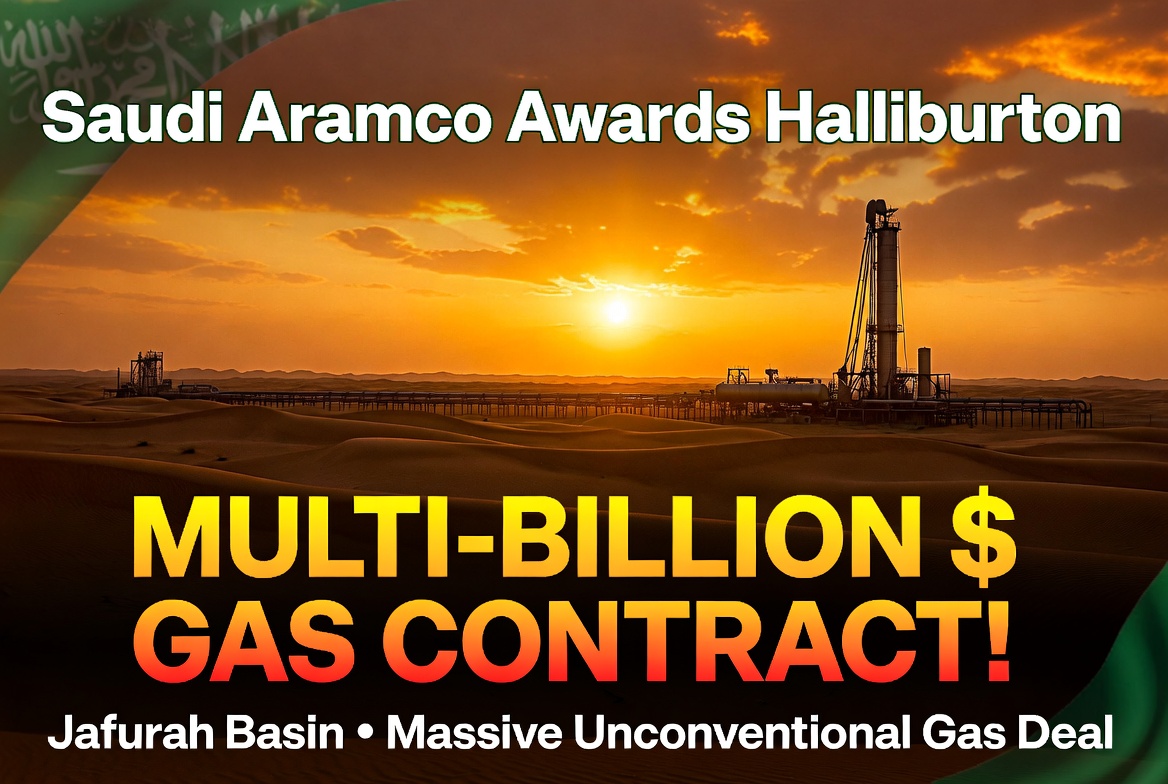
Riyadh/Dhahran, July 17, 2026 — Saudi Aramco has awarded Halliburton a multi-billion-dollar, multi-year contract for integrated stimulation and completion services supporting unconventional gas development, with a key focus on the massive Jafurah Basin in Saudi Arabia’s Eastern Province.
This award underscores Aramco’s aggressive push to scale one of the world’s largest unconventional gas programs outside North America. The contract covers drilling and completion solutions, hydraulic fracturing, well intervention, and advanced digital technologies across the Kingdom’s unconventional plays, with specific emphasis on Jafurah.
Contract Highlights and Technology DeploymentHalliburton will deploy the Kingdom’s first fully integrated intelligent fracturing platform, combining its OCTIV® Auto Frac technology with Sensori™ fracturing monitoring services. Activities are slated to begin in the third quarter of 2026. The platform enables real-time optimization of hydraulic fracturing performance, improved operational efficiency, workflow predictability, and execution reliability across high-intensity multi-well campaigns.
Halliburton plans to expand local manufacturing, strengthen the Saudi supply chain, and invest in workforce development as part of its long-standing partnership with Aramco (over 80 years in the Kingdom).
The deal forms part of Aramco’s broader multi-billion-dollar gas expansion program and builds on earlier contracts, including a 2018 unconventional gas stimulation agreement and ongoing involvement in Jafurah subsurface work alongside other service providers like SLB and Baker Hughes.
Scale and Impact of the Jafurah Natural Gas Play
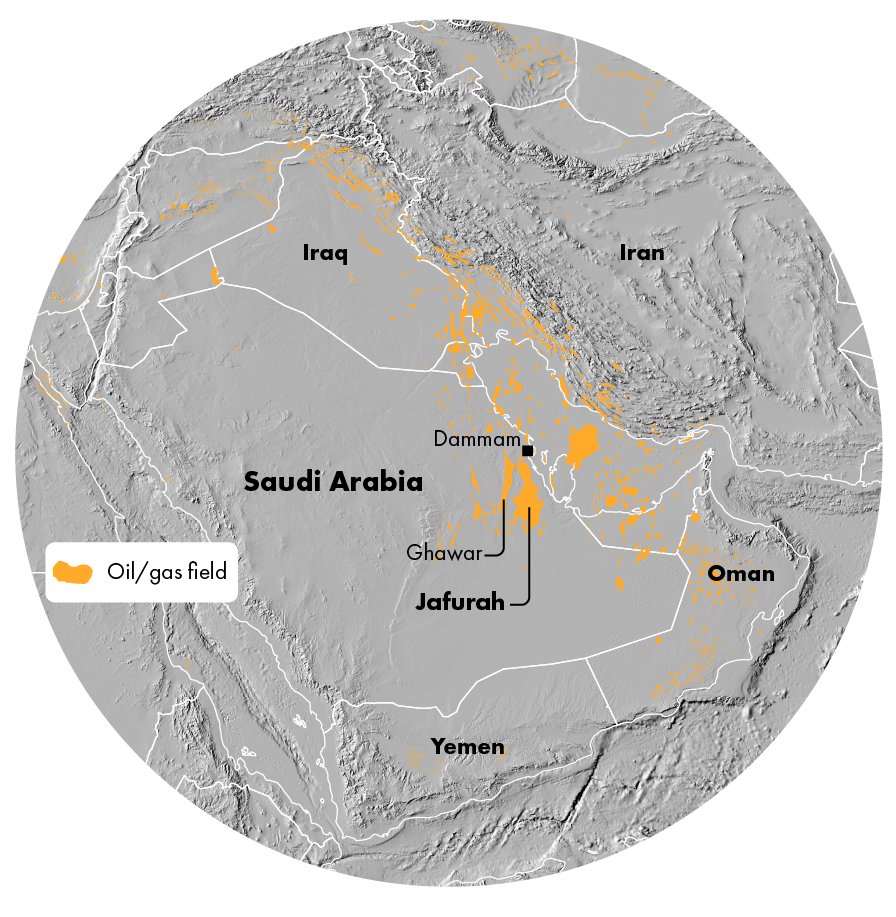
Jafurah is Saudi Arabia’s largest unconventional non-associated gas development and the biggest liquids-rich shale gas play in the Middle East. It spans approximately 17,000 square kilometers and holds an estimated 229 trillion standard cubic feet (tscf) of raw gas and 75 billion stock tank barrels (STB) of condensate in place.
Production from Phase 1 began in December 2025 at an initial rate of around 450 million standard cubic feet per day (MMscfd). Aramco targets a ramp-up to:2 billion standard cubic feet per day (bscfd) of sales gas
420 MMscfd of ethane
Approximately 630,000 barrels per day (bpd) of gas liquids and condensates by 2030.
Total lifecycle investment in Jafurah exceeds $100 billion. In 2025, Aramco completed an $11 billion lease-and-leaseback deal for the Jafurah gas processing facilities and Riyas NGL fractionation plant with a Global Infrastructure Partners (GIP, part of BlackRock)-led consortium, unlocking capital while retaining operational control.
This Halliburton contract will accelerate drilling, fracturing, and completion activities, helping Aramco meet its revised target of increasing overall sales gas production capacity by approximately 80% by 2030 (compared to 2021 levels). The added gas supports domestic power generation, petrochemical feedstock, and industrial growth under Vision 2030 while displacing higher-value crude oil currently burned for electricity.
Potential for Red Sea Pipeline and LNG Export Infrastructure
Jafurah lies in the Eastern Province, where most existing gas infrastructure (Master Gas System expansions, processing plants) is concentrated. Aramco already operates the East-West (Abqaiq-Yanbu) NGL pipeline and gas transmission lines (including the SAPLINE segment of the Master Gas System) that deliver gas and NGLs westward to the Yanbu industrial complex on the Red Sea coast for local power, desalination, and petrochemical use.
A dedicated new large-diameter gas pipeline specifically to support an LNG export terminal on the Red Sea is not currently part of announced plans tied to Jafurah or this contract. Saudi Arabia’s near-term gas strategy prioritizes domestic consumption and liquids displacement over large-scale LNG exports from the Kingdom. Aramco has instead pursued overseas LNG investments and supply agreements (e.g., deals in the U.S.) to build a global LNG presence.
Long-term, if significant gas surpluses emerge beyond domestic needs, expansions or new corridors to the Red Sea could theoretically support an LNG liquefaction facility at or near Yanbu. However, such a project would involve substantial additional capital for a trans-peninsular pipeline (crossing challenging terrain) and liquefaction infrastructure. Current priorities remain ramping Jafurah production, expanding the Master Gas System eastward and within the Kingdom, and maximizing value from associated liquids and petrochemical integration.
Strategic Benefit: Reducing Oil Burn for Electricity Generation
One of the core strategic objectives of Aramco’s gas expansion—including Jafurah—is to reduce Saudi Arabia’s reliance on burning crude oil for power generation. Historically, the Kingdom has consumed hundreds of thousands of barrels per day of crude (with summer peaks exceeding 600,000–700,000 bpd) in power plants and desalination facilities.
Increasing domestic natural gas supply allows the replacement of liquid fuels with cleaner-burning gas in combined-cycle power plants. This:
- Frees up significant volumes of crude oil for export (higher economic value)
- Improves the Kingdom’s energy mix and reduces emissions intensity
- Supports petrochemical growth and new industries (e.g., data centers, hydrogen pathways)
- Aligns with Vision 2030 economic diversification and long-term net-zero ambitions by 2060
Jafurah’s ramp-up to 2 bscfd of sales gas by 2030 is explicitly positioned to contribute to this liquids displacement strategy, alongside other gas developments like Tanajib.OutlookThe Halliburton award signals continued momentum in Aramco’s unconventional gas program. With advanced digital fracturing technology now being deployed at scale in Jafurah, the project is well-positioned to deliver on its ambitious production targets, bolstering Saudi Arabia’s energy security and economic transition.As Jafurah scales, it will play a pivotal role in transforming Saudi Arabia from an oil-centric energy giant into a more diversified gas and petrochemical powerhouse—while directly supporting the critical goal of minimizing crude oil combustion in the domestic power sector.
Appendix: Sources and Links
- Jack Prandelli (@jackprandelli) X post (July 17, 2026): https://x.com/jackprandelli/status/2078099343538544671
- Zawya: “Halliburton wins multi-year Aramco gas development contract” – https://www.zawya.com/en/business/energy/halliburton-wins-multi-year-aramco-gas-development-contract-sgu6522w
- Economy Middle East: Aramco awards Halliburton multi-year Jafurah contract… – https://economymiddleeast.com/news/aramco-awards-halliburton-multi-year-jafurah-contract-for-saudi-arabias-first-integrated-intelligent-fracturing-platform/
- The Machine Maker: Halliburton Secures Multi-Year Contract from Aramco… – https://themachinemaker.com/news/halliburton-secures-multi-year-contract-from-aramco-to-support-saudi-arabias-unconventional-gas-development/
- Aramco official: Jafurah midstream deal announcement (Oct 2025) – https://www.aramco.com/en/news-media/news/2025/aramco-closes-jafurah-midstream-deal-with-international-consortium
- Reuters coverage of Jafurah production start and scale (Feb 2026) – https://www.reuters.com/business/energy/saudi-aramco-bringing-shale-gas-revolution-arabian-desert-2026-02-27/
- Additional context from Aramco gas expansion contracts and targets (various 2024–2026 reports)
This article is prepared for the Energy News Beat Channel based on publicly available reports and announcements as of July 17, 2026. Production targets and investment figures are based on Aramco disclosures and may be subject to updates.